Operations
Part of Hospitality marketing strategy: the choices that shape everything else, 2027 edition
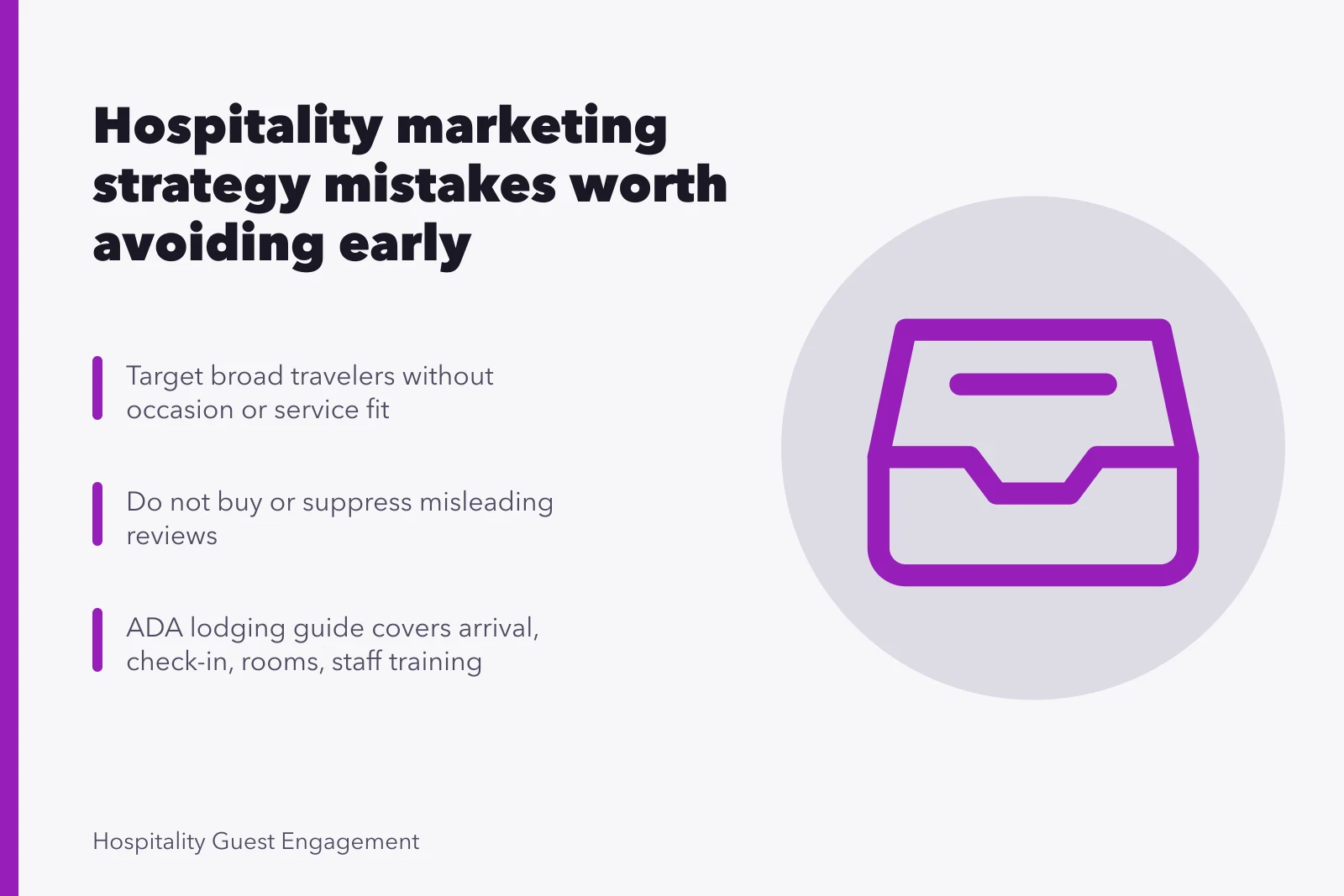
Hospitality marketing strategy mistakes worth avoiding early
hospitality marketing strategy mistakes include vague audiences, weak offers, false review shortcuts, inaccessible journeys, channel confusion, and weak economics.
What to take away
- A campaign cannot repair an offer that is unavailable or an experience the property cannot deliver.
- Review volume is not permission to manipulate guest feedback.
- Accessibility and current service facts belong in the strategy, not a later website task.
Hospitality marketing strategy mistakes often appear as isolated channel problems, but the root cause is usually an unclear decision. Teams spend before defining the guest, publish before confirming the offer, and count conversions before reconciling revenue, channel cost, cancellations, and delivery.
Avoid twelve recurring mistakes
- Targeting broad travelers without an occasion or service fit
- Copying competitor claims without property proof
- Promoting inventory or hours that are not current
- Hiding taxes, fees, restrictions, or cancellation terms
- Treating every channel as a last-click sales channel
- Moving existing direct demand to a costlier partner and calling it growth
- Buying, suppressing, or selectively requesting misleading reviews
- Making accessibility information difficult to find or verify
- Sending demand into a broken booking or reservation journey
- Ignoring staffing, response, and recovery capacity
- Using averages that hide weak dates, markets, or service periods
- Keeping failed campaigns alive because the spend was already approved
The FTC's staff answers on the Consumer Reviews and Testimonials Rule explain distinctions among reviews and testimonials and address fake reviews, incentives, insider relationships, suppression, and other conduct. The answers are not a safe harbor, so evaluate the actual program and current law. Fake review penalties also shape how a property handles guest feedback under hospitality reputation management.
Do not promise an inaccessible experience
The Justice Department's ADA lodging guide for blind or low-vision guests covers arrival, check-in, rooms, restaurants, recreational areas, business facilities, and staff training. Use it within the property's current legal and operational review rather than treating one guide as a complete accessibility audit.
| Failure | Immediate response | System repair |
|---|---|---|
| Wrong public fact | Correct affected copies | Assign an authoritative field owner |
| Unavailable offer | Pause promotion | Connect release to inventory and capacity |
| Manipulated feedback | Stop the practice and preserve evidence | Create reviewed solicitation and response rules |
| Inaccessible path | Provide a usable route | Test content, booking, arrival, and service |
| Weak economics | Limit spend | Reconcile net contribution by route |
Fix the mechanism, not only the visible ad. Trace the failure to its source, approval, feed, access, vendor, incentive, or reporting rule. Verify the correction from the guest's side and add a test that would have found the problem earlier.
Prove the correction
The GAO data reliability guide treats reliability as fitness for an intended use and requires documented assessment. Use that test for hospitality marketing strategy mistakes; the federal guide does not certify the local data.
The FTC advertising substantiation policy requires a reasonable basis before objective advertising claims are disseminated. Apply that U.S. rule to public hospitality marketing strategy mistakes performance statements, with advice for the actual facts.
A dashboard change does not close a mistake. Trace the correction from the source record through processing, reporting, exports, and the decision owner. Preserve the prior value, reason, date, reviewer, and affected actions.
Then test whether the same defect can recur. This turns an error list into an operating control and gives later readers evidence the published conclusion was actually repaired.
For hospitality marketing strategy mistakes, keep the evidence record beside the decision so a reviewer can reproduce the reasoning without relying on memory. Set the next review date for hospitality marketing strategy mistakes and name the change that would trigger an earlier check.
Common questions
Is low occupancy always a marketing problem?
No. Demand, rate, distribution, product, reputation, operations, access, or market conditions may be responsible.
Can a hotel offer an incentive for reviews?
The facts and applicable rules matter. Do not condition incentives on sentiment, hide material connections, or create a misleading picture.
What is the most expensive mistake?
It varies, but scaling inaccurate demand into poor delivery can damage revenue, trust, staff workload, and future distribution at once.