Costs
Part of Hospitality marketing strategy: the choices that shape everything else, 2027 edition
A working brief on hospitality marketing strategy best practices, updated for 2027
hospitality marketing strategy best practices connect truthful offers, accessible journeys, channel roles, service capacity, evidence, measurement, and correction.
What to take away
- Every practice gets a name, an owner and a pass or fail test before another tactic is added.
- Price, limits and dates appear where the guest decides, checked on the rendered ad or page rather than the draft.
- Demand, conversion and channel cost are compared against your own trailing range before any published figure.
- For 2027, AI answer surfaces, universal opt-out signals and Canadian loyalty tax rules are live constraints.
The hospitality marketing strategy choices behind this brief set the frame. The rest covers what a hotel or restaurant team can run this quarter, with a step, a record and a test.
Six practices, named and step by step
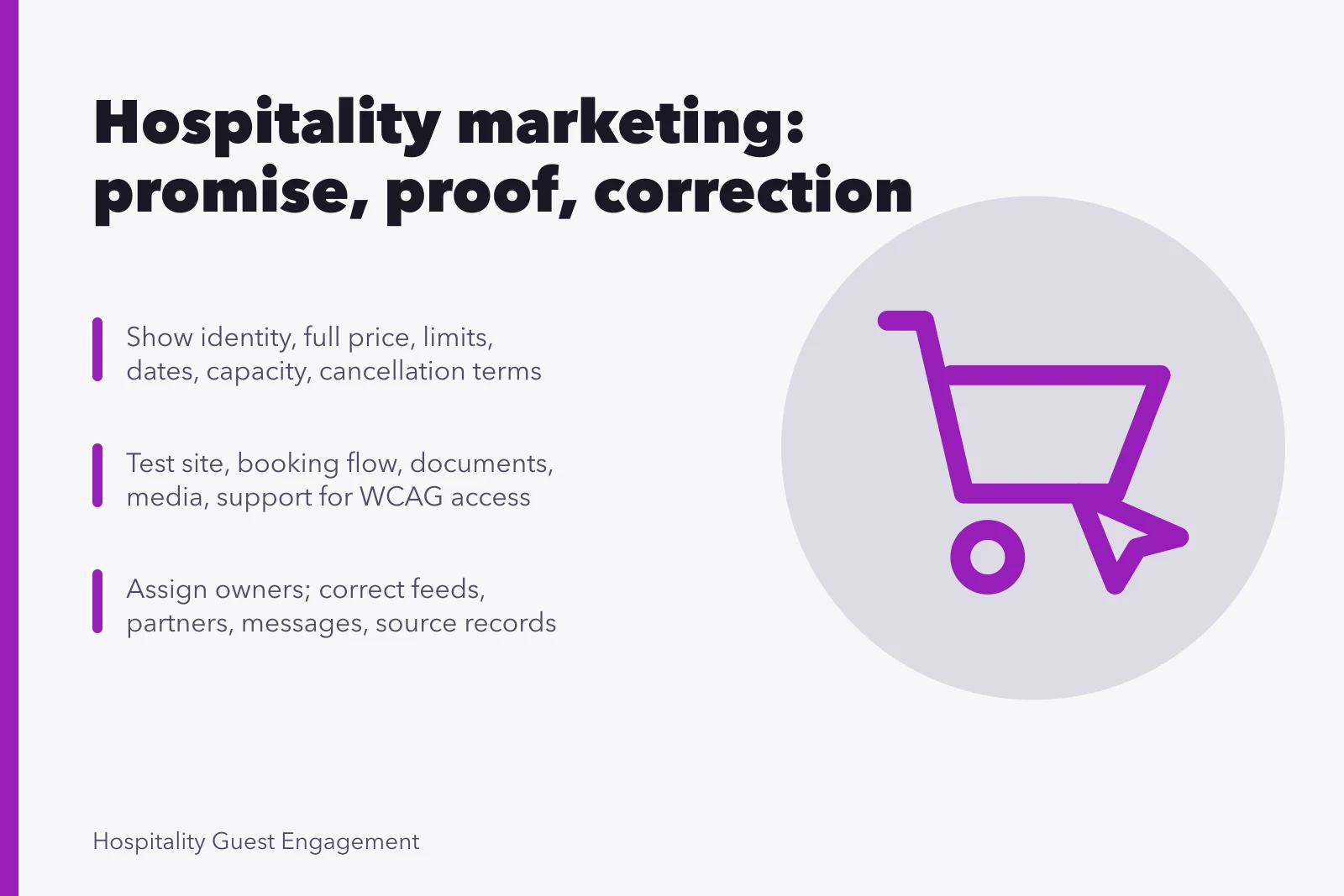
- Build one offer sheet per live promotion. Fields cover full price, inclusions, blackout dates, capacity cap, cancellation terms and tax treatment. Copy it into the ad, page, booking widget and partner feed instead of retyping it.
- Run a rendered impression check. Read the ad, landing page, booking step and confirmation email on a phone. Write down what the guest sees, then close the gaps.
- Do an accessibility pass on the booking path. The W3C WCAG standards overview lists the criteria to test. Start with keyboard-only booking, screen reader output on errors, and contrast on price and date fields.
- Keep one operating record per property. Every public fact carries an owner, a source and a review date in the same file as the decision.
- Give each channel one job and one cost number, then record cost per booking each month.
- Write an acceptance test per practice. A test needs a threshold, a data source and a reviewer. Anything less is a preference.
The FTC's digital advertising disclosure guidance covers prominence, proximity and device constraints. Apply it to your offer and jurisdiction, since it is staff guidance rather than one national rule.
| Practice | Hotel step | Restaurant step |
|---|---|---|
| Offer sheet | Room rate with taxes, resort fee, inclusions, blackout dates | Prix fixe with cover cap, service charge, allergen notes |
| Rendered check | Booking engine on iOS and Android, plus OTA copy | Delivery listing and Google Business Profile menu |
| Accessibility pass | Date picker, payment step, cancellation flow | Order page, allergen filter, pickup time picker |
| Channel cost | Direct, brand search, metasearch, OTA | Direct, delivery apps, local search, email |
Benchmarks and typical ranges
Treat these as typical ranges, not targets. Pull your own 12-month range first, then use the table to spot a figure far outside it. Benchmark baselines and outlier checks explain how to split ranges by property type and season.
| Metric | Typical range | Where to check |
|---|---|---|
| Direct booking share of room nights | 20 to 35 percent | Booking engine source tags against the PMS |
| Booking engine conversion | 1.5 to 4 percent | Analytics sessions against confirmed reservations |
| OTA commission | 15 to 20 percent of room revenue | OTA statements and rate parity records |
| Restaurant no-show rate | 5 to 12 percent of covers | Reservation platform against POS covers |
Ranges move with market, season and rate position. A Colorado ski resort in February and a Miami hotel in August will not share a conversion figure.
Example: a claim traced from an ad to a verified correction
An airport hotel advertises a free shuttle every 20 minutes and breakfast included. Evidence sits in the shuttle vendor contract and the rate plan code. Inventory is seats per hour against expected demand, and the booking system holds the rate plan that includes breakfast.
When the shuttle contract ends on 31 March, the ad, OTA content, Google Business Profile and pre-arrival email change on the same day. The record shows who changed what, and when. A mystery booking in April confirms the new wording.
A 60-seat restaurant sells a family platter said to serve four. The yield sheet sets the portion, the POS holds the item, and DoorDash, Uber Eats and SkipTheDishes carry the description in Canada. A portion change updates the POS, the delivery menus, the website and the business profile.
Reading hospitality marketing analytics with a sceptical eye matters here. A corrected page can sit behind a cached partner feed for days, so check the partner placement as well as your own site.
What changes for 2027
Discovery is shifting toward AI answer surfaces, which summarise hotels and restaurants and send fewer clicks. Track profile views, branded search and direct visits beside click-based numbers.
Universal opt-out signals such as Global Privacy Control are honoured under several US state privacy laws. Confirm that your tag manager and guest WiFi platform read the signal.
In Canada, loyalty and reward programs carry GST/HST consequences when points buy free or discounted items. The CRA GST/HST guidance for businesses covers registration and reporting for those rewards.
Review cadence tightens. Rates, menus, hours and shuttle schedules move to a monthly check, with an extra pass before holidays and closures.
Acceptance tests and review cadence
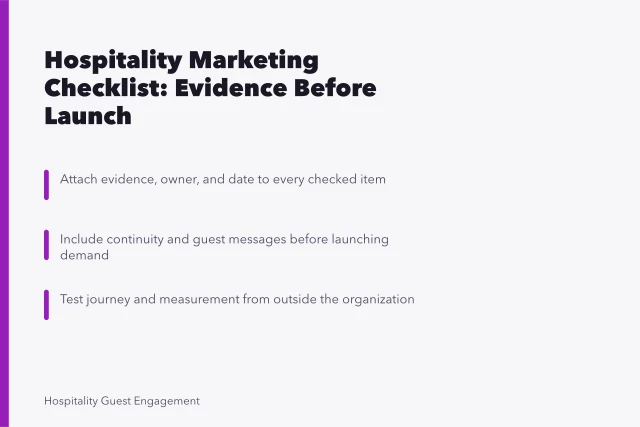
- Every live offer has a named owner and a review date.
- Ad, page, booking widget and pre-arrival message show the same price and terms.
- The booking path passes a keyboard and screen reader test.
- Each correction log entry closes within five business days.
A practice without a test is a preference. Write the threshold, the source and the reviewer before the campaign goes live.
Run the list in a normal week and once during a controlled failure, such as a cancelled shuttle or a sold-out menu item. The hospitality marketing strategy checklist turns these lines into a form you can reuse each quarter.