Rules
Hospitality marketing strategy: the choices that shape everything else, 2027 edition
hospitality marketing strategy in 2027 connects guest demand, a clear offer, direct and partner channels, service capacity, measurement, and weekly decisions.
What to take away
- Choose priority guests and occasions from property evidence, not a generic traveler persona.
- Match every promise to a bookable offer, current operations, and an owned guest journey.
- Measure qualified demand, contribution, experience, and repeat behavior together.
- Give each channel a role and a stop rule before assigning budget.
Hospitality marketing strategy is a set of choices about which guests, occasions, markets, offers, channels, experiences, and economics a property will pursue. It is not a calendar of posts or a list of promotions. A useful strategy connects demand to inventory, rate, service capacity, distribution cost, and the experience guests actually receive.
Hotels, restaurants, resorts, venues, and attractions face a special constraint: the product is perishable, partly delivered by people in real time. Other guest businesses do too, and an unsold room tonight or an empty table during service cannot be stored.
Marketing belongs in the same operating conversation as revenue, reservations, and food and beverage. A campaign can create demand operations cannot fulfill, so include guest service, finance, ownership.
Write the strategy as decisions
Begin with a one-page decision record. State the commercial objective, priority demand pockets, guest problems, distinctive proof, bookable offers, geographic scope, channel roles, service constraints, measurement rules, budget boundaries, owners, and review dates. Include what the business will not target. Exclusions prevent a strategy from becoming a collection of unrelated requests.
One-page decision record
- Commercial objective and priority demand pockets
- Guest problems and distinctive proof
- Bookable offers and geographic scope
- Channel roles and service constraints
- Measurement rules and budget boundaries
- Owners, review dates, and exclusions
| Decision | Evidence needed | Output |
|---|---|---|
| Demand | Bookings, covers, inquiries, search, events, travel data | Priority market and occasion |
| Guest | Need, party, timing, access, value, decision path | Specific job and barrier |
| Offer | Inventory, cost, capacity, restrictions, proof | Bookable promise |
| Channel | Reach, intent, control, cost, role, dependency | Defined job and limit |
| Experience | Operational standard, owner, recovery route | Promise the team can deliver |
| Measure | Source, definition, window, reconciliation | Decision-ready scorecard |
Use one sentence that forces tradeoffs: For a named guest in a named situation, the property will win a defined decision because it offers a verified advantage that alternatives do not provide in the same way. If the sentence could describe any nearby property, it is not yet a position.
Map demand before choosing channels
The U.S. National Travel and Tourism Office groups official research on arrivals, traveler characteristics, receipts, air travel, economic impact, forecasts, and market profiles on its travel and tourism research page. Its coverage is especially useful for international U.S. demand, but it does not replace a property's own market, booking, and guest evidence.
Internal vs external demand evidence
Internal evidence
- Who booked
- Actual guests
- What they bought
- Purchase records
- Cancellations
- Cancellation data
- Arrival
- How they arrived
- Questions
- Guest asks
- Return
- Repeat behavior
External evidence
- Who booked
- Market estimate
- What they bought
- Opportunity size
- Cancellations
- Trend context
- Arrival
- Access patterns
- Questions
- Unmet needs
- Return
- Outside base
Build a demand map at the level where action is possible. Separate local, drive, domestic fly, and international markets. Within each, distinguish occasions such as weekend leisure, family visit, business project, group event, celebration, dining convenience, wellness, sports, or disruption stay. Record season, lead time, party, length, daypart, stay pattern, access need, price sensitivity, and decision trigger.
A demand map should mix internal and external evidence. Internal evidence shows who booked, what they bought, when they canceled, how they arrived, what they asked, and whether they returned. External evidence estimates the opportunity outside the current guest base. Do not let a broad tourism trend override a property's own location, concept, inventory, reputation, and capacity.
Select guests by value and fit
A priority segment needs more than age or income. Describe the guest's job, context, constraints, alternatives, information needs, decision participants, buying window, desired outcome, and reasons to trust. Add the property's ability to serve that guest profitably. A high-volume segment can be a poor choice when acquisition cost, discounting, cancellations, operational strain, or weak repeat potential erase its value.
Priority segment fit test
- Name the occasion and decision
- Estimate accessible demand and winnable share
- Check inventory, staffing, language, accessibility
- Compare net contribution after costs
- State evidence to reduce or stop investment
Turn the position into a bookable offer
A position becomes useful when a guest can recognize and buy it. Define the included product, eligible dates or service periods, price logic, taxes and fees, restrictions, availability, cancellation terms, access details, proof, and next step. Make the wording consistent across ads, listings, landing pages, menus, booking engines, call scripts, confirmation messages, and on-property delivery.
Bookable offer components
- Included product and eligible dates
- Price logic, taxes, and fees
- Restrictions, availability, cancellation terms
- Access details and proof
- Consistent wording across all touchpoints
- Next step for the guest
Do not use a package to hide weak value. A useful offer removes a decision barrier, combines services that belong together, or makes the property's advantage easier to buy. Estimate contribution at realistic redemption and displacement levels. Test whether employees and partners can explain the offer without adding qualifications that the marketing omitted.
Give each channel one primary job
Owned, earned, partner, marketplace, and paid channels can work together without one shared metric, while search captures existing intent and social creates recognition and proof. Email helps known guests make another relevant decision.
Channel roles and failure warnings
Channel role
- Create demand
- Attention without intent
- Capture demand
- Clicks hit unavailable
- Convert
- Rate up, completion down
- Retain
- Frequency up, response weak
- Distribute
- Volume shifts from cheaper
- Protect trust
- Old facts stay public
Failure warning
- Create demand
- Capture demand
- Convert
- Retain
- Distribute
- Protect trust
Travel sellers and marketplaces provide reach and convenience, while local partnerships connect the property to an occasion. The direct site and reservation team should turn interest into a clear, low-friction choice.
| Channel role | Primary signal | Failure warning |
|---|---|---|
| Create demand | Qualified audience reaches offer | Attention without later intent |
| Capture demand | Eligible inquiry or booking | Clicks reach unavailable inventory |
| Convert | Completed profitable action | Rate rises while completion falls |
| Retain | Relevant repeat action | Frequency rises while response weakens |
| Distribute | Incremental net contribution | Volume shifts from cheaper routes |
| Protect trust | Accurate answer and recovery | Old facts remain public |
Document channel dependency. A partner may own the audience, ranking, data, or cancellation relationship. An owned channel may still rely on a booking platform, payment service, or agency account. Preserve access, exports, source files, tagging rules, contracts, and an exit route. No single vendor should be the only place where the team can see or control a material guest journey.
Design the journey around guest questions
Map the decision from first trigger through discovery, comparison, booking, preparation, arrival, use, payment, departure, review, recovery, and return. At each point, list the guest's question, required fact, emotional concern, responsible system, operational owner, response time, and safe next step. Different occasions can require different journeys even when they purchase the same room or table.
Guest decision journey stages
- TriggerGuest recognizes a need
- DiscoveryFinds the property
- ComparisonWeighs alternatives
- BookingCompletes purchase
- PreparationPlans arrival and stay
- ArrivalChecks in and uses service
- DeparturePays, reviews, recovers, returns
Reduce uncertainty before adding persuasion. Show current location, room or seating details, availability, complete price, policies, transport, parking, food options, accessibility information, contact routes, and what happens after purchase. If a fact changes often, connect the public answer to an authoritative owner and a correction process.
Connect marketing to service capacity
A campaign should have a capacity note. Record available inventory, rate or menu constraints, staffing, response coverage, service standard, fulfillment risk, and the person who can pause promotion. Review compressed periods separately. A property may need to shift spend, narrow geography, close an offer, or promote a different daypart when demand exceeds the service that protects the promise.
Campaign capacity note
- Available inventory and rate constraints
- Staffing and response coverage
- Service standard and fulfillment risk
- Person who can pause promotion
- Compressed periods reviewed separately
Create a feedback loop from calls, chats, reservation notes, cancellations, no-shows, review themes, recovery cases, and frontline observations. Classify signals instead of forwarding anecdotes. A recurring question may indicate missing content. A repeated complaint may expose a promise problem. A high-converting offer with poor delivery is not a marketing success.
Build the measurement contract first
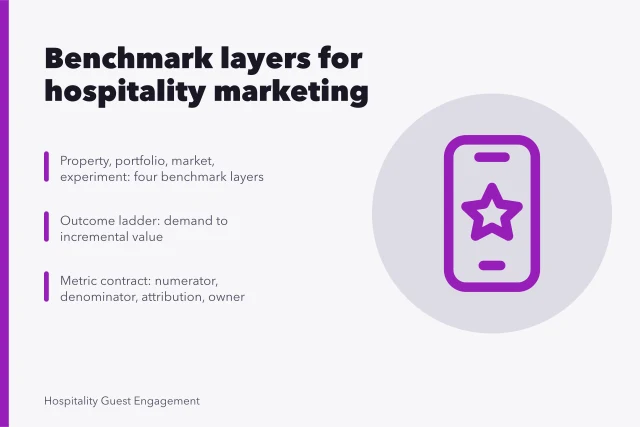
For every key metric, record its business question, event, unit, source, timestamp, attribution rule, inclusion and exclusion logic, owner, quality test, reporting delay, and decision threshold. Reconcile marketing records with the system that owns the outcome, such as the property management, point-of-sale, reservation, event, or finance system.
Leading indicators vs business outcomes
Leading indicators
- Visibility
- Reach and engagement
- Sessions
- Bookings and covers
- Inquiries
- Event contracts
- Diagnosis
- Length of stay
- Movement
- Net revenue and contribution
- Early signal
- Repeat and experience
Business outcomes
- Visibility
- Sessions
- Inquiries
- Diagnosis
- Movement
- Early signal
Separate leading indicators from business outcomes. Visibility, reach, engagement, sessions, and inquiries can diagnose movement. Bookings, covers, event contracts, length of stay, cancellation, net revenue, contribution, repeat behavior, and guest experience show whether the activity created useful demand. Report counts, rates, and distributions so averages do not hide a weak market or service period.
Plan tests that can teach the team
State a hypothesis, eligible audience, offer, control or baseline, primary metric, guardrails, run window, sample limitations, and decision rule before release. Test one meaningful choice at a time when possible. A new image, audience, price, landing page, and booking path launched together can produce movement without explaining why.
Test plan before release
- Hypothesis and eligible audience
- Offer, control, and baseline
- Primary metric and guardrails
- Run window and sample limits
- Decision rule stated in advance
- Stop boundary for guest harm
Protect guests and operations during experiments. Do not create misleading scarcity, hide material terms, or expose one group to a materially inferior service without proper review. Stop when inventory, staffing, accuracy, privacy, accessibility, or guest harm crosses a predefined boundary. Preserve weak and null results so the same failed idea is not repeatedly funded.
Run a weekly commercial rhythm
| Cadence | Questions | Decision |
|---|---|---|
| Daily | What changed in availability, demand, service, or public facts? | Pause, correct, or redirect |
| Weekly | Which segment, offer, and channel moved a qualified outcome? | Adjust budget and work |
| Monthly | What created incremental net contribution and guest value? | Scale, redesign, or stop |
| Quarterly | Are the position, demand choices, and dependencies still sound? | Renew the strategy |
Keep the weekly meeting short and evidence-led. Review material changes, pace against capacity, channel role, offer performance, guest friction, data quality, current experiments, and decisions due. Every action gets an owner and date. Park requests that do not fit the strategy until a leader explicitly changes the priorities.
Use a 90-day launch plan
- Days 1 to 30inventory demand, guests, offers, channels, public facts, accounts, contracts, capacity, and measurement gaps.
- Days 31 to 60select priority decisions, repair one end-to-end journey, define offers, assign channel roles, and test reporting.
- Days 61 to 90run bounded campaigns, inspect guest and operational outcomes, correct failures, and fund only supported work.
Start with one occasion that matters commercially and can be observed end to end. The team must explain why demand is attractive, what the guest needs, how the offer answers it, and where the guest will see it.
The service must deliver, the outcome must be verified, and evidence must trigger a change. That working loop is the foundation for a larger strategy.
Verify hospitality marketing strategy before release
For hospitality marketing strategy, the GAO evaluation design guide explains how evaluation questions, evidence needs, and design choices fit together. The guide is written for federal program evaluation. Use its design discipline as a check on the method, not as proof that a marketing result is causal or transferable.
The W3C Privacy Principles statement gives system designers a shared vocabulary for privacy and warns against shifting privacy work onto individuals. Apply that principle to the data flow behind hospitality marketing strategy. It does not replace the law, contract terms, consent analysis, or a review of the actual configuration.
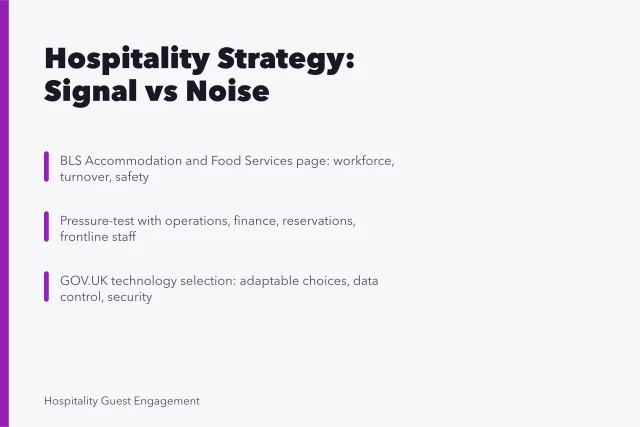
The GOV.UK technology selection guidance recommends choices that can change over time, preserve data control, address security risk, and include ownership cost. Those public-service rules become useful buying questions for hospitality marketing strategy, but they are not private-sector mandates or product endorsements.
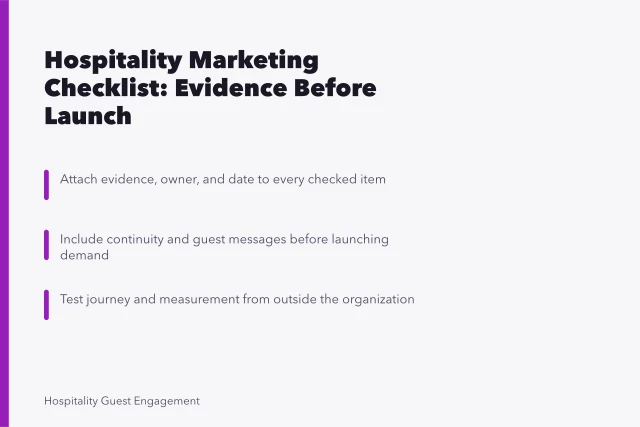
Apply these checks to the actual hospitality marketing strategy workflow. Record the tested data, roles, product versions, exceptions, and approval date. Repeat the review after a material source, model, access, contract, or decision change. The added sources define separate evaluation, privacy, and operating questions; none certifies the local implementation or supplies a guaranteed marketing result.
Common questions
What should a hospitality marketing strategy include?
Include priority demand, guests, position, offers, channel roles, journey, service capacity, economics, measurement, owners, risks, and review dates.
How often should the strategy change?
Review operating signals weekly and the core choices quarterly or after a material market, property, capacity, distribution, or guest change.
Should direct bookings always be the main goal?
No. Judge each route by its strategic role, incremental demand, net contribution, guest relationship, dependency, and ability to serve the occasion.
What is the best first project?
Choose one valuable occasion with clear inventory, reliable service, observable demand, and an outcome that can be reconciled to an owning system.
In this guide
- Getting hospitality marketing strategy questions right the first timecommon hospitality marketing strategy questions cover demand, guests, positioning, offers, channel roles, budgets, direct bookings, measurement, and review cycles.
- Hospitality marketing strategy development: signal versus noisehospitality marketing strategy development turns market evidence, property economics, guest needs, capacity, offers, channels, and measurement into explicit choices.
- Where the hospitality marketing strategy examples agree, and where they do notHospitality marketing strategy examples agree on guest experience and data use but differ on pricing, channel mix, loyalty design and local partnerships.
- Hospitality marketing strategy mistakes worth avoiding earlyhospitality marketing strategy mistakes include vague audiences, weak offers, false review shortcuts, inaccessible journeys, channel confusion, and weak economics.
- A hospitality marketing strategy checklist built for real conditionshospitality marketing strategy checklist steps cover demand, guest fit, positioning, offers, channels, continuity, data security, measurement, ownership, and review.
- Hospitality marketing strategy benchmarks: baselines, ranges and outliersHospitality marketing strategy benchmarks only mean something when the comparison group, the period and the metric definition match your own property.
- Hospitality marketing strategy tools under review: the good, the weak and the verdictHospitality marketing strategy tools get reviewed here on decisions, data flow and exit rights, so operators can see which ones fit and which do not.