Careers
Part of Hospitality marketing strategy: the choices that shape everything else, 2027 edition
A hospitality marketing strategy checklist built for real conditions
hospitality marketing strategy checklist steps cover demand, guest fit, positioning, offers, channels, continuity, data security, measurement, ownership, and review.
What to take away
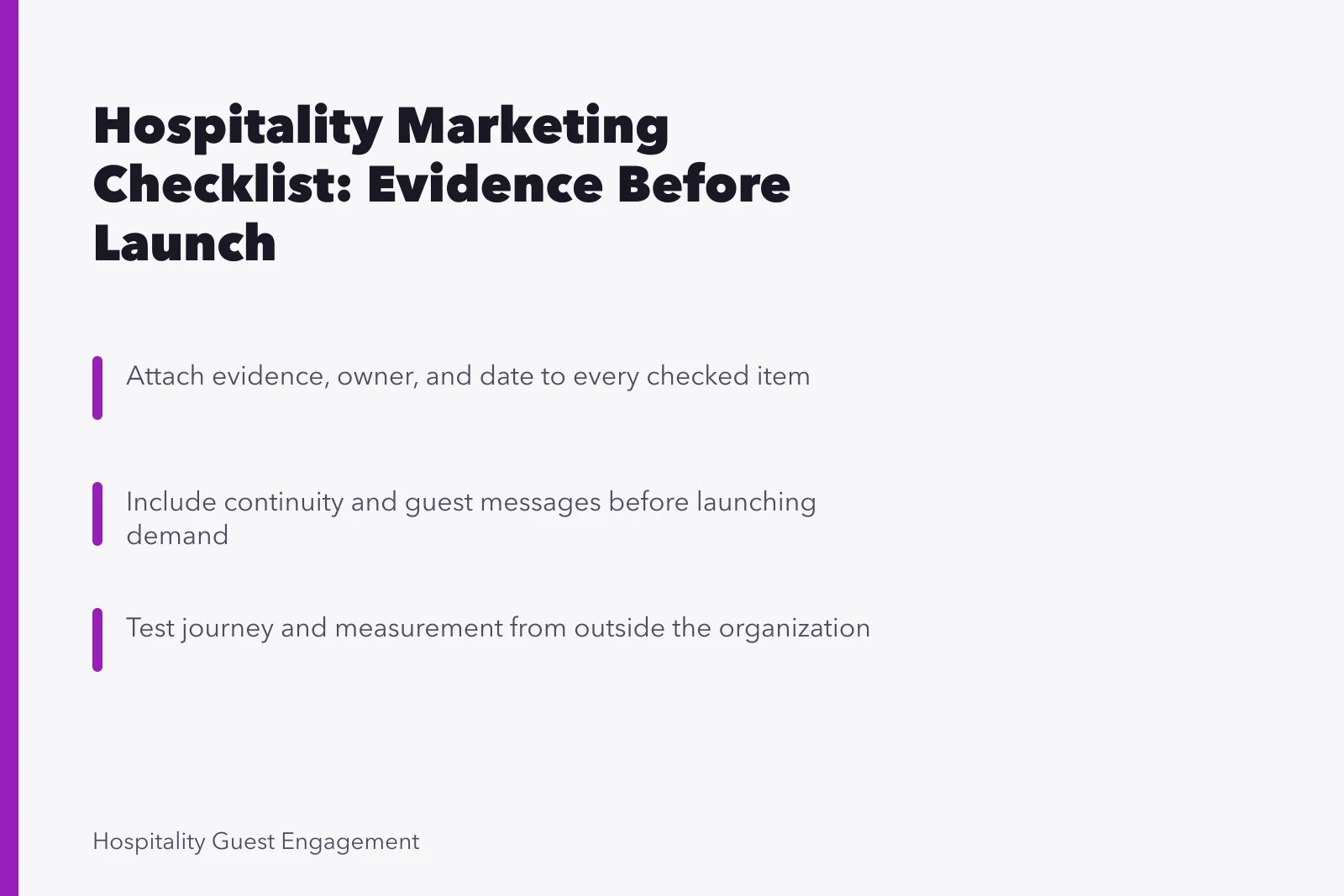
- Attach evidence, an owner, and a date to every checked item.
- Include continuity and guest communication before launching demand.
- Test the journey and measurement from outside the organization.
A hospitality marketing strategy checklist should verify that the commercial idea, guest promise, operating capacity, channel route, and measurement can work together. A checked box without current evidence is not a release decision.
Market and offer
- State the objective, time frame, baseline, and financial definition
- Name the priority market, occasion, guest job, and excluded demand
- Estimate reachable demand with dated internal and external evidence
- Verify the position against alternatives and current service proof
- Document inventory, price, taxes, fees, restrictions, cancellation, and access
- Model channel and variable service costs at realistic response levels
Journey and operations
Ready.gov's page on business emergency plans identifies continuity, crisis communication, emergency response, and technology recovery as connected planning needs. A hospitality campaign should have owners and current guest messages for service disruptions rather than improvising after promotion has created demand. A hospitality reputation management plan should name who answers guests during a disruption and who reviews the pattern afterward.
- Walk discovery, comparison, booking, preparation, arrival, use, payment, departure, and recovery
- Confirm reservation and frontline response coverage
- List public facts that change and assign authoritative owners
- Set capacity, accuracy, safety, and guest-harm stop rules
- Prepare correction, closure, disruption, and alternate-service messages
- Test vendor access, account ownership, exports, and emergency pause controls
Data and measurement
NIST's small business quick-start guides provide introductory cybersecurity and privacy resources for smaller organizations. They do not certify a property, but they can help frame risk discussions about accounts, guest data, vendors, detection, response, and recovery.
Gate / Evidence
- Audience
- Fields, source, permission, exclusions, suppression
- Release
- Approved copy, current offer, destination, owner, date
- Outcome
- Defined event reconciled to reservation, sales, or finance
- Experience
- Service and recovery signals by relevant segment
- Closure
- Decision, correction, archive, and lesson
Before launch, have a person outside the project attempt the journey on representative devices and through phone or message routes. After launch, verify the live placement, destination, price, availability, confirmation, tracking, and operational alert. Reopen the checklist after any material market, offer, platform, vendor, data, property, or service change.
Record the gate result
The W3C Privacy Principles statement gives web-system designers shared privacy concepts and warns against shifting privacy work to individuals. Apply it to hospitality marketing strategy checklist, then review the governing law and configuration.
The CISA software acquisition fact sheet covers development practice, supply-chain exposure, deployment, and vulnerability management. Add those government-acquisition questions to a hospitality marketing strategy checklist review without treating them as local approval.
For every checklist item, record pass, fail, not applicable, or accepted exception. Add evidence location, reviewer, decision date, and next review. A checked box without proof cannot protect a release.
Stop work when a mandatory privacy, security, data-quality, accessibility, or correction condition fails, even if the remaining score looks favorable. Documented pass or fail records feed the common hospitality marketing strategy questions teams ask before budgets are set.
Keep the evidence record beside the decision so a reviewer can reproduce the reasoning without memory. Set the next review date and name the change that triggers an earlier check.
Record rejected options and the chosen path because the original constraint may later change, and use the same definitions in the interface, export, meeting note, and correction log. Close unused reports and permissions after the decision cycle ends.
Common questions
Can one checklist cover every property?
Use a common control structure, then adapt requirements to the property, jurisdiction, product, guests, systems, and channels.
Who signs the checklist?
Named owners should approve only the facts and risks within their authority, with one accountable commercial release owner.
What should stop launch?
Missing support for a material promise, unsafe data use, unavailable capacity, an unusable journey, or an outcome that cannot be verified.