Reviews
Part of Hospitality marketing strategy: the choices that shape everything else, 2027 edition
Hospitality marketing strategy tools under review: the good, the weak and the verdict
Hospitality marketing strategy tools get reviewed here on decisions, data flow and exit rights, so operators can see which ones fit and which do not.
What to take away
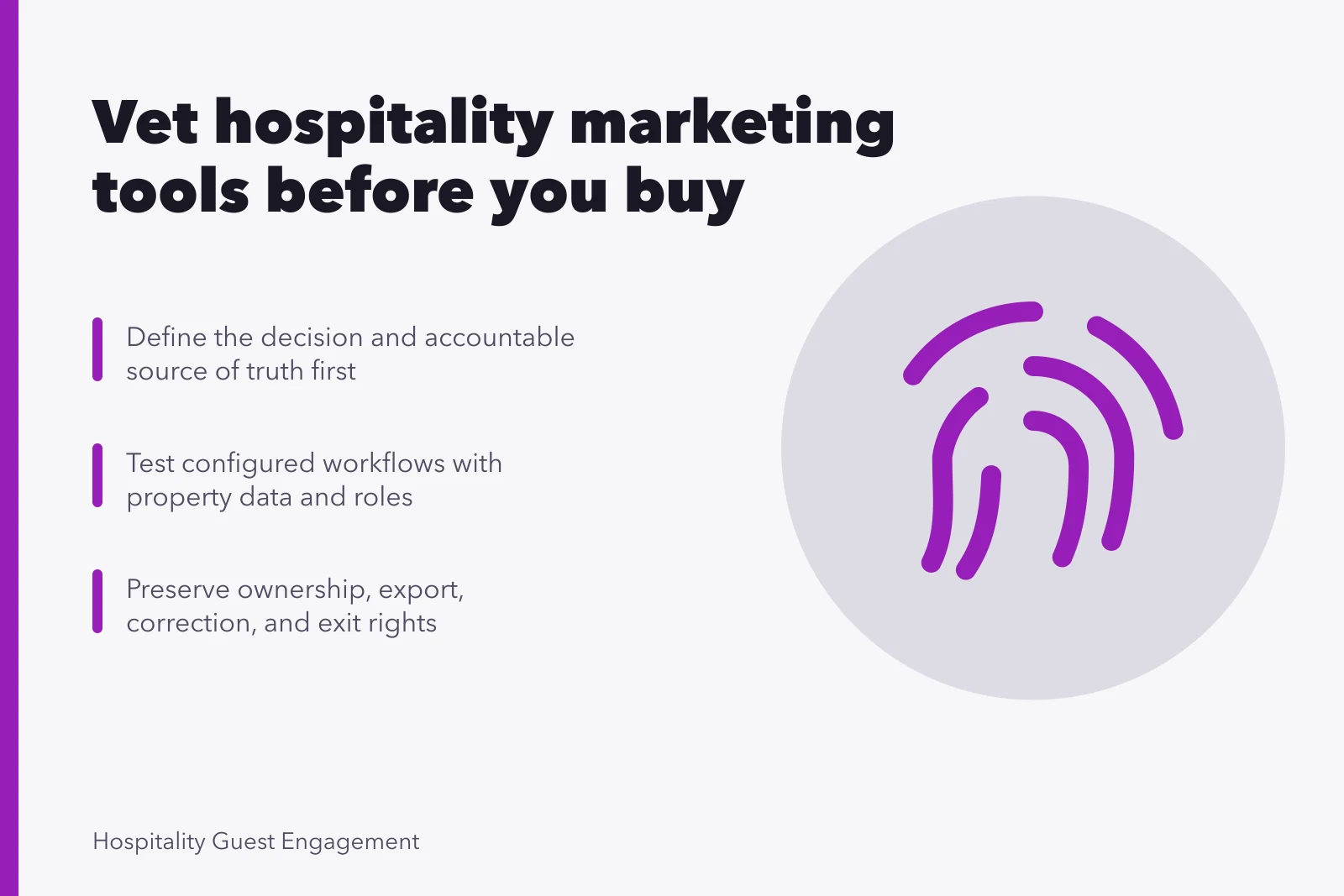
- Name the decision and the system that owns the number before you compare any tool.
- Test the configured workflow with your own rates, roles and one deliberate failure.
- Score exit terms as heavily as featuresexport, deletion, pricing and termination.
- A dashboard is a presentation layer; reconcile it to the PMS or CRM that owns the outcome.
- Keep the evidence record and the rejected options beside the decision.
Hospitality marketing strategy tools split into families, and each family answers a different question. The seven below are the products that come up in hotel and restaurant stacks. A category label tells you nothing about fit, so each entry notes the fit, the price basis and the weak point.
Property and reservation systems
SevenRooms is a restaurant reservation, waitlist and guest CRM platform sold on subscription. It does not publish a rate card, so quotes are per venue with onboarding charged separately.
Property and reservation systems
SevenRooms
- Best fit
- Full-service restaurants
- Weak point
- Narrow for multi-outlet
- Pricing basis
- Per venue, monthly
Toast
- Best fit
- Single-concept operators
- Weak point
- Marketing thinner, ties you in
- Pricing basis
- Published plans, 2.49% + 15¢
Revinate
- Best fit
- Hotels with PMS feed
- Weak point
- Depends on feed quality
- Pricing basis
- Annual, per property
Expect a typical monthly quote in the low hundreds per venue. It suits full-service restaurants that want reservation data feeding guest profiles.
Weak point: it is restaurant-shaped, so a hotel with spa, golf or multi-outlet needs will find the model narrow.
Toast bundles POS, reservations and marketing on published software plans. It publishes card processing at 2.49% plus 15 cents for card-present transactions, and advertises starter hardware at $0 when a venue commits to that processing.
It suits single-concept operators who want one vendor and one bill. Weak point: the marketing side is thinner than a dedicated email platform, and the hardware and processing terms tie you in.
Revinate runs hotel guest data, email and reputation management on an annual subscription quoted per property. It suits branded and independent hotels that already have a PMS feed. Weak point: the value depends entirely on how clean that feed is.
Email, CRM and lifecycle
Cendyn covers hotel CRM, loyalty and campaign execution, quoted by property count. Groups running tiered loyalty programs are the fit; a single independent usually is not, because the quote scales with portfolio size. Weak point: implementation is a project, not a switch-on, and it needs a named owner on your side.
Sprout Social handles social publishing, inbox and reporting on per-seat pricing. Published tiers sit in the low hundreds per seat per month on annual billing, and monthly billing costs more. It suits restaurant groups answering DMs and reviews in one queue. Weak point: it is not a CRM and will not hold booking history.
Search, reviews and analytics
SEMrush covers keyword, competitor and local listing tracking on a tiered subscription. Published tiers run from roughly $140 a month for Pro to about $500 for Business, and each tier caps projects, keywords tracked and seats. It suits marketing teams building organic demand. Weak point: it reports search visibility, not revenue.
Google Business Profile is free and is where most local discovery starts. Hours, photos, menus, Q&A and review replies are the fields that move calls and direction requests. It suits every property. Weak point: it is a channel you influence, not a system you own.
Google's Analytics help page for custom campaign URLs defines UTM parameters and notes values are case sensitive. A naming standard reduces fragmented reporting, though tags never prove incrementality.
It also settles the common hospitality marketing strategy questions owners and operators argue over.
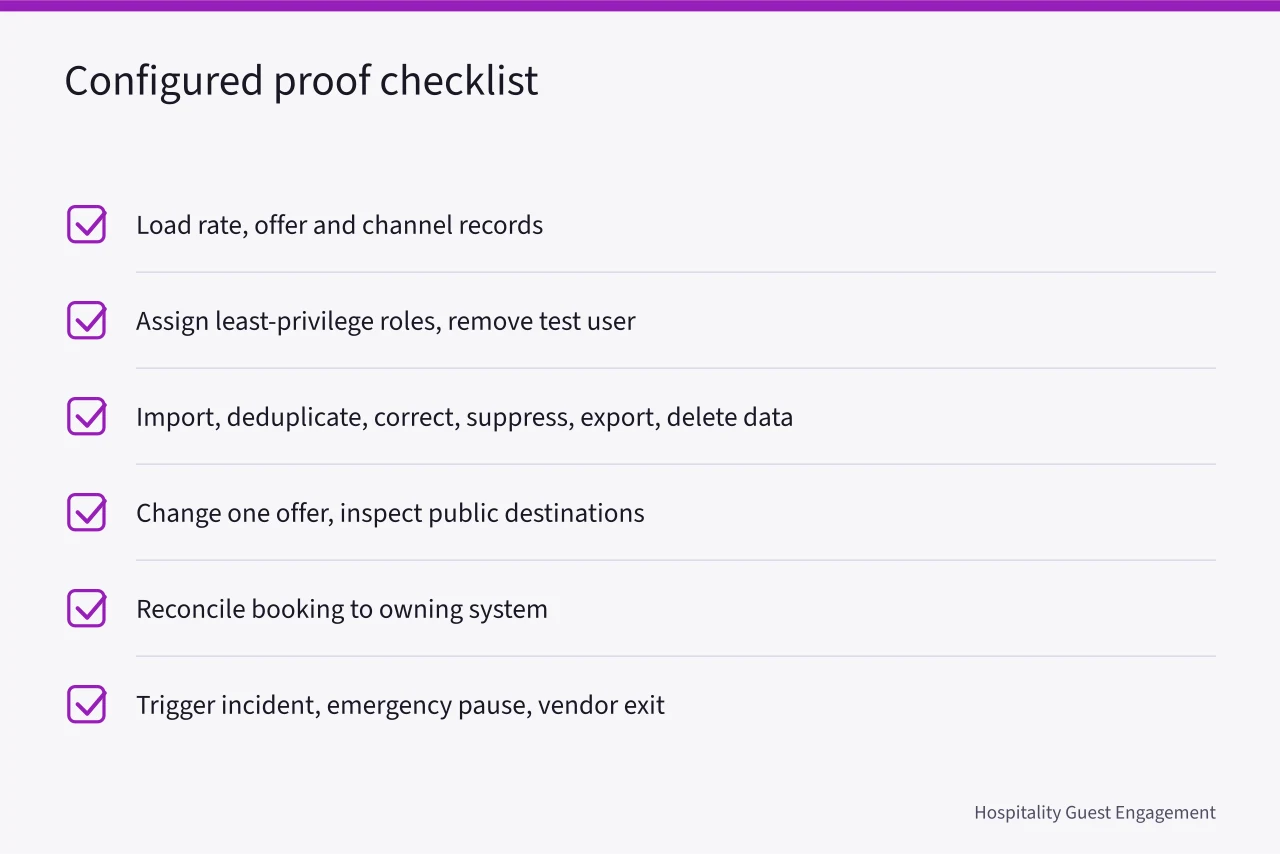
Run a configured proof
- Load representative rate, offer and channel records
- Assign least-privilege roles, then remove a test user
- Import, deduplicate, correct, suppress, export and delete test data
- Change one offer and inspect every public destination
- Reconcile a booking back to the system that owns it
- Trigger an incident, an emergency pause and a vendor exit
The NIST Privacy Framework is voluntary guidance for identifying privacy risk. Use its questions on guest data, but it does not establish legal compliance on its own.
Score evidence, not demonstrations
Ask for current documentation on data fields, integrations, roles, and logs.
Ask for current documentation on retention, support levels, subcontractors, and incident response.
Ask for current documentation on accessibility, exports, deletion, pricing, and termination.
Separate what exists in theory from what you will actually operate. Weight the score to material needs, because a neat convenience feature should not cancel a data, ownership or exit weakness. Record assumptions, open questions, pilot results and owners.
The GOV.UK technology selection guidance recommends adaptable choices, data control, security review and ownership-cost analysis. Those questions shape hospitality marketing strategy development before any license is signed.
The GOV.UK open standards guidance ties open standards to interoperability and lower supplier dependence, which is the test for whether your guest data can move.
The verdict
Revinate and Cendyn lead on hotel guest data and loyalty. SevenRooms and Toast carry restaurant operations. Sprout Social covers social response, SEMrush covers demand research, and Google Business Profile covers local presence. None of them is the strategy. Each is a place to run one.
Tool verdict at a glance
SevenRooms
- Best fit
- Restaurant reservations
- Weak point
- Narrow for hotels
- Pricing basis
- Per venue
Toast
- Best fit
- Single-concept restaurants
- Weak point
- Thin marketing
- Pricing basis
- Plans + 2.49%
Revinate
- Best fit
- Hotels with clean PMS
- Weak point
- Feed quality
- Pricing basis
- Annual per property
Cendyn
- Best fit
- Groups with loyalty
- Weak point
- Project implementation
- Pricing basis
- Per property count
| Tool | Best fit | Weak point | Pricing basis |
|---|---|---|---|
| SevenRooms | Restaurant reservations, waitlist and guest CRM | Built for restaurants, narrow for multi-outlet hotels | Quoted per venue, monthly |
| Toast | Single-concept restaurants wanting one vendor | Marketing tools thinner than a dedicated email platform | Published software plans, processing at 2.49% plus 15 cents card-present |
| Revinate | Hotels with a clean PMS feed | Value depends on feed quality | Annual subscription, quoted per property |
| Cendyn | Groups running tiered loyalty | Implementation is a project, not a switch-on | Quoted by property count |
| Sprout Social | Social publishing, inbox and review replies | Not a CRM, no booking history | Per seat, low hundreds a month on annual billing |
| SEMrush | Keyword, competitor and local listing research | Search visibility, not revenue | Tiered, about $140 to $500 a month |
| Google Business Profile | Local discovery | A channel you influence, not a system you own | Free |
Give every candidate the same source sample, roles, output, failure case and export task. Measure setup time, recurring labor, specialist help, correction work and shutdown effort. Credit a feature only when an intended user finishes the task safely.
Keep the evidence record beside the decision, and record rejected options too, because the constraint that ruled them out may change. That record makes a hospitality marketing strategy checklist easier to follow and defend. Set the next review date and name the change that triggers an earlier one.
Common questions
Should one platform manage every channel?
Only if the configured system meets the property's needs without unacceptable dependency, data, access or exit risk. Most groups run two or three, with the PMS as the record of truth.
Is a dashboard a source of truth?
Usually it is a presentation layer. Find the system that owns each outcome, then reconcile the dashboard to it before anyone acts on a number.
How long should a tool trial run?
Long enough to cover a real demand period, dirty data, support response and a full export. A trial that never hits a failure case has tested nothing.