Rules
Part of Hospitality marketing strategy: the choices that shape everything else, 2027 edition
Hospitality marketing strategy development: signal versus noise
hospitality marketing strategy development turns market evidence, property economics, guest needs, capacity, offers, channels, and measurement into explicit choices.
What to take away
- Start with the business constraint and a defined commercial outcome.
- Build demand pockets from geography and occasion before writing personas.
- Make the strategy falsifiable with assumptions, owners, thresholds, and review dates.
Hospitality marketing strategy development begins with commercial and operating facts, not campaign ideas. The team needs to know which inventory or service periods matter, what demand is available, which guests fit the property, what it can credibly promise, and how a result will be verified.
Create the evidence pack
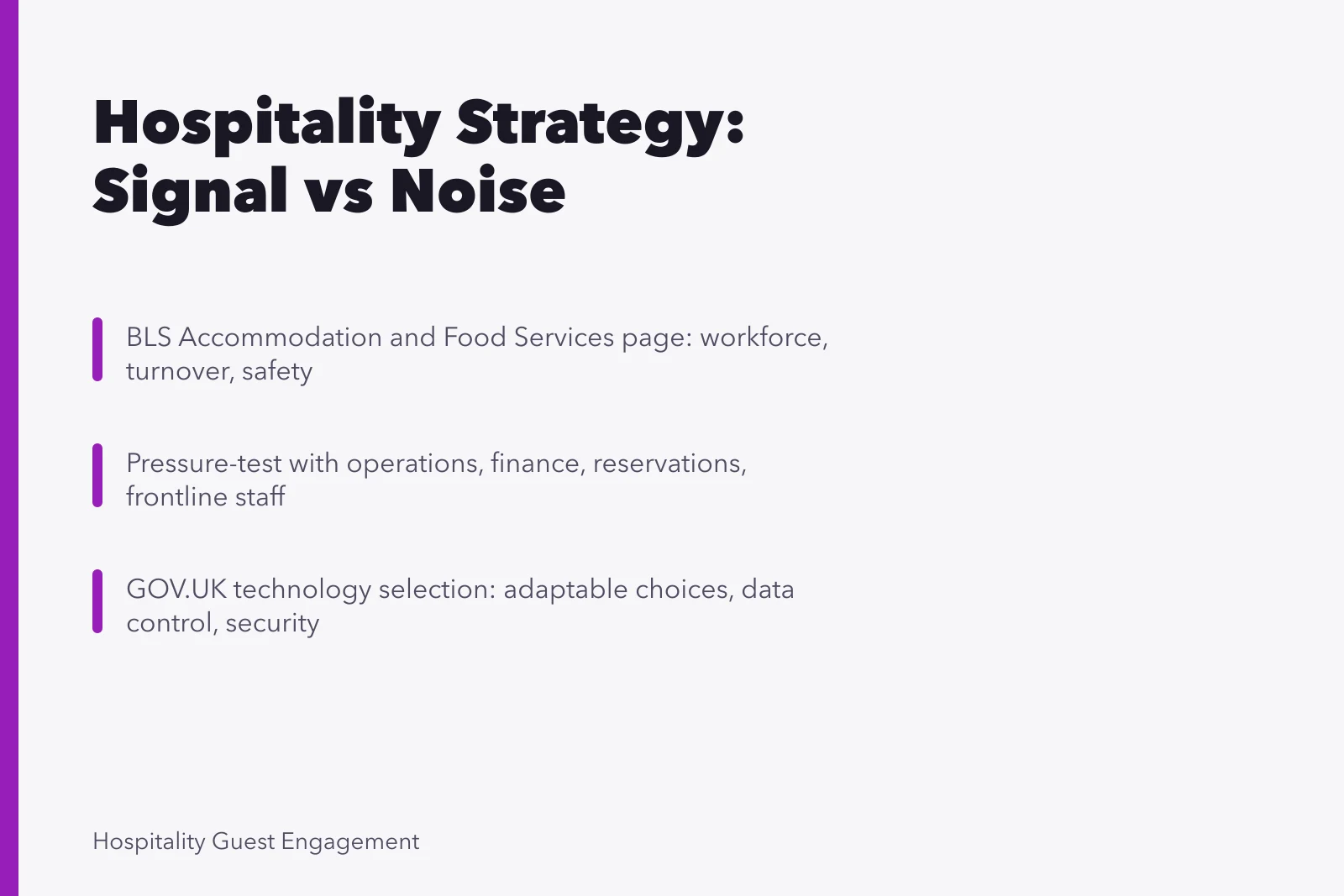
The Bureau of Labor Statistics maintains an Accommodation and Food Services industry page with current workforce, earnings, turnover, safety, productivity, and establishment indicators. It supplies operating context, not a demand forecast for one property.
- Property and outlet inventory by date and service period
- Booking, cover, event, cancellation, no-show, and contribution history
- Origin, occasion, party, lead time, duration, and channel patterns
- Guest questions, review themes, recovery cases, and accessibility needs
- Competitor offers, public facts, distribution, and experience evidence
- Market, event, transport, economic, and travel indicators with dates
Move from facts to choices
| Stage | Decision | Required challenge |
|---|---|---|
| Objective | Commercial result and time frame | Why this outcome now? |
| Demand | Priority market and occasion | What proves reach and fit? |
| Position | Reason to choose | Can operations prove it? |
| Offer | Bookable value and terms | Is net contribution sound? |
| Channel | Role, budget, and limit | What happens without it? |
| Measure | Metric and decision rule | Which system owns truth? |
The National Travel and Tourism Office's international visitor forecast gives a five-year outlook for travel to the United States and named source markets. Use it as one dated scenario input. A national inbound forecast does not establish local demand, a property's likely share, or the result of a campaign.
Pressure-test the draft
Ask operations to identify promises that could fail, finance to test full channel and service costs, and reservations to attempt the journey. Ask frontline staff what guests misunderstand.
Ask an analyst to reproduce every baseline, and leadership which attractive opportunities will be declined so priority work has resources. A short list of common hospitality marketing strategy questions can keep that pressure test focused on demand, guests, and positioning.
Publish assumptions beside decisions. Examples include expected event attendance, flight capacity, response time, available rooms, staffing, price position, or distribution terms. Assign an indicator and review date to each assumption. When the evidence changes, revise the strategy explicitly rather than adding another disconnected campaign.
Run a controlled handoff
The GOV.UK technology selection guidance recommends adaptable choices, data control, security review, and ownership-cost analysis. Use those public-service questions when assessing hospitality marketing strategy development; they are not product endorsements.
The CISA software acquisition fact sheet covers development practice, supply-chain exposure, deployment, and vulnerability management. Add those government-acquisition questions to a hospitality marketing strategy development review without treating them as local approval.
Assign each step to a named role and an observable finish condition. The analyst can reproduce the result, and the decision owner can explain the action and stop rule.
Include one broken-data case and one revoked-access case. Record the repair, time required, and vendor help, so the written process reflects normal operation, not a prepared demonstration.
For hospitality marketing strategy development, keep the evidence record beside the decision. A reviewer can then reproduce the reasoning without memory.
Set the next review date for hospitality marketing strategy development and name the change that would trigger an earlier check. A reproducible evidence record also supports hospitality reputation management, where guest truth and review integrity must survive contact with reality.
Common questions
How long should development take?
A small property can create a useful first version in weeks when evidence and decision owners are available, then improve it through measured work.
Should forecasts set the budget?
No. Use forecasts with property history, current pace, local signals, capacity, economics, and uncertainty.
What makes a strategy ready?
The choices, evidence, offer, channel roles, service requirements, measures, owners, stop rules, and review dates are clear enough to operate.