Rules
Part of Hospitality marketing strategy: the choices that shape everything else, 2027 edition
4 plain facts about hospitality marketing strategy case studies
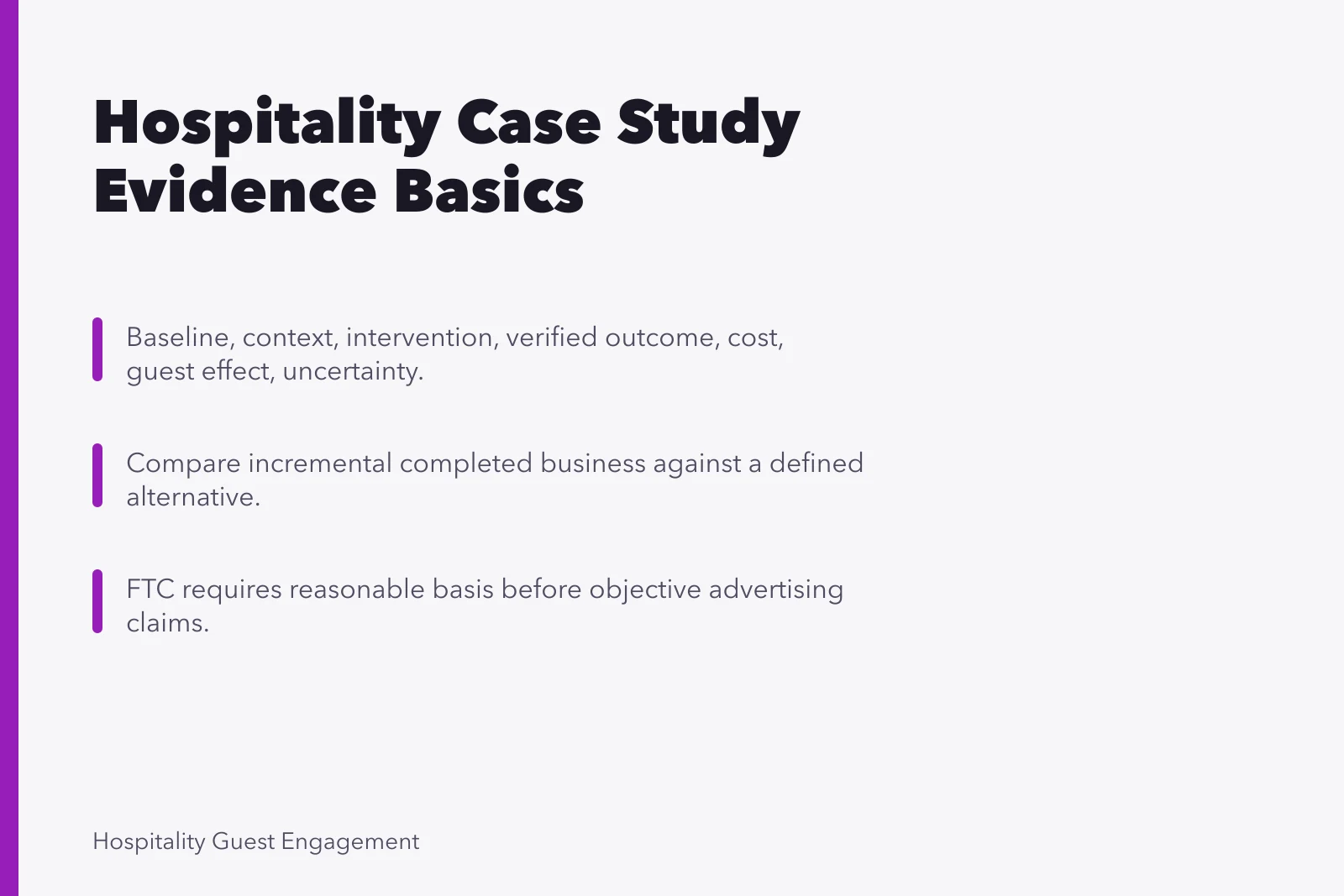
hospitality marketing strategy case studies need a baseline, context, intervention, verified outcome, cost, guest effect, uncertainty, and cautious causal claims.
What to take away
- A before-and-after chart alone does not prove marketing caused the change.
- Record service, distribution, pricing, and market changes beside the intervention.
- A useful case explains failures, costs, and limits as well as outcomes.
Hospitality marketing strategy case studies should help a reader judge what changed, why it may have worked, what else moved, and whether the result can transfer. A promotional success story that omits the baseline, full cost, cancellations, displacement, or guest delivery is not decision-grade evidence.
Use a case evidence record
Field / Question
- Context
- Which property, market, dates, inventory, and constraints applied?
- Problem
- What observable gap required a decision?
- Intervention
- What audience, offer, channel, journey, and service changed?
- Comparison
- What credible baseline or control was used?
- Outcome
- Which owning system verified the result?
- Economics
- What media, commission, discount, labor, technology, and service costs applied?
- Experience
- What happened to guests and operations?
- Limits
- Which alternative explanations and transfer risks remain?
Worked example using typical ranges, not a named case. Baseline: 1,000 room nights a month. Campaign spend: $5,000. Incremental: 80 room nights at $180 average daily rate, or $14,400. Variable service cost: $45 per room night, or $3,600. Net contribution before media: $10,800. Net after media: $5,800.
GAO's short publication on performance measurement and evaluation distinguishes ongoing performance measurement from periodic evaluation that examines how and why a program works. The distinction helps hospitality teams avoid presenting a dashboard change as causal proof.
Inspect channel contribution
BEA's travel and tourism product guide covers macroeconomic accounts, not property-level campaign evidence.
For a channel case, compare incremental completed business and contribution against a defined alternative. Account for direct bookings, customers who switched offers, demand shifted between dates, commission, and media.
Account for discount, cancellations, and service cost; show sensitivity when the baseline is uncertain; channel contribution comparisons hold only when the hospitality marketing strategy benchmarks behind them are defined and consistent.
Make the case reusable
- Provide the exact metric definitions and dates
- Separate observed facts from interpretation
- Name material concurrent changes
- Report weak, null, and adverse outcomes
- Explain the service and data controls
- State where transfer is likely to fail
A strong internal case can be small. One property can document a targeted repair to an event inquiry journey, compare matched periods, reconcile signed business, interview users, inspect service outcomes, and state uncertainty. The value comes from traceability, not dramatic scale.
Audit the published evidence
The FTC advertising substantiation policy requires a reasonable basis before objective advertising claims are disseminated. Apply that U.S. rule to public hospitality marketing strategy case studies performance statements, with advice for the actual facts.
The FTC guidance for marketers using reviews warns about fake feedback, selective requests, conditioned incentives, hidden relationships, and paid rankings. Apply those U.S. integrity checks when hospitality marketing strategy case studies content names providers.
Separate provider claims, customer statements, measured records, and independent findings. Record selection criteria, commercial ties, product version and study population, method, and missing evidence.
A recognizable public source, such as a Cornell Center for Hospitality Research report or an STR/CoStar benchmark study, gives definitions and methods you can test. Reproduce one material claim with local data before recommending a provider or copying a case. Before trusting any provider case, run the common hospitality marketing strategy questions that separate evidence from sales talk.
For hospitality marketing strategy case studies, keep the evidence record beside the decision so reviewers can reproduce the reasoning without relying on memory.
Record rejected options and the chosen path because the original constraint may later change. Use the same definitions in the interface, export, meeting note, and correction log.
Common questions
Does a case study need a randomized test?
No, but its design should match the claim and address plausible alternative explanations honestly.
Can vendor-reported return be used?
Use it as one record, then verify outcomes, costs, attribution, and exclusions in property-controlled systems.
What makes a case publishable?
Permission, accurate evidence, disclosed method and limits, protected guest data, and language that matches the evidence.