Guides
Reading hospitality marketing analytics with a sceptical eye
hospitality marketing analytics connects guest demand, campaign cost, direct and indirect bookings, fulfilled revenue, contribution, testing, and decisions.
What to take away
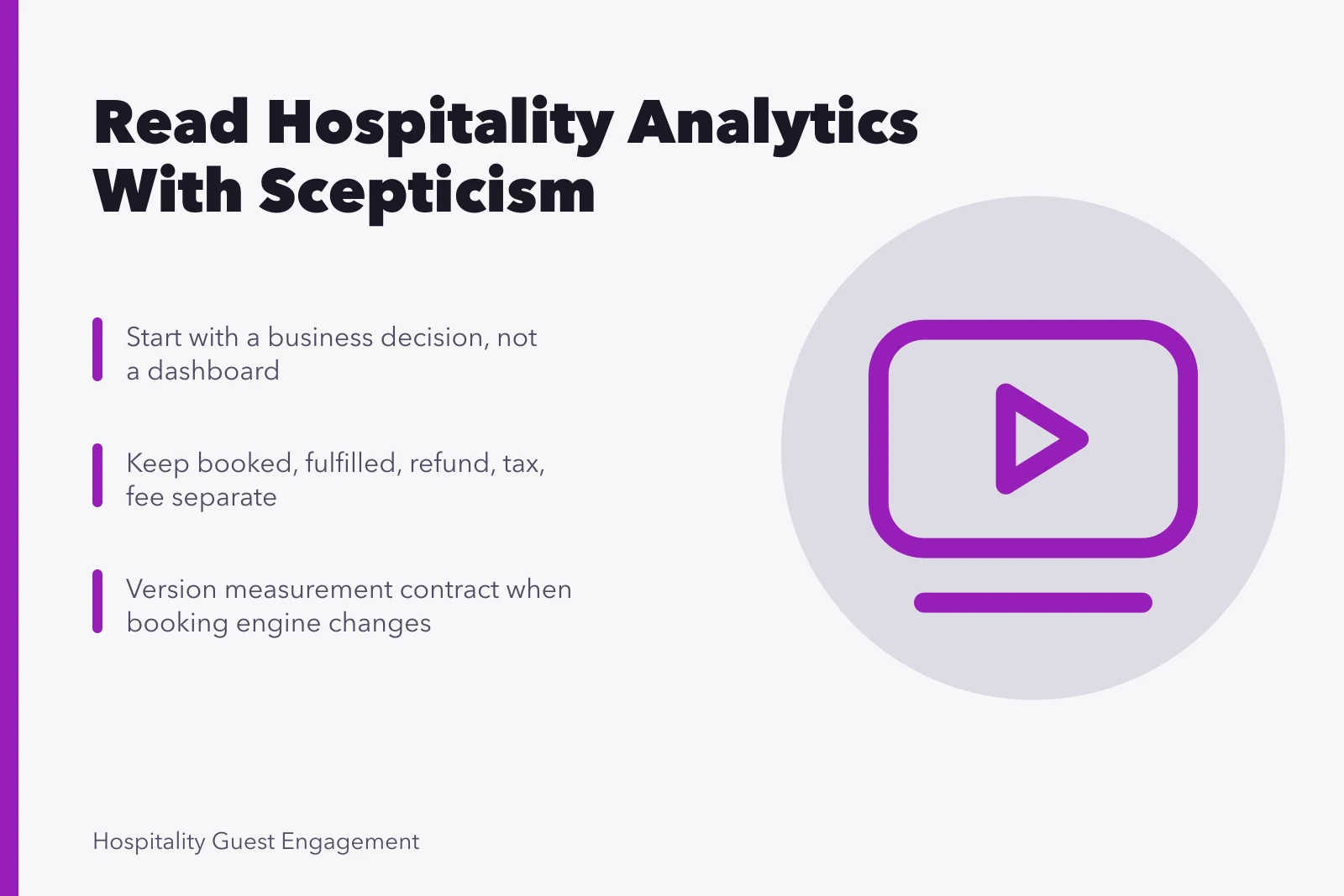
- Start with a business decision, not a dashboard.
- Reconcile marketing actions with fulfilled hospitality outcomes.
- Keep attribution, incrementality, and forecasting separate.
- Publish definitions, data gaps, and uncertainty beside every result.
Governed hospitality marketing analytics turns records into decisions: demand, media, website, reservation, and point-of-sale data, plus guest and finance data. It tells a hotel, restaurant, venue, attraction, or spa what happened, what probably contributed, what was truly incremental, and next steps. Clubs or travel operators get the same.
Reporting platforms organize evidence but can't repair a vague goal, broken event, duplicate reservation, hidden cancellation, or weak comparison.
Write a decision statement and name property or outlet, audience, market, offer, and channel. Name eligible period, capacity constraint, outcome, economic rule; name owner and action that will change.
Ask whether to shift paid-search budget for weekday stays, repeat a local dining offer, change a landing page, or pause a campaign whose gross bookings vanish after cancellations. Each question needs different evidence.
Map the hospitality measurement chain
| Stage | Evidence | Common break |
|---|---|---|
| Demand | Search, map, referral, call, visit | Unknown source or mixed market |
| Intent | Availability check, menu view, inquiry | Inconsistent event or duplicate firing |
| Transaction | Reservation, order, ticket, deposit | Channel and currency mismatch |
| Fulfillment | Stayed night, served cover, attended visit | Cancellation, no-show, refund, comp |
| Economics | Net revenue, variable cost, contribution | Gross booking value treated as profit |
| Learning | Comparison, experiment, forecast | Attribution presented as causation |
Create one measurement contract
For every key metric, document its business question, exact definition, numerator, denominator, grain, source, eligible records, exclusions, currency, timezone, freshness, owner, quality test, and decision threshold. Version the contract when a booking engine, channel mapping, consent setup, campaign taxonomy, property system, or finance rule changes. A familiar label such as conversion rate is not a definition.
Pick the unit before data collection. Valid units include person, browser, session, inquiry, and room-night. Reservation, cover, order, ticket, and stay are valid; household counts.
Units are not interchangeable: one traveler may use several devices, one reservation may contain several nights, one restaurant order may cover several guests. Keep original grain and state how any rollup was built; a hotel marketing plan depends on that unit choice, because one reservation can hold several room-nights.
Design events around business meaning
Use stable, readable event names for meaningful actions such as viewing availability, starting a reservation, submitting a qualified inquiry, ordering, purchasing, canceling, refunding, checking in, and completing a stay. Add controlled parameters only when they serve an approved decision. Avoid putting names, email addresses, reservation numbers, free text, or other sensitive identifiers into general analytics fields.
Google's current explanation of reporting identity in Analytics describes User-ID, device ID, and modeling as identity spaces and says the selected option affects reporting rather than data collection or processing. That product behavior is a reason to disclose the reporting identity and consent context instead of treating an analytics user count as a literal count of unique guests.
Maintain a taxonomy register with the event, trigger, required parameters, prohibited fields, responsible system, platform destinations, validation case, effective date, and retirement rule. Test clean paths and difficult ones: multiple rooms, group bookings, cross-domain payment, phone follow-up, voucher use, modifications, cancellations, partial refunds, no-shows, split checks, and repeat orders.
Reconcile marketing with fulfilled outcomes
Marketing platforms usually see clicks and tagged events before the property knows if a booking was honored. Join the earliest useful campaign record to the reservation or order under a documented key; update it when status changes.
Keep booked value, fulfilled value, refund, tax, and fee as separate fields. Keep commission, variable cost, and contribution separate; do not overwrite original transaction.
Set reconciliation windows that match the business. A same-day restaurant offer can settle quickly, while a resort booking may be changed months later. Report preliminary, matured, and final views rather than waiting silently or pretending fresh numbers are complete. Track unmatched marketing events, unmatched transactions, duplicates, changed currencies, and late adjustments as quality metrics.
Keep channel rules explicit
Create a dated source-and-medium map: paid search, organic search, metasearch, online travel agencies, marketplaces. Add maps, affiliates, creators, email, social. Include referrals, direct traffic, calls, walk-ins, offline partnerships.
Preserve raw values before applying the map. Review new and unknown values weekly. A large direct bucket often means missing evidence, not pure brand demand. This map also supports hospitality social media work, where channel labels decide which posts get credited.
Use consistent campaign names, parameters, property identifiers, markets, offers, and creative codes. Control case, spacing, abbreviations, and placeholder values. Record redirects, cross-domain behavior, consent effects, and vendor auto-tagging. When a channel changes its taxonomy, update the map prospectively and annotate the series rather than silently rewriting history.
Separate three kinds of measurement
| Method | Question | Safe conclusion |
|---|---|---|
| Descriptive reporting | What was recorded? | Observed volume, rate, value, and mix |
| Attribution | How did a rule or model assign credit? | Credited contribution under stated settings |
| Experiment or causal design | What changed because of the action? | Estimated incremental effect under assumptions |
| Forecast | What may happen next? | Projected range under inputs and scenario |
| Qualitative research | Why might guests behave this way? | Themes and hypotheses from the studied sample |
Attribution is useful for organizing paths and operating bidding systems, but credit is not the same as lift. An experiment needs a treatment, comparison, assignment method, primary outcome, sample plan, analysis rule, guardrails, and stopping rule. If randomization is impractical, use the strongest feasible comparison and say what may still confound it.
Measure economics, not just activity
Pair reach, clicks, visits, inquiries, and bookings with net fulfilled revenue, contribution, acquisition cost, cancellation, refund. Pair orders likewise, add no-show, capacity use, and repeat behavior; state the return numerator: revenue, gross profit, or contribution.
Include platform fees, agency cost, discounts, and commissions when a decision requires total cost; include creative, labor, technology. That repeat behavior is the same signal a guest loyalty program uses to judge whether members return.
Hospitality capacity makes averages dangerous. A campaign that fills already constrained Saturday nights may displace higher-value demand, while one that produces fewer Tuesday bookings may add more contribution. Segment by arrival date, daypart, property, outlet, room or product type, market, lead time, party size, length of stay, rate plan, and capacity state when those fields change the decision.
Build data-quality controls
- Validate tags in a controlled test environment before release
- Compare browser events with server, booking, order, and finance records
- Monitor event volume, missing fields, duplicates, unknown channels, and impossible values
- Check timezone, currency, tax, commission, and refund treatment
- Annotate consent, campaign, site, vendor, and property-system changes
- Keep raw records, transformations, metric definitions, and report versions traceable
- Assign incident severity, owner, correction, reprocessing, and stakeholder notice
Set expected ranges rather than one brittle total. Alert on sudden loss, duplication, schema drift, unmatched IDs, delayed feeds, and changes in status distribution. Investigate the source before editing the dashboard. If a result was published from defective data, correct the number, explain the effect, and preserve the original version and decision record.
Design a decision-ready dashboard
Lead with the question, current decision, accountable owner, period, and data status. Show a small set of outcomes, their comparisons, capacity or mix context, uncertainty, and known gaps. Let readers drill into property, market, channel, campaign, device, offer, arrival date, and fulfillment status without hiding denominator changes. Include definitions where the user encounters the metric.
Use charts only when they reveal a relationship. A line chart can show change over time; a distribution can expose polarization; a funnel can reveal recorded loss between steps; and a table can support exact operational decisions. Avoid decorative gauges, unexplained composite scores, dual axes that imply false relationships, and rankings built from tiny samples.
Run a weekly analytics review
- Confirm source freshness, quality alerts, corrections, and open incidents
- Review fulfilled outcomes, contribution, capacity, cancellations, and refunds
- Explain material changes through documented evidence and alternatives
- Separate observed performance, attributed credit, test estimates, and forecasts
- Choose one decision, owner, action, deadline, and success condition
- Record what would reverse the decision and when it will be revisited
Use a 90-day implementation plan
Days 1-30: inventory decisions, systems, identifiers, fields, and privacy duties. Then vendors, metrics, and current reports. Pick one property journey and define its contract.
Days 31-60: implement and validate the event and transaction chain, channel map, fulfillment reconciliation, and dashboard.
Days 61-90: run one decision cycle and one credible test. Inspect operating impact, correct the measurement, and document the next expansion.
The result should be a modest, trusted system. It tells commercial, operations, guest service, and finance teams the same story at the right grain. It distinguishes bookings from stays, activity from value, attribution from incrementality, and a clean chart from a sound decision. Hospitality marketing analytics earns influence when its numbers survive reconciliation and its recommendations survive real operations.
Verify hospitality marketing analytics before release
For hospitality marketing analytics, the GAO evaluation design guide explains how evaluation questions, evidence needs, and design choices fit together. The guide is written for federal program evaluation. Use its design discipline as a check on the method, not as proof that a marketing result is causal or transferable.
The W3C Privacy Principles statement gives system designers a shared vocabulary for privacy and warns against shifting privacy work onto individuals. Apply that principle to the data flow behind hospitality marketing analytics. It does not replace the law, contract terms, consent analysis, or a review of the actual configuration.
The GOV.UK technology selection guidance recommends choices that can change over time, preserve data control, address security risk, and include ownership cost. Those public-service rules become useful buying questions for hospitality marketing analytics, but they are not private-sector mandates or product endorsements.
Apply these checks to the actual hospitality marketing analytics workflow. Record the tested data, roles, product versions, exceptions, and approval date. Repeat the review after a material source, model, access, contract, or decision change. The added sources define separate evaluation, privacy, and operating questions; none certifies the local implementation or supplies a guaranteed marketing result.
Common questions
What is hospitality marketing analytics?
It is the governed use of demand, marketing, transaction, fulfillment, guest, and financial evidence to make and evaluate commercial decisions.
Which metric should a hotel start with?
Start with the fulfilled outcome and economic measure tied to the decision, then work backward to the signals that explain it.
Is attribution the same as incrementality?
No. Attribution assigns credit under a rule or model; incrementality estimates what changed because of the marketing action.
How often should reports update?
Match freshness to the decision, label preliminary and matured data, and wait for fulfillment when the result depends on stays, visits, refunds, or cancellations.