Operations
How to Set Up Hotel Guest Messaging Without Annoying Guests
To set up hotel guest messaging, US hotels need written opt-in consent first, then a four-stage rollout over about ten weeks, with the desk doing most of the work.
What to take away
- Set up hotel guest messaging in four stages across about ten weeks, with consent records ahead of software.
- Nothing goes live until the opt-in wording is written, approved and stored with a timestamp.
- The usual stall is staff adoption, not technology, and it shows as a slow rise in opt-outs.
- Run one property or one guest segment first for three to four weeks, with a manual fallback.
- Promotional and service messages belong on separate tracks under US consent rules.
The sequence matters more than the platform. A property that buys software first and writes consent language second usually rebuilds the setup within a quarter, and the second build is harder than the first. The same sequencing logic runs through the wider hospitality marketing strategy, where one bad order of operations is expensive to undo.
Consent wording and the record behind it
US law separates service messages from marketing messages, and the marketing side carries the heavier burden. Promotional texts generally need prior express written consent that you can produce later. A room-ready alert sits on a lighter standard, but only while it stays purely operational. Mix the two into one thread and the lighter standard disappears.
Consent Standards by Message Type
Service message
- Consent needed
- Lighter standard
- Must be provable
- While operational
- If mixed
- Lighter standard gone
Marketing message
- Consent needed
- Prior express written
- Must be provable
- Yes, produce later
- If mixed
- Heavier burden applies
Write the opt-in sentence and the record that proves it before capture devices, before training, before any contract. Store the date, the channel, the exact wording and the confirmation for each guest. The Federal Trade Commission's data security guidance covers what you owe guests if that record leaks.
Everything downstream waits on that sign-off. Until the consent wording is approved by whoever owns your legal exposure, no platform, no desk tablet and no staff briefing should be scheduled. That is the single hard blocker in this rollout. Allow one to two weeks.
Front desk capture, weeks three to five
Two to three weeks of writing, rehearsal and testing.
Front Desk Capture Setup
- Write check-in ask in 12 words or fewer
- Give every agent same script and card
- Test wording on 20 arrivals
- Log refusals, then adjust wording
Staff should hear that a refusal is a normal outcome. The desk needs one named owner for the program. Hotel SMS guest communication works when the ask is short, consistent and easy to decline.
The controlled pilot, weeks six to nine
Run three to four weeks on one property, or one segment such as arrivals only. Keep the pilot small enough that one person can read every reply.
Track opt-outs daily and hold a manual queue for guests who do not answer. Match the tone of your hotel demand into bookings work, so guests do not meet two brands during one stay. Do not add a second channel yet.
The four stages and their gates
| Stage | Work | Duration | Gate before starting |
|---|---|---|---|
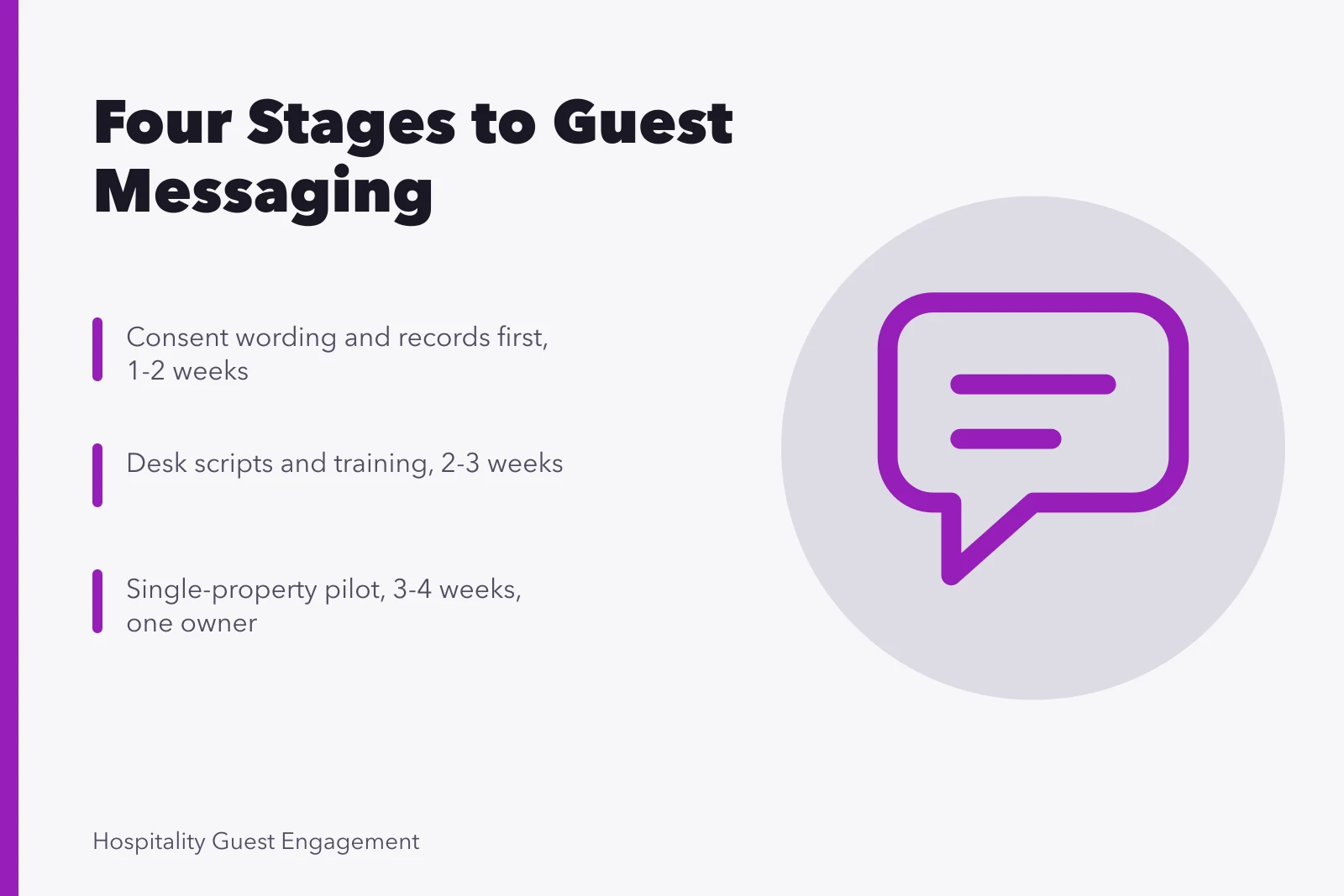
| One | Consent wording and records | 1-2 weeks | Legal sign-off |
| Two | Desk scripts and training | 2-3 weeks | Approved consent wording |
| Three | Single-property pilot | 3-4 weeks | One named program owner |
| Four | Full rollout | 4-6 weeks | Opt-out rate flat or falling |
Where it stalls
Opt-out creep is the named failure mode, and it stays hidden for months. Replies shorten, then stop, then a guest asks to be removed.
The cause is nearly always message mixing: a restaurant discount pushed into a thread the guest joined for arrival details. Complaints that start there land in public reviews, so the escalation path should feed your hospitality reputation management routine.
A second stall looks like staff drift. The desk asks in week one and skips the ask by week three. That happens when nobody owns the program after launch week.
What to do while waiting
- Merge duplicate guest profiles so one person receives one message.
- Draft the ten replies your team sends most often.
- Agree the escalation path for a complaint that arrives by text.
- Choose the single daily metric you will watch during the pilot.
Small properties without a marketing hire can work from the Small Business Administration's marketing and sales guide while the pilot runs.
Example: a 90-room independent near a mid-size airport
The property piloted on arrivals only for four weeks with one tablet and one script. Opt-outs stayed low, so the same flow extended to departures two months later. The lesson was scope rather than software: one segment, one channel, one owner, then widen.
Common questions
Do I need written consent for a room-ready text?
Usually not, as long as the message is purely operational and the guest gave a number for that purpose. Add a promotion and the marketing standard applies instead.
How long should the pilot run before full rollout?
Three to four weeks of data is the minimum. Extend it if opt-outs are still rising at the end.
What happens when a guest replies STOP?
Remove the guest from the promotional track quickly, keep the record, and confirm that nothing further will be sent. Service messages may still be allowed on a separate thread.
Does WhatsApp belong in the mix?
For international arrivals, WhatsApp can carry concierge questions that guests would not send by SMS. Add it only after one channel is stable, and log consent per channel. Consent gathered now also becomes the base for a guest loyalty program later.