Costs
Hospitality Guest Engagement Software: Which Modules Matter in Practice
Hospitality guest engagement software costs run from about $60 to $1,200 a month in the US, plus setup. Here is what each module buys and where budgets leak.
What to take away
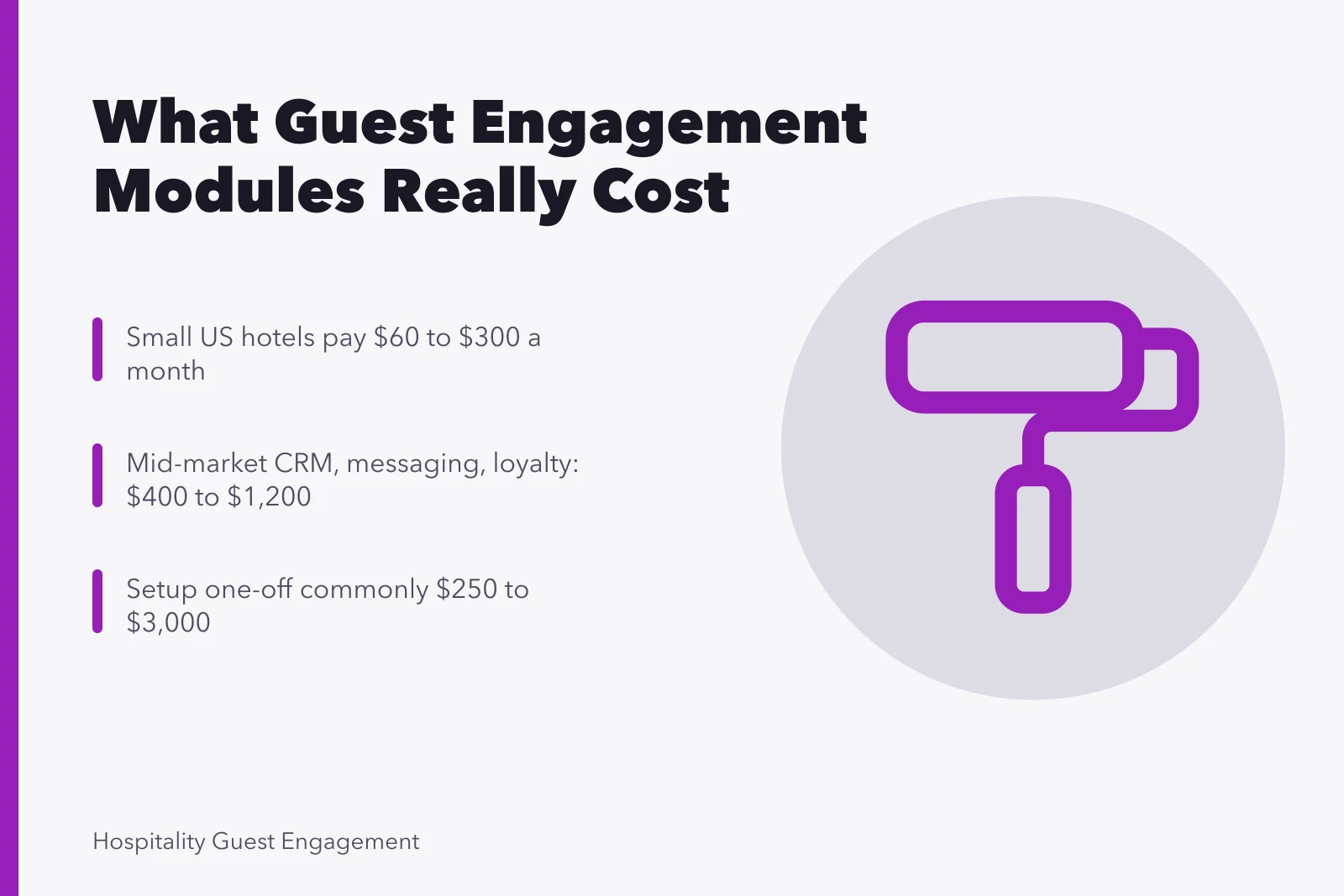
- Small US independent hotels and restaurants typically pay $60 to $300 a month for guest engagement software, before setup or per-message fees.
- Mid-market hotels running a CRM, messaging, and loyalty module together usually land between $400 and $1,200 a month.
- Setup is a one-off cost, commonly $250 to $3,000, and it is the line most often left out of a first-year budget.
- Message volume, review responses, and payment processing are variable costs that scale with guest count, not with seats.
- A guest engagement platform usually replaces one or two standalone tools, so compare the bundle against what you already pay.
What the range covers
Hospitality guest engagement software is sold as modules rather than one product. A hotel might buy a CRM, a messaging inbox, and a survey tool from the same vendor. A restaurant might buy a reservation and waitlist module plus a text club. The price reflects how many modules you switch on and how many guests pass through them.
What you get at the low end is contact storage, basic segmentation, and one messaging channel. At the high end you get unified profiles across properties, automated pre-arrival and post-stay flows, and reporting that ties spend to repeat visits. Most operators do not need the high end on day one.
Line by line
The figures below are illustrative monthly ranges for US independents, drawn from public vendor pricing pages and operator quotes. Your own quote will move with property size and message volume.
| Cost line | Typical monthly range | One-off or recurring |
|---|---|---|
| CRM and guest profiles | $80 to $500 | Recurring |
| Guest messaging inbox | $60 to $400 | Recurring |
| Loyalty and rewards module | $100 to $350 | Recurring |
| Review and reputation module | $75 to $250 | Recurring |
| SMS and email message volume | $20 to $300 | Recurring, variable |
| Setup, data migration, training | $250 to $3,000 | One-off |
Two lines deserve a closer look. Message volume is billed per send or per segment, so a property with 4,000 past guests pays far more than one with 400. Setup is quoted once, but it recurs if you switch vendors or add a second property.
A restaurant running only a text club and a reservation module can stay near the bottom of the table. A 120-room hotel with automated pre-arrival messaging and a loyalty tier structure sits near the top. For a closer look at how reservation tools price out, see Restaurant Reservation Platforms Compared for Independent US Restaurants.
Fixed against variable
Seats and modules are fixed. You pay the same whether a module sends 200 messages or 2,000. That predictability helps when you forecast, and it hides the cost of growth until the next contract cycle.
Fixed vs Variable Costs
Fixed
- What
- Seats, modules
- Predictability
- Same each month
- Risk
- Hides growth cost
- Budget at
- List price
Variable
- What
- Messages, reviews
- Predictability
- Rises with occupancy
- Risk
- Doubles in busy months
- Budget at
- Busiest month
Message volume, review requests, and payment processing are variable. They rise with occupancy and covers. A busy December can double a variable line that looked modest in a slow February.
Budget the fixed lines at list price and the variable lines at your busiest month, not your average one. The gap is where most first-year overruns start.
Ask each vendor which lines are capped and which are not. A capped SMS bundle is easier to plan around than an open per-message rate. The SBA's guidance on marketing and sales is a reasonable starting point for setting that spend against expected return.
What the tools do not include
Software does not write your messages, staff your front desk, or clean a guest list. Those are labor costs, and they often exceed the subscription. A hotel running automated pre-arrival flows still needs someone to answer replies within an hour.
Integration work is another excluded line. Connecting a platform to a property management system or a point-of-sale system can take paid developer time. If the vendor does not list your system as a supported integration, treat that as a cost, not a feature gap.
Compliance is a third. Messaging US guests brings the Telephone Consumer Protection Act into play, and consent records must be kept. Handling guest data brings California Consumer Privacy Act duties for properties with California guests.
Neither is a software line item, but both shape what you can send. The NIST Privacy Framework helps map the data you hold.
Where budgets leak
Leaks rarely come from the headline price. They come from modules switched on and never used, duplicate tools kept alive during a migration, and message volume that nobody watches after month three.
- List every module you pay for and name the person who uses it.
- Check whether any module duplicates a tool you already own.
- Pull the last three months of message volume and compare it to the plan.
- Confirm which integrations are included and which are billed as custom work.
- Set a review date before renewal, not after.
A second leak is data quality. Duplicate guest records inflate message volume and skew reporting, so you pay twice for the same person. Cleaning the list before migration is cheaper than cleaning it after.
For the demand side of the same budget, the notes on hotel email marketing cover what actually earns a reply. If your spend is weighted toward reviews and replies, the reputation management piece explains where the effort pays back.