Guides
Notes on hotel email marketing from the field
hotel email marketing in 2027 connects permission, guest timing, useful content, authenticated delivery, accessible design, completed stays, and accountable records.
What to take away
- Give every email a guest job and a business outcome.
- Separate service communication from marketing purpose and permission.
- Authenticate sending domains and monitor recipient-provider evidence.
- Reconcile clicks with bookings, cancellations, consumed stays, and cost.
Hotel email marketing is the planned use of permitted email to help a suitable person discover, evaluate, book, prepare for, experience, remember, or return to a lodging business. The work includes audience acquisition, purpose classification, consent and preference records, guest timing, content, design, accessibility, authentication, deliverability, testing, support, measurement, security, and coordination with property operations.
Email earns its place when it answers a real guest question or supports a defined decision. A pre-arrival note may reduce uncertainty, a quiet-period offer may create suitable demand, and a post-stay message may close a service loop. These messages have different purposes, recipients, facts, permissions, risks, actions, and measures. Treating them as one monthly blast hides those differences.
Begin with a guest decision
Write the audience, situation, observed friction, desired action, completed outcome, timing, property scope, source data, owner, budget, and stop rule. State why email is appropriate instead of a confirmation page, account message, phone call, app notice, or staff interaction. A send calendar is an execution tool, not a strategy.
Guest Stage to Email Job
- Discovery: explain distinctive stay occasion
- Evaluation: answer room, location, policy question
- Pre-arrival: prepare guest for accurate arrival
- On-property: offer relevant available service
- Post-stay: close feedback or recovery
- Return: present timely reason to revisit
| Guest stage | Useful email job | Completed check |
|---|---|---|
| Discovery | Explain a distinctive stay occasion | Qualified direct sessions or inquiries |
| Evaluation | Answer a real room, location, or policy question | Suitable booking completion |
| Pre-arrival | Prepare the guest for an accurate arrival | Completed task and fewer avoidable contacts |
| On-property | Offer a relevant, available service | Consumed ancillary purchase |
| Post-stay | Close feedback or recovery | Resolved case or permitted return action |
| Return | Present a timely reason to revisit | Incremental consumed stay |
Classify purpose before writing
Decide whether the message is promotional, transactional, relationship-based, operational, or mixed under the applicable rules and facts. A reservation confirmation can become marketing when promotional material changes its primary purpose. Keep the business reason, legal analysis, permission or other basis, terms version, and suppression logic with the campaign record.
Do not use a service message to bypass a marketing choice. Place necessary booking information first, keep it accurate, and remove unrelated sales pressure when the email must serve an existing transaction. When a message contains both service and marketing material, review the subject, opening, prominence, volume, and reasonable recipient interpretation.
Build a permission and preference record
Record how and when an address entered the system, the notice shown, the action taken, the property or brand covered, the communication purpose, and any later change. Separate email from text permission and marketing from service notices. Make refusal, preference changes, and unsubscribe easy to use and quick to honor.
Use a suppression record rather than deleting evidence that someone asked not to receive marketing. Synchronize it across the property, portfolio, central reservation system, loyalty platform, email provider, customer service tool, data warehouse, and agency workflow. Test what happens when a guest changes an address, merges accounts, closes an account, or books after opting out.
Design a small lifecycle
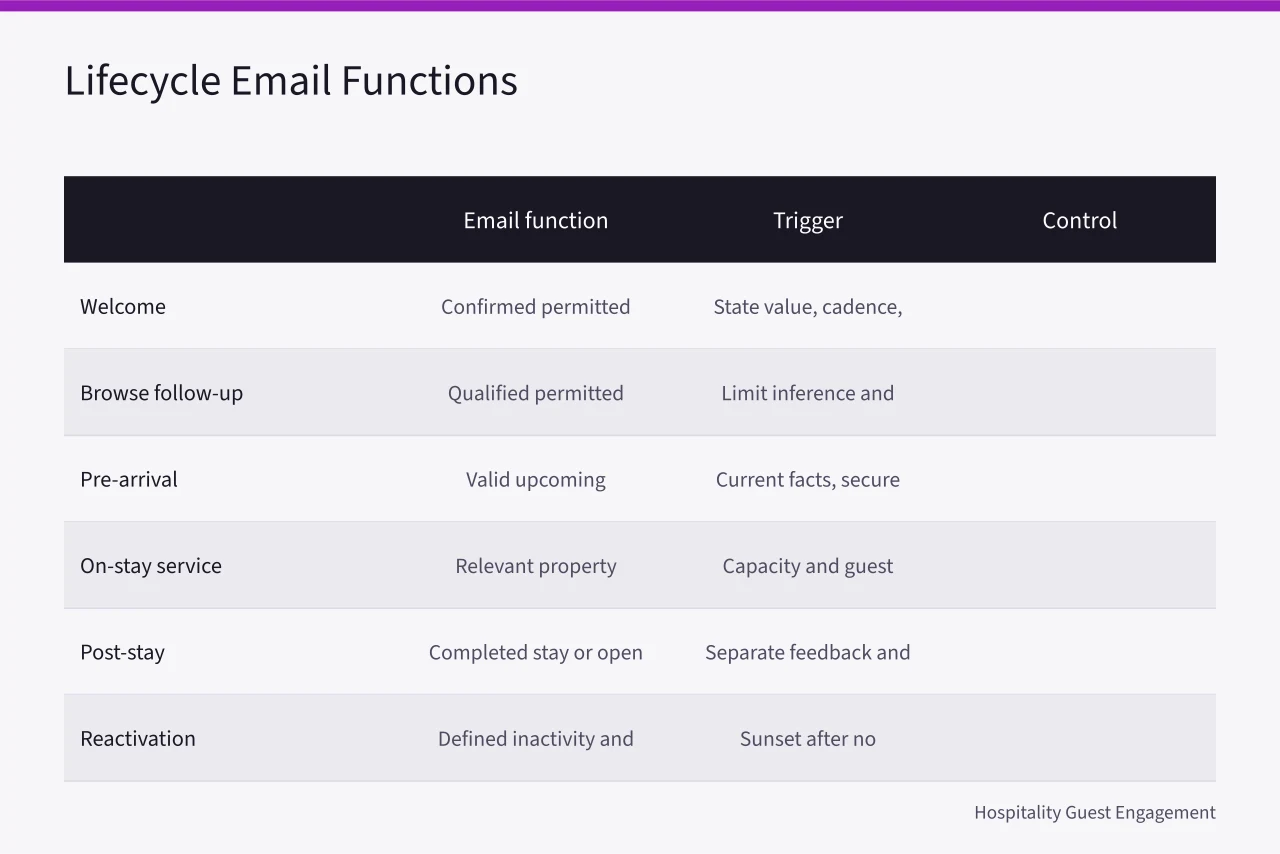
| Email function | Trigger | Control |
|---|---|---|
| Welcome | Confirmed permitted signup | State value, cadence, and preferences |
| Browse follow-up | Qualified permitted behavior | Limit inference and frequency |
| Pre-arrival | Valid upcoming reservation | Current facts and secure action route |
| On-stay service | Relevant property moment | Capacity and guest context |
| Post-stay | Completed stay or open case | Separate feedback and promotion |
| Reactivation | Defined inactivity and continuing permission | Sunset after no response |
Start with two or three messages the property can support, map every data field, decision rule, content version, send window, and exclusion, map fallback, destination, service owner, outcome.
When a reservation changes, the message and scheduled journey must change with it. Automation must not preserve an outdated room, fee, access route, or arrival instruction. Journey logic that survives reservation changes is the same discipline behind guest loyalty marketing.
Write from property truth
Use controlled sources for property name, address, check-in and checkout, room type, occupancy, price, taxes, fees, cancellation, deposit, parking, transportation, accessibility, renovation, amenities, dining, spa, events, weather-sensitive services, and contact routes. Assign an owner and expiration trigger to each material fact.
Lead with the answer or benefit. Use a recognizable sender name, specific subject, useful preview text, descriptive heading, concise paragraphs, visible action, and honest urgency. Keep material conditions close to the claim. A beautiful image cannot compensate for a mismatched rate, unavailable upgrade, or link that lands on different terms.
Make the message usable
Build for a narrow screen and a range of clients. Use live text for important information, meaningful image alternatives, sufficient contrast, readable type, logical order, clear links, generous targets, and a complete plain-text version. Test with images blocked, dark mode, zoom, keyboard navigation, and a screen reader. The booking or preference destination must be accessible too.
Personalization should fail safely. If a name, property, date, balance, image, or recommendation is missing, use an accurate neutral fallback or suppress the message. Preview real edge cases instead of one perfect test record. Never expose one guest's reservation, loyalty, or recovery information to another recipient.
Protect sending identity
Google's current email sender guidelines describe requirements for mail sent to personal Gmail accounts, including authentication, DNS, TLS, message format, spam-rate management, and additional duties for senders near or above 5,000 messages a day. The page also recommends consistent volume and monitoring. Apply each provider's current rules to the traffic it receives.
Inventory every platform and partner authorized to send from the hotel or group domain. Configure SPF, DKIM, and DMARC deliberately; align visible and technical identities; protect administrative access; monitor reports; and retire unused senders. A campaign can be accurate and permitted yet still fail because the domain, infrastructure, or volume pattern is not trusted.
Control frequency and collisions
Set caps on newsletters, offers, loyalty, pre-arrival, and on-stay sends. Cap post-stay, events, restaurants, spas, and corporate sends.
Prioritize necessary service messages, but not every booking message is necessary; suppress promotions during unresolved complaints, cancellations, emergencies, bereavement, or other harmful selling contexts; coordinate restaurants and spas before release; a restaurant marketing calendar often collides with hotel sends.
Use a contact policy that records brand, property, channel, purpose, priority, last contact, next eligible time, local time, stay status, service case, and exception. Review the final recipient count and exclusions before release. Sudden audience changes deserve investigation, not an assumption that the database simply grew.
Measure the whole guest path
| Stage | Evidence | Limitation |
|---|---|---|
| Accepted | Recipient server accepted message | Not proof of inbox placement |
| Opened | Recorded open event | Privacy and client behavior affect it |
| Clicked | Tracked destination request | Can include automation or repeat clicks |
| Booked | Reservation tied under declared rules | May cancel or have occurred anyway |
| Consumed | Stay or ancillary service completed | Needs operational reconciliation |
| Economic | Incremental net contribution | Requires comparison and full cost |
Preserve counts beside rates. Define delivered, unique open, unique click, click-to-open, bounce. Define complaint, unsubscribe, booking, cancellation, consumed stay. Define revenue, contribution, incremental lift. Segment by purpose, audience, property, market, device. Segment by client, domain, offer, stay window, prior behavior.
Guest Path Evidence Limits
Stage
- Accepted
- Recipient server accepted message
- Opened
- Recorded open event
- Clicked
- Tracked destination request
- Booked
- Reservation tied under declared rules
- Consumed
- Stay or ancillary service completed
- Economic
- Incremental net contribution
Evidence
- Accepted
- Not proof of inbox placement
- Opened
- Privacy and client behavior affect it
- Clicked
- Can include automation or repeat clicks
- Booked
- May cancel or have occurred anyway
- Consumed
- Needs operational reconciliation
- Economic
- Requires comparison and full cost
Limitation
- Accepted
- Opened
- Clicked
- Booked
- Consumed
- Economic
Annotate tracking, consent, price, inventory, creative. Annotate operational changes.
Email counts matter only when tied to the hospitality marketing strategy, which set the audience, offer, and channel mix.
Open tracking can be distorted by image loading and privacy features, so it should not determine guest intent by itself. Clicks can also be generated by security systems. Use server responses and provider tools for delivery diagnostics, site and reservation evidence for actions, and property and finance records for completed value.
Test one decision at a time
Choose a meaningful variable such as audience rule, send timing, value proposition, explanation order, destination, or benefit. Define the hypothesis, primary measure, guardrail, sample, assignment, observation window, stopping rule, and analysis before launch. Subject-line tests that optimize an open proxy may produce no additional booking or guest value.
Protect the comparison from overlapping sends, changing rates, inventory closures, holidays, tracking changes, and staff actions. Report absolute counts and uncertainty. If a variant wins the click but creates more cancellations, complaints, or support work, the business decision should reflect the full outcome.
Run a dependable production workflow
- Brief the guest decision, message purpose, recipient rule, permission, facts, action, and completed outcome
- Build from approved modules and current property data
- Review claims, terms, accessibility, personalization fallbacks, and secure destinations
- Authenticate the sender and verify current provider requirements
- Test representative records, clients, devices, images-off, plain text, links, and suppression
- Approve the exact audience and scheduled time
- Monitor delivery, replies, bookings, cancellations, service, complaints, and corrections
- Archive the final content, audience logic, approvals, evidence, and result
Plan the first 90 days
- Days 1 to 30audit sources, permissions, suppression, senders, authentication, lifecycle messages, templates, destinations, and completed-outcome data
- Days 31 to 60repair critical defects and pilot one defined guest journey with a small eligible audience
- Days 61 to 90reconcile delivery, action, consumed stays, costs, complaints, and service effects, then expand, revise, or stop
Keep marketing, reservations, operations, revenue, customer care, technology, data, privacy, security, accessibility, and finance involved at the points where their evidence matters. An agency or platform may execute the send, but the hotel remains accountable for its promise, guest treatment, domain identity, data, and records.
First 90 Days Plan
- Days 1-30Audit sources, permissions, suppression, senders
- Days 31-60Repair critical defects and pilot one journey
- Days 61-90Reconcile results, then expand, revise, or stop
The practical standard: a wanted message from a trusted sender answers a timely guest need and states accurate terms. It works on the recipient's device, leads to a secure and consistent destination, and ends in the represented stay or service.
The team can explain what happened without treating a tracked open as proof of demand.
Verify hotel email marketing before release
For hotel email marketing, the GAO evaluation design guide explains how evaluation questions, evidence needs, and design choices fit together. The guide is written for federal program evaluation. Use its design discipline as a check on the method, not as proof that a marketing result is causal or transferable.
The W3C Privacy Principles statement gives system designers a shared vocabulary for privacy and warns against shifting privacy work onto individuals. Apply that principle to the data flow behind hotel email marketing. It does not replace the law, contract terms, consent analysis, or a review of the actual configuration.
The GOV.UK technology selection guidance recommends choices that can change over time, preserve data control, address security risk, and include ownership cost. Those public-service rules become useful buying questions for hotel email marketing, but they are not private-sector mandates or product endorsements.
Apply these checks to the actual hotel email marketing workflow. Record the tested data, roles, product versions, exceptions, and approval date. Repeat the review after a material source, model, access, contract, or decision change. The added sources define separate evaluation, privacy, and operating questions; none certifies the local implementation or supplies a guaranteed marketing result.
Common questions
What is hotel email marketing?
It is the governed use of permitted email to support suitable lodging decisions and experiences from discovery through return.
How often should a hotel email guests?
Use the minimum frequency that serves a clear guest job, respects permission and context, and can be coordinated across all sending systems.
Which metric matters most?
Commercial decisions should reach completed stays or services, incremental net contribution, guest delivery, and risk rather than stopping at opens.
Should service and marketing email use the same workflow?
They may share infrastructure, but their purpose, permission, priority, content, suppression, and measurement should be explicitly classified.