Rules
ADA compliance in guest engagement materials, a US guide
Hospitality guest engagement materials must meet ADA Title III rules, from WCAG websites to accessible menus, service animal policies and event planning.
What to take away
- ADA Title III covers nearly every hotel and restaurant in the United States, and it reaches hospitality guest engagement materials: websites, apps, menus, signage, kiosks and event handouts.
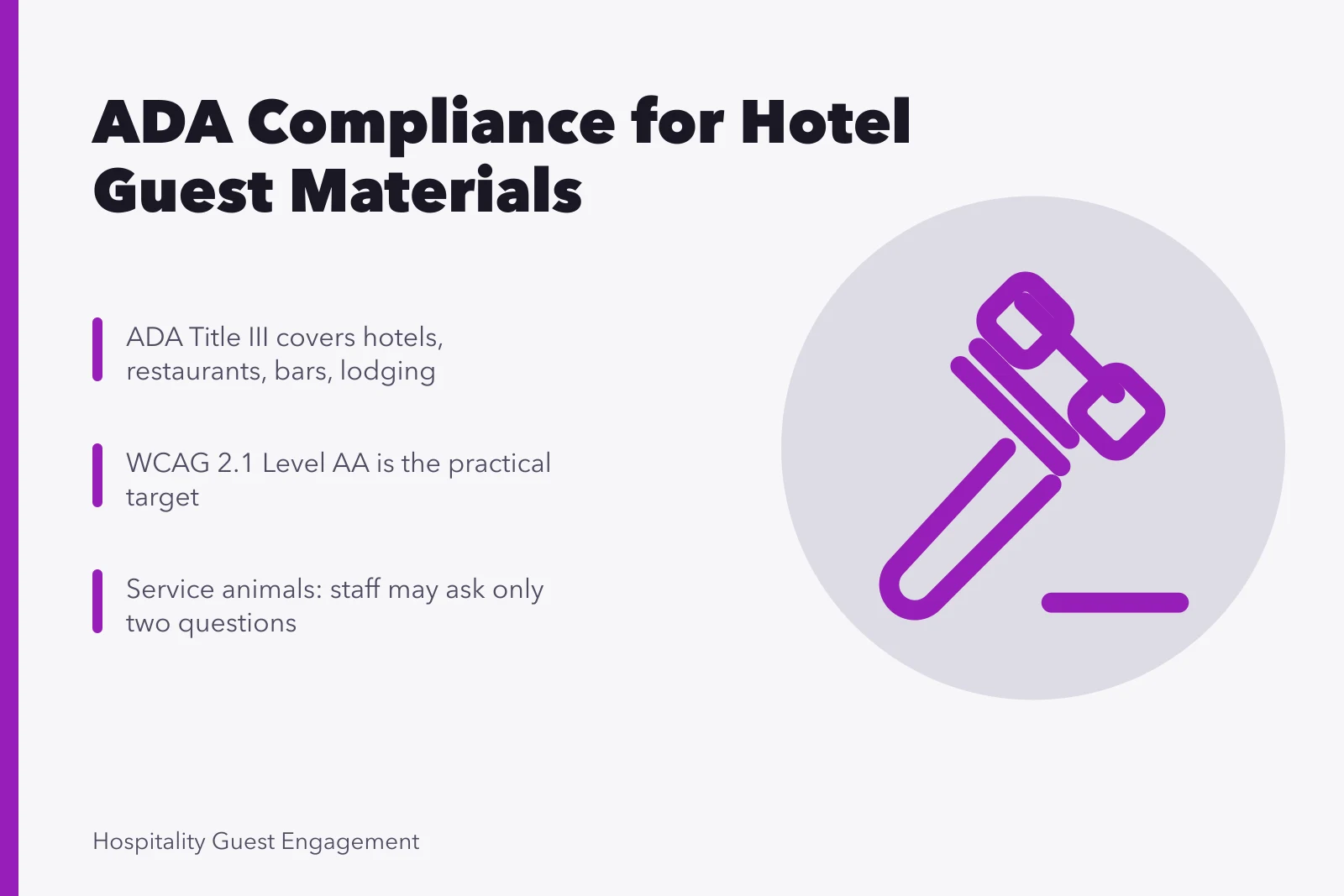
- Websites and apps are judged against WCAG website accessibility expectations, with WCAG 2.1 Level AA the benchmark courts and the Department of Justice treat as the practical target.
- Effective communication means auxiliary aids and services, not just ramps: large print menus, braille, screen reader friendly PDFs and captioned video all count.
- Service animal rules let handlers bring trained dogs into guest areas. Mobility devices such as wheelchairs and scooters must be allowed everywhere guests go.
- The 2010 ADA Standards for Accessible Design govern the physical side: routes, seating, counters, restrooms and assembly areas used for meetings.
- Complaints and DOJ enforcement cases usually start with small, fixable failures: an unreadable menu, a booking site that cannot be completed by keyboard, a refused service animal.
ADA Title III duties that reach guest engagement materials
ADA Title III regulations cover hotels, restaurants, bars and other places of lodging and eating as public accommodations. The duty is not limited to the building. It follows anything a guest has to read, hear, click or complete to use your service.
The regulation splits obligations into two broad buckets. New construction and alterations must meet design standards. Existing facilities must remove architectural barriers where removal is readily achievable. Guest engagement materials sit in a third, less obvious zone: communication.
That zone is where marketing teams get exposed. A restaurant that prints a menu nobody can read, or a hotel whose booking flow stalls for a screen reader user, has a communication problem even if the lobby is flawless. The Department of Justice treats those failures as Title III violations.
Who is covered matters for small operators. Title III applies to places of public accommodation regardless of size. There is no small business exemption, though what counts as readily achievable depends on resources and cost.
Franchise and management structures complicate responsibility. A brand may control the central reservation system while a franchisee controls the property. Both can be named in a complaint. Contracts should say who fixes what, and who pays.
Third-party vendors are the quiet risk. Reservation engines, kiosk suppliers, menu QR platforms and event registration tools all shape the guest experience. Your compliance posture is only as good as the least accessible tool in the stack. That is a procurement question as much as a legal one.
Your hospitality guest engagement software should therefore be reviewed for accessibility before renewal, not after a complaint arrives. Ask vendors for a current accessibility conformance report and a remediation timeline.
Website and app accessibility: WCAG expectations for hotels and restaurants
WCAG website accessibility expectations come from the Web Content Accessibility Guidelines, published by the W3C. The ADA itself does not name WCAG. Courts and the Department of Justice have repeatedly used WCAG 2.1 Level AA as the measuring stick in settlements and consent decrees.
Level AA is the practical target. Level A alone leaves common failures in place, and Level AAA is not realistic for most booking flows. Aim for AA, document your testing, and keep a dated record.
The four principles are worth memorizing because they map to real defects. Content must be perceivable, operable, understandable and well built. Most hospitality failures fall into the first two.
Perceivable problems include images without alternative text, videos without captions, and text that fails contrast against a photo background. Operable problems include booking widgets that only respond to a mouse and carousels that cannot be paused.
Understandable problems are usually form design: unclear error messages, time limits that expire mid-booking, and required fields marked only by color. Failures in the fourth principle mean the code breaks with assistive technology.
A hotel booking engine is the highest-risk page on most sites. Test the full path: search dates, choose a room, select a rate, enter payment, receive confirmation. Each step must work by keyboard alone, with a visible focus indicator.
Restaurants face a different pattern. Menus published as image files are invisible to screen readers. So are PDFs exported from design software without tagged structure. Plain HTML menus solve both problems and load faster on phones.
Mobile matters more in hospitality than in most sectors. Guests browse on phones in transit. Touch targets, pinch zoom and orientation lock all affect whether a guest can complete a reservation.
Accessibility overlaps with the basics of software selection, because the same platforms handle booking, messaging and post-stay surveys. A vendor that cannot document conformance is a liability across all three.
Keep an audit trail. Automated scanners catch roughly a third of issues. Manual testing with a keyboard and a screen reader catches the rest. Record who tested, when, and what changed.
Effective communication: menus, signage and digital ordering tools
The effective communication rule means guests with disabilities get information in a form they can use. It applies to guests, not just patients or clients.
Auxiliary aids and services are the mechanism. For a restaurant, that can mean a large print menu, a braille menu, a staff member reading the menu aloud, or a digital menu that works with a screen reader.
You choose the aid, within reason. The rule does not require every format at every table. It requires an effective one, provided without surcharge and without advance notice where possible.
QR code menus created a wave of complaints after 2020. A QR code is fine as an option. It is not fine as the only path for a guest without a smartphone, or when the linked PDF is untagged and unreadable.
Signage follows the same logic. Directional signs, restroom signs, elevator signage and evacuation maps must be legible and, where the standards require, include raised characters and braille. Font size and contrast are not decorative choices.
Digital ordering kiosks and table tablets need accessible modes. Common failures include touch-only interfaces with no audio option, no headphone jack, and no way to call a staff member for help.
Point-of-sale and payment terminals are part of the same chain. A guest who can order but cannot pay independently has not been served. Ask terminal vendors about tactile keypads and audio guidance.
Staff training decides whether any of this works. A host who does not know the braille menu exists will not offer it. Put the aids in the pre-shift briefing and in the reservation notes field.
Online ordering and delivery pages deserve a pass too. Allergen information buried in an image, delivery radius maps with no text alternative, and tip screens that trap keyboard users are all fixable.
If you run guest messaging, keep accessibility in the channel plan. See how to set up hotel guest messaging so that SMS and chat options do not become the only way to reach the front desk. Guests who cannot use a phone app still need a route to a human.
Service animals and mobility devices in guest-facing communications
Service animal requirements are frequently misunderstood, and the misunderstanding usually shows up in written policy. The ADA defines a service animal as a dog that is trained to perform tasks or do work for someone with a disability. Emotional support animals are not service animals under Title III.
Staff may ask two questions and only two: is the dog required because of a disability, and what work or task has the dog been trained to perform? They may not ask for documentation, ask about the disability, or require a demonstration.
No breed or weight restriction applies, and no pet fee or deposit may be charged. The dog must be under the handler's control, typically leashed, and housebroken. A dog that is out of control can be excluded.
Restaurants must admit service animals in guest areas, including dining rooms, even where state or local health rules restrict animals. Those health codes generally exempt service animals, and the ADA controls the outcome.
Hotels must place a service animal with its handler rather than in a pet-designated room, and cannot isolate the guest in an inferior room. That is a common complaint pattern and an easy one to avoid.
Mobility devices get similar treatment. Wheelchairs, scooters, canes, crutches and walkers must be permitted in all areas open to guests. A hotel cannot require a guest to leave a scooter at the door or transfer to a house chair.
Pool lifts, beach wheelchairs and accessible transportation are separate obligations, but the communications around them matter. If your website says a pool lift exists, it must work, and staff must know how to operate it.
Written policies should be short and accurate. A one-page service animal policy posted at the front desk prevents arguments. A policy that mentions certification or a fee invites complaints.
Marketing copy is part of the record. A listing that says pets welcome, no animals in the dining room can be read as excluding service animals. Add a line clarifying that service animals are always welcome.
Event planning and accessible materials for meetings and functions
Accessible event planning starts before the contract. Ask about step-free routes from the drop-off point to the meeting room, accessible restrooms on the same floor, and the number of accessible guest rooms held for the block.
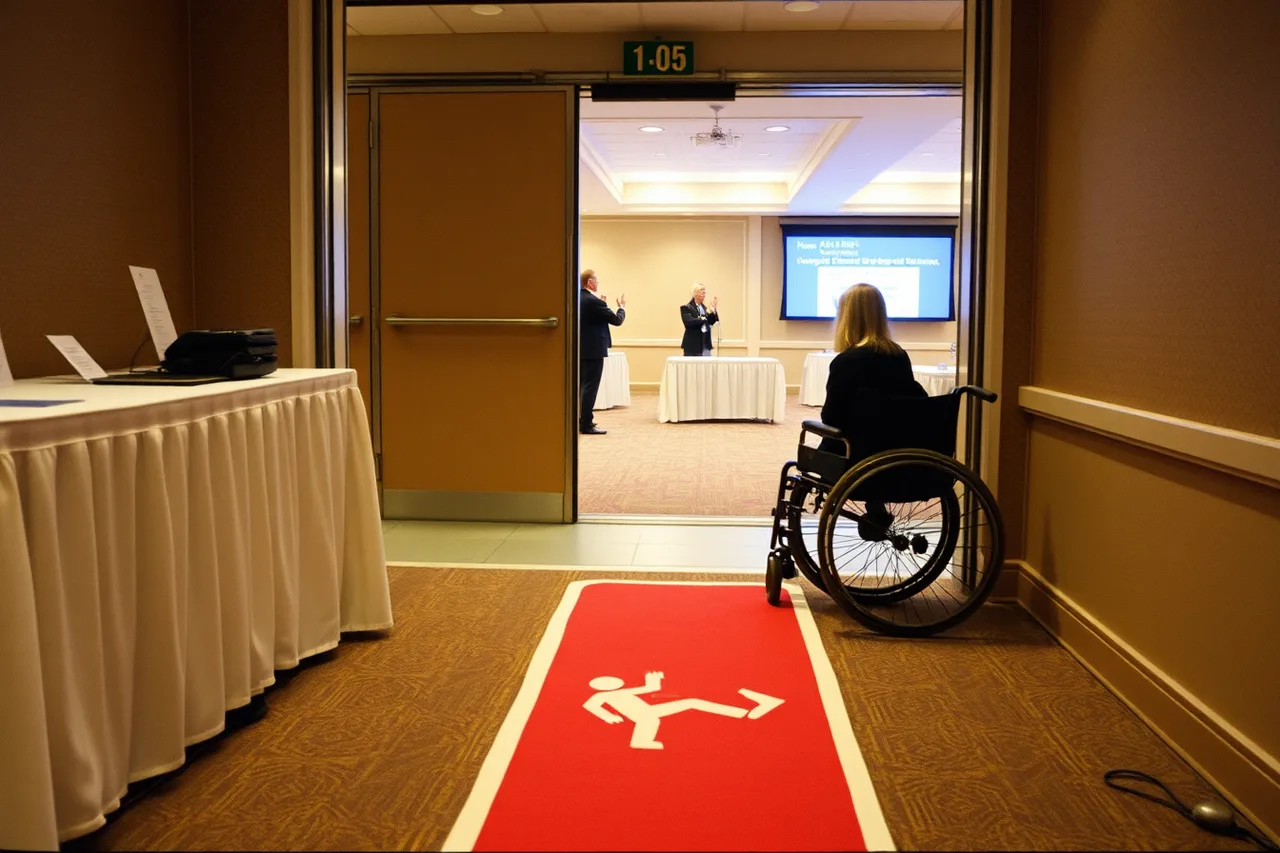
Registration is the first barrier. Forms must work with screen readers, allow a request for accommodations, and give a real deadline. A comment box labeled other is not an accommodations process.
Promotional materials need the same treatment as any other guest engagement asset. Save-the-dates, programs, menus and name badges should use readable fonts, strong contrast and text alternatives where distributed digitally.
Speaker content is where events fail most often. Slides shown on screen need to be described, captioned or distributed in advance. Live captioning and sign language interpreters are auxiliary aids, and they need lead time to book.
Seating layout matters for sightlines. Reserve front-row space for guests who are deaf or hard of hearing, and leave clear routes between tables. Buffet lines need a step-free path and staff available to assist.
Food and beverage functions raise the same menu questions as restaurants, at larger scale. Provide allergen and ingredient information in accessible formats, and label buffet items with large, high-contrast cards.
Post-event surveys and follow-up emails are guest engagement materials too. If the survey tool is not accessible, you lose the feedback from the guests most likely to have had a problem.
Build an accessibility line into the event budget rather than treating it as an add-on. Captioning, interpreters, accessible transport and large print runs are predictable costs, not emergencies.
Document what you provided. If a complaint arises, a written record of accommodations offered and delivered is the strongest defense available.
DOJ guidance, complaints and enforcement cases to learn from
The Department of Justice publishes guidance and maintains a public list of ADA enforcement cases. Reading a handful of hospitality cases is more instructive than reading the statute twice.
Patterns repeat. Booking websites that cannot be used without a mouse. Restaurants with no accessible seating. Hotels that refuse service animals or charge pet fees. Event venues with inaccessible restrooms or no accessible route to the stage.
Settlements typically require more than a one-time fix. They require a written policy, staff training, an accessibility coordinator, a complaint procedure, and periodic reporting to the department for a set period.
That structure is the real lesson. Compliance is a process with named owners, not a project with an end date. The operators who avoid complaints are the ones who log issues and close them.
Private lawsuits are the larger volume risk. Title III plaintiffs can seek injunctive relief and attorney fees, and serial plaintiffs target common defects across many properties. Quick fixes remove the incentive.
State law can go further than federal law. California, New York, Illinois and Colorado have their own accessibility and human rights statutes with different remedies. A federal fix may not close a state claim.
Industry bodies help with the practical side. The American Hotel & Lodging Association and the National Restaurant Association publish guidance and training material that translates the rules into operational steps.
Complaints also arrive through channels that are not legal at all. A guest who cannot read your menu posts about it. That is where hospitality reputation management and accessibility work intersect, because the review is public and the fix is usually cheap.
Auditing your guest engagement assets against the 2010 Standards
The 2010 ADA Standards for Accessible Design set the technical requirements for buildings and sites. They cover parking, routes, entrances, counters, dining surfaces, guest rooms and assembly areas.
Use them to audit the physical side of guest engagement: the path a guest takes from arrival to service. Measure rather than estimate. Aisle widths, counter heights and clear floor space are specified numbers.
Pair that with a digital audit. The two halves of the review should run on the same schedule so fixes are coordinated and budgeted once.
Work through the assets in order of guest contact. Each item below is a check you can assign to a named person with a due date.
Guest engagement asset audit
- Booking engine tested by keyboard and screen reader
- Menus as tagged HTML, large print, braille
- PDFs checked for tags and reading order
- Video captioned with on-page transcripts
- Service animal policy written and briefed
- Routes, seating, counters measured to 2010 Standards
- Event registration includes accommodations request field
Track findings in one register with owner, date found, date fixed and evidence. A spreadsheet is enough. The point is that nothing sits unresolved for months.
Retest after every platform change. A booking engine upgrade or a new kiosk can undo earlier work, and the regression will not announce itself.
| Asset | Main risk | Standard or rule to check |
|---|---|---|
| Hotel website and booking engine | Keyboard traps, unlabeled fields, no alt text | WCAG 2.1 Level AA |
| Restaurant menu | Image-only PDF, low contrast, no large print | Effective communication rule |
| Signage and wayfinding | Missing braille, poor contrast, small type | 2010 ADA Standards |
| Service animal policy | Fees, documentation demands, breed limits | ADA service animal rule |
| Event registration and programs | Inaccessible forms, uncaptioned slides | WCAG 2.1 Level AA and effective communication |
| Kiosks and payment terminals | Touch-only interface, no audio mode | Effective communication rule |
Set a review cadence. Quarterly for digital assets, annually for physical ones, and immediately after any complaint or near miss.
Finally, connect accessibility to the wider marketing calendar. The common hospitality marketing strategy questions that come up at a campaign launch should include an accessibility sign-off, the same way brand and legal review do. Add social channels to that review, since guest loyalty marketing now includes captions on every video and alt text on every image.