Rules
3 ways state alcohol rules shape New Orleans restaurant marketing
Hospitality guest engagement in New Orleans runs through Louisiana alcohol law, which shapes happy hour promos, festival permits and Mardi Gras marketing.
What to take away
- Hospitality guest engagement in New Orleans is shaped less by ad budgets than by Louisiana alcohol beverage control rules on price, hours and permits.
- Happy hour is legal here, but the Louisiana Office of Alcohol and Tobacco Control bans advertising free drinks and sets other limits that constrain promotion copy.
- Festival permits, not liquor licenses alone, decide whether a Mardi Gras season event can pour drinks and sell tickets.
- Good promotions sell food, reservations and experiences, then let the drink license ride along.
- Every event still has to pass health inspection and food safety rules, which the FDA Food Code and CDC guidance spell out.
How Louisiana alcohol beverage control shapes New Orleans promotions
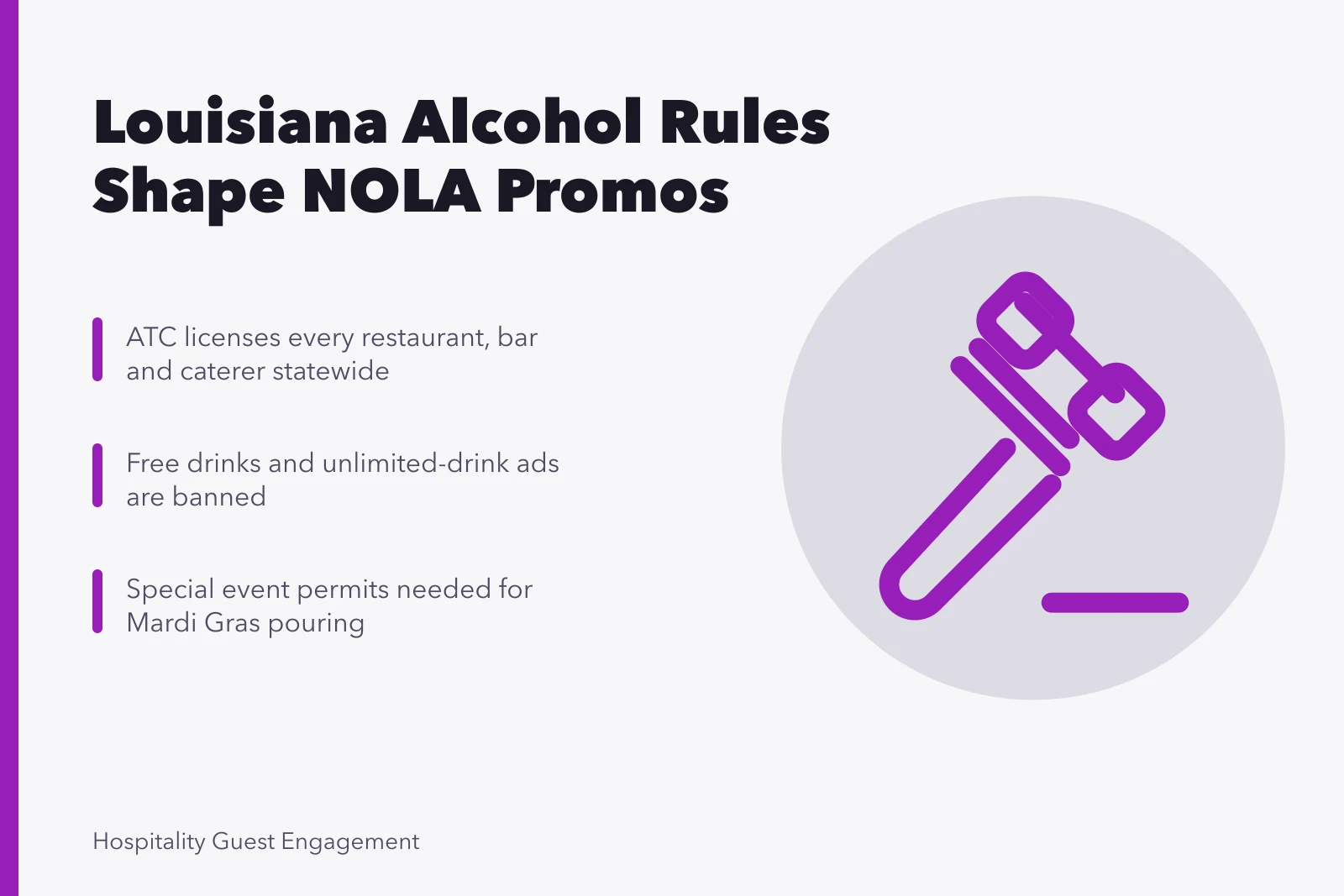
The Louisiana alcohol beverage control board, formally the Office of Alcohol and Tobacco Control, licenses every restaurant, bar and caterer in the state. New Orleans sits inside that system like any parish, with no separate city liquor code of its own.
The ATC writes the retail permit classes, the hours of sale and the advertising limits that restaurant promotions must fit inside.
That is the first way the rules shape marketing: they decide what a promotion can say. Class A, B and C retail permits cover different mixes of alcohol and food service, and each carries its own conditions.
A restaurant that wants to sell packaged beer to go, for example, needs a permit class that allows it, and the marketing for that offer has to match the permit.
Advertising restrictions matter just as much. Louisiana law prohibits advertising free drinks or unlimited drinks for a fixed price, and it bars promotions that encourage excessive consumption. So the classic "all you can drink" brunch flyer is not a legal option in New Orleans, no matter how well it might perform.
A second effect lands on pricing. The ATC bans selling alcohol below cost and prohibits certain price-cutting practices. That rules out the deep discount mechanics some national chains use to drive traffic, such as penny drinks or two-for-one deals built around liquor.
A third effect is timing. Louisiana law restricts alcohol sales during certain hours and on specific days, and those limits vary by permit and by local option. A late-night promotion that runs past the legal cutoff creates a compliance problem, not a marketing win.
For operators, the practical move is to treat the permit as the brief. Before a campaign is written, confirm which permit class covers the venue, what hours it allows and what the advertising rules permit. That keeps the creative team from building a promotion the ATC would shut down.
This is where a disciplined approach to restaurant marketing pays off. The restaurants that handle Louisiana's rules well tend to plan promotions around food, service and atmosphere first, then add alcohol as an element rather than the headline.
Happy hour rules and what they mean for restaurant marketing
Happy hour regulation in Louisiana is narrower than many operators assume. The ATC does not ban happy hour itself. It bans the advertising and the pricing practices that surround it, which changes how a New Orleans restaurant can promote a discounted drink window.
Here are the specifics that matter for promotion copy.
Happy Hour Ad Compliance
- No free drink ads
- No unlimited drinks for set price
- No selling alcohol below cost
- No two-for-one liquor deals
- No language encouraging heavy drinking
The marketing workaround is straightforward. Promote the food, the time window and the experience, and let the drink menu speak for itself inside the venue. A raw bar special, a chef's happy hour plate or a fixed-price small plates menu can carry the promotion without naming a drink discount in the ad.
Digital channels need the same care. A social post is advertising under Louisiana rules, so the same limits apply to Instagram, email and the restaurant's own website. The safe pattern is to describe the occasion, not the alcohol deal.
There is a real upside to the constraint. Promotions built on food and hospitality tend to draw a broader crowd than drink-only specials, and they hold up better with guests who are not drinking. That is a stronger base for repeat visits than a price war on cocktails.
Operators who want to see how this plays out across venues can study hospitality guest engagement software from markets with similar rules. The pattern shows up repeatedly: the offer is the food, the drink is the accompaniment.
Federal rulemaking also touches this ground. Alcohol and hospitality businesses can track proposed and final rules through the Federal Register business and industry topic, which publishes notices that sometimes reach state-licensed premises.
Festival permits and event marketing during Mardi Gras season
Mardi Gras season is the biggest event marketing window in New Orleans, and it runs on permits rather than on ad spend. A restaurant that wants to sell alcohol at a parade-adjacent event, a courtyard party or a pop-up needs the right state permit for that specific activity.
Festival Alcohol Permit Steps
- Identify event, dates, premises
- Apply for state special event permit
- Secure city temporary food approval
- Confirm who holds each permit in writing
- Pass event kitchen inspection
Louisiana issues special event permits for alcohol sales at temporary locations. The permit names the event, the dates and the premises, and it is separate from the restaurant's regular retail license. Selling under the wrong permit, or outside the named dates, is a violation even if the restaurant holds a valid annual license.
City rules layer on top. New Orleans requires its own approvals for temporary food and beverage operations, and event organizers often need a parade or special event permit from the city. A restaurant partnering with a krewe or a promoter should confirm in writing who holds which permit before any marketing goes out.
Food safety is the other half of festival service. Temporary food stands and event kitchens are inspected, and the standards track the FDA Food Code, which sets the temperature, handling and sanitation provisions that state and local programs adopt.
The CDC's guidance on improving restaurant food safety practices covers the staffing and process habits that keep an event kitchen out of trouble.
A worked example shows how the pieces fit. A Garden District restaurant wants to run a courtyard party on a parade Saturday, sell tickets and pour drinks.
- Confirm the restaurant's retail permit class covers off-premises or event sales, or apply for a special event permit.
- File for the city special event approval and any parade-related permit the location requires.
- Verify the temporary food service setup meets FDA Food Code and local inspection standards.
- Check the event hours against Louisiana alcohol sales hour limits.
- Write the promotion so it sells the party, the food and the location, not a drink deal.
When the permits are in hand, the marketing can be confident. Mardi Gras marketing works best when it sells access, timing and atmosphere: a reserved courtyard, a viewing spot, a set menu. Those offers do not depend on alcohol pricing, so they stay inside the rules.
Promoters should also keep the calendar in view. Permit applications take time, and the season compresses. Restaurants that start the paperwork late lose the best dates.
Guest engagement tactics that stay inside the rules
Guest engagement in a regulated market is about giving people reasons to return that do not depend on discount liquor. That is a stronger position than it sounds, because it builds a guest list rather than a price-sensitive crowd.
Start with a loyalty program built on food and experience. Reward visits, not drink volume. A points program that tracks dinners, brunch visits or event attendance gives the restaurant useful data and gives guests a reason to come back.
Use reservations and events as engagement tools. Chef's table nights, tasting menus and cooking classes create occasions that fill seats without a drink promotion. They also generate content that is easy to market.
Train staff on the rules, then let them sell. Servers who understand the happy hour limits can describe the drink menu accurately without making promises the restaurant cannot advertise. That protects the permit and improves the guest experience.
Track what actually works. A simple record of which promotions drew repeat guests, and which drew one-time bargain hunters, tells an operator where to spend next season. Getting a hospitality marketing strategy right often comes down to measuring that difference.
Build the compliance steps into the marketing calendar. Answering common hospitality marketing strategy questions about permit verification, ad copy review and event approval keeps campaigns from stalling.
For operators planning the next season, the broader question is how to grow without leaning on alcohol discounts. That is the subject of guest loyalty marketing in a market where the rules reward food-led promotion.
Federal regulatory context is worth monitoring too. The Federal Register topics index groups notices by subject, which makes it easier to follow alcohol-related rulemaking that could reach Louisiana operators.