Rules
What ADA compliance means for Chicago hotel guest communications
Hospitality guest engagement in Chicago now hinges on ADA-compliant menus, apps, and event materials, with local enforcement and clear complaint routes.
What to take away
- Hospitality guest engagement in Chicago must deliver effective communication to guests with disabilities, not just physical access.
- Digital menus, booking apps, and event handouts fall under ADA Title III rules for public accommodations.
- Illinois accessibility provisions and Chicago Business Affairs and Consumer Protection licensing add local layers.
- ADA enforcement cases show that inaccessible guest communications trigger complaints and settlements.
- A short checklist can keep front desk, marketing, and events teams aligned.
ADA duties that apply to Chicago hotel guest communications
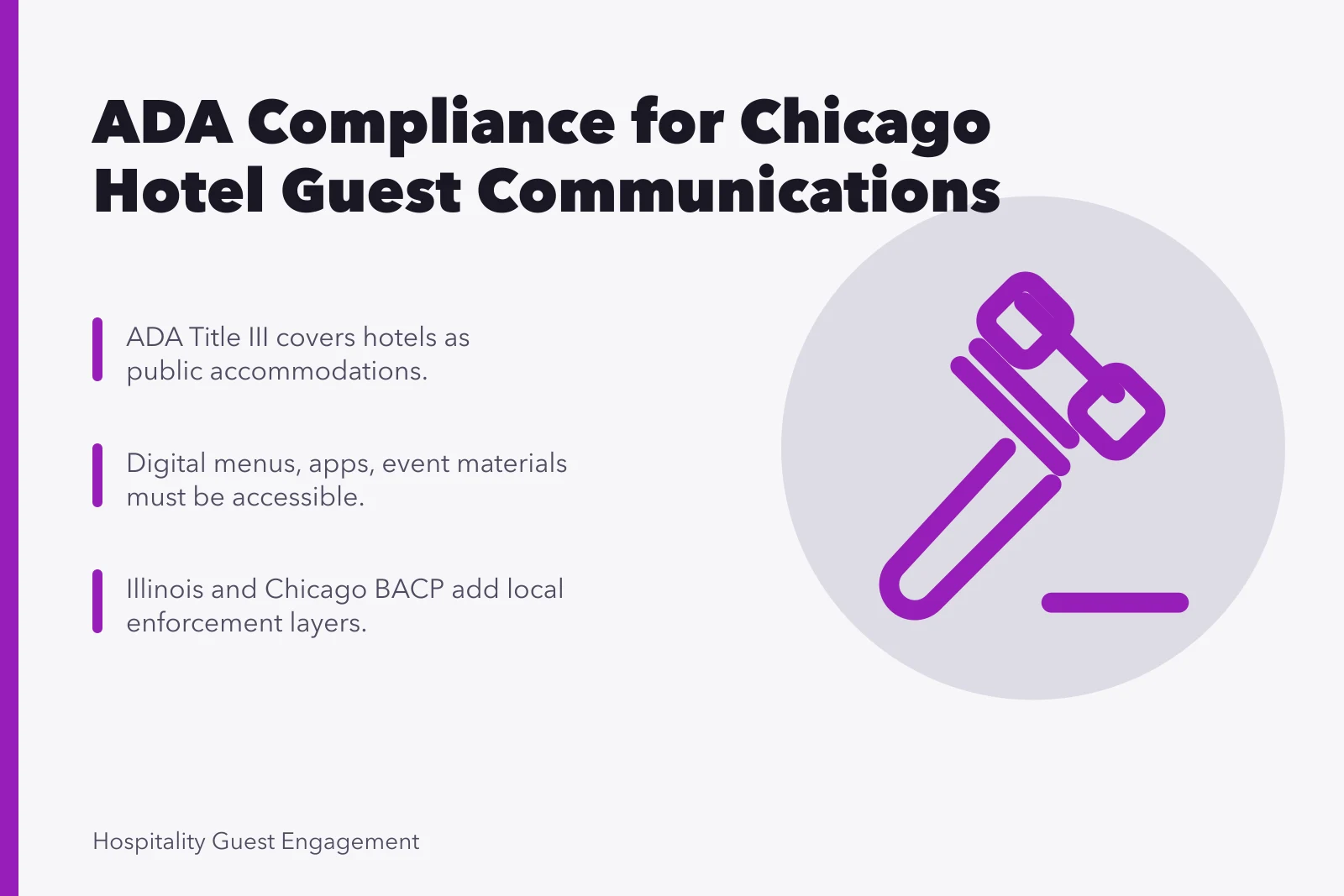
ADA Title III regulations cover hotels as places of public accommodation. They require auxiliary aids and services when needed for effective communication with guests who have hearing, vision, or speech disabilities. That duty reaches the front desk, reservations, room service, and event sales.
A Chicago hotel cannot treat communication access as optional. ADA Title III regulations set the baseline for what hotels must provide.
Effective communication requirements mean hotels must offer appropriate aids and services unless doing so would cause an undue burden or a fundamental alteration. Examples include qualified interpreters for a wedding contract meeting, written materials in large print, or captions on a training video shown to event staff.
The rule is about results: the guest must be able to understand and be understood. Effective communication requirements explain the standard in plain terms.
Chicago hotels with older buildings often focus on ramps and door widths. Communication access gets less attention. That gap shows up in complaints about a deaf guest who cannot get a straight answer at check-in or a blind guest who receives a printed menu with no alternative. Marketing teams should not assume the front desk handles every request correctly.
Third-party vendors matter. If a Chicago hotel uses an outside call center, a reservation platform, or a chat tool, the hotel still owns the guest experience. Contracts should state who provides interpreters, captions, or accessible documents and how quickly. A vendor that cannot deliver accessible communication becomes the hotel's problem.
Training is the cheapest fix. Front desk and reservations staff should know how to reach a qualified interpreter, where large print materials are stored, and how to use a text-based relay service. A short script for common requests prevents improvisation. This is basic operational hygiene for any hotel guest messaging setup across channels.
Digital menus, apps and event materials under Title III
Digital menu accessibility is now a core part of guest communications accessibility. A PDF menu that cannot be read by screen readers, or a QR code that leads to an image-only page, excludes blind guests.
Under Title III, a hotel restaurant or bar in Chicago should provide an accessible digital menu or a staff-read alternative. The fix is usually simple: real text, clear headings, and alt text on images.
Apps and web booking tools face the same logic. If a guest cannot complete a reservation or request an accessible room because a form lacks labels or a calendar is mouse-only, the hotel risks a complaint. Accessibility overlays do not cure a broken form. Build or buy tools that work with screen readers and keyboard navigation.
Event materials need the same treatment. Conference handouts, slide decks, and signage for a Chicago hotel ballroom should be available in accessible formats on request. That includes large print, braille, or an electronic version that a screen reader can read. For deaf attendees, captions and interpreters belong in the event plan, not added after a request.
A worked example helps. Suppose a Chicago hotel hosts a 200-person sales conference. The event team posts a PDF agenda with tiny type and no tags. A blind attendee asks for an accessible version. The hotel can email a tagged Word document and a plain-text agenda within an hour.
That response meets the effective communication standard and avoids a complaint. The same team should caption the keynote and provide a sign language interpreter if requested in advance.
Marketing staff often pick the tools. When evaluating hospitality guest engagement software, ask vendors how their menus, forms, and messaging handle screen readers and captions. A short vendor questionnaire saves months of rework. Teams that map modules before buying avoid inaccessible defaults.
Illinois and Chicago rules layered on federal requirements
Illinois accessibility provisions add state-level expectations for public accommodations. The Illinois Human Rights Act and state building codes address access and discrimination, and they can apply alongside federal law. A Chicago hotel should treat federal and state requirements as a floor, not a ceiling. Local inspectors and complainants may look at both.
The Chicago Business Affairs and Consumer Protection (BACP) licenses and regulates many businesses, including hotels. BACP handles public way use, consumer protection, and certain operating rules. A hotel's license and operations can be reviewed when guest complaints arise.
The department is a local touchpoint for compliance questions. Chicago Business Affairs and Consumer Protection publishes rules and complaint channels.
Chicago hospitality regulations also include health, fire, and building rules that intersect with accessibility. A renovated lobby or restaurant may need plan review for accessible routes and communication features.
Marketing teams should not sign off on a new digital menu or event layout without checking with operations and legal. A short hospitality seo guide helps confirm accessible assets before a campaign goes live.
Illinois accessibility laws and Chicago rules do not replace the ADA. They stack. A hotel that meets the federal standard may still miss a state or local requirement. The practical move is a single compliance owner who tracks all three layers and updates the guest communications plan each year.
Local enforcement cases and complaint routes
ADA enforcement cases show the risk is real. The U.S. Department of Justice and private plaintiffs have pursued hotels over inaccessible websites, reservation systems, and communication aids. Settlements often require staff training, accessible digital content, and reporting for several years. ADA enforcement cases list actions that touch hospitality and digital access.
A complaint can start with one guest. The ADA complaint process lets anyone file with the Department of Justice or a private attorney. A Chicago hotel that ignores a request for an interpreter or an accessible menu may face an investigation, a settlement, and legal fees.
The reputational cost adds to the financial one. File a complaint explains how the process works.
Complaints often follow a pattern. A guest asks for an accessible format, staff say no or stall, and the guest documents the exchange. Hotels that log requests and respond fast close the issue before it escalates. A simple tracker for accommodation requests is a strong defense.
Local media and review sites can amplify a complaint. Chicago is a convention city, and meeting planners watch accessibility records. A single viral post about a denied accommodation can affect group business. That is why hospitality reputation management and accessibility work belong in the same room.
Prevention is cheaper than defense. Train staff, audit digital menus and apps, and keep a written record of accommodations provided. If a complaint arrives, a documented good-faith process helps. For teams building that process, a guide to audit hotel google business profile covers the review and response side.
A practical checklist for Chicago hotel communications teams
Use this checklist before launching any guest-facing campaign, menu, or event.
- Confirm a named staff member owns ADA communication requests for the hotel.
- List auxiliary aids and services available, including interpreters, captions, large print, and braille.
- Test digital menus, booking forms, and apps with a screen reader and keyboard only.
- Add alt text to images and real text to PDFs used in guest communications.
- Train front desk, reservations, and events staff on request handling and response times.
- Include accessibility requirements in vendor contracts for call centers and platforms.
- Keep a log of accommodation requests and how each was resolved.
Run the checklist as a quarterly audit. Assign a due date to each item and review open gaps with operations and legal. Keep the completed audit with vendor contracts so the hotel can show its process if a guest or agency asks.
Numbered steps for a new digital menu project:
- Draft the menu in plain text and structure it with headings.
- Export to HTML or a tagged PDF, then test with a screen reader.
- Add alt text to photos and avoid text inside images.
- Post the accessible version at the same QR code and keep a large print copy at the host stand.
- Train staff to offer the accessible format without being asked.
For event materials, apply the same steps to agendas, slide decks, and signage. Build captions and interpreter booking into the event timeline. Confirm that the venue's Wi-Fi and AV setup can display captions.
Document everything. A dated record of training, audits, and accommodations shows good faith. It also helps when a guest, a planner, or an enforcement agency asks questions. Accessibility is now part of hospitality guest engagement, not a separate project.