Rules
FTC endorsement guides for hospitality influencers, an overview
Hospitality guest engagement runs on trust, so US hotel and restaurant campaigns must follow the FTC Endorsement Guides on influencer disclosure.
What to take away
- Hospitality guest engagement now depends on disclosuresa tagged hotel or restaurant post without a clear material connection disclosure is a deceptive ad under the FTC Endorsement Guides.
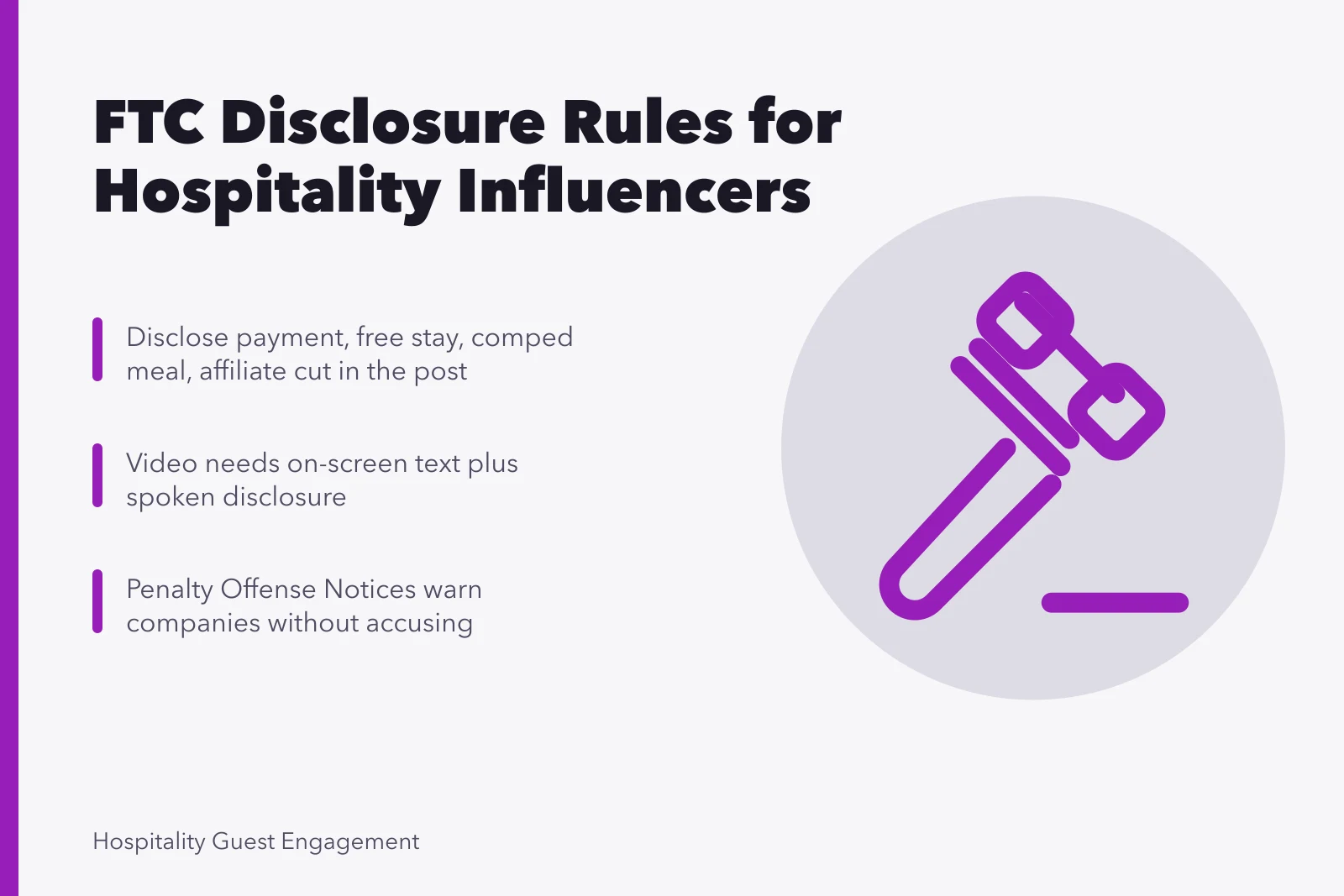
- Disclose the material connection, meaning any payment, free stay, comped meal or affiliate cut, in the post itself rather than a bio.
- Short-form video and stories need the disclosure on screen and spoken, because captions get truncated and stickers get tapped past.
- The FTC has not fined first-time influencers, but it has sent warning letters and issued Notices of Penalty Offenses that raise the cost of repeat violations.
- Training and contract clauses do the heavy liftingbrief creators in writing, audit live posts, and keep a record of both.
What the FTC Endorsement Guides require of hotel and restaurant campaigns
The FTC Endorsement Guides are the agency's interpretation of Section 5 of the FTC Act, which bans deceptive acts and practices in commerce. An endorsement is any advertising message that consumers believe reflects the opinions of someone other than the advertiser. Pay a creator to praise your rooftop bar and that message is an endorsement.
The guides apply to hotels, restaurants, spas, tour operators and the agencies that book creators for them.
The core rule is simple. If a creator has a connection to your brand that would affect how much weight a guest gives the review, that connection must be disclosed clearly and conspicuously.
A free two-night stay in Miami Beach is a material connection. So is a comped tasting menu in Chicago, a paid flat fee, or a commission on a booking link.
The FTC's own answers to common questions cover how the guides treat tags, employee posts, and reviews that arrive through a sweepstakes or loyalty perk. Those are the situations hospitality marketers hit most often.
The agency's FTC's Endorsement Guides: What People Are Asking page is the plainest starting point for a marketing manager writing a brief.
Liability is not limited to the creator. The FTC can pursue the advertiser, the agency and the endorser. That matters for hospitality because campaigns usually run through three parties: the property, the brand's marketing team, and a creator agency.
If a creator posts a glowing review of a Las Vegas pool party without disclosure, the FTC's first question is who arranged it.
Two exceptions are worth knowing. If the creator genuinely paid full price and no other connection exists, no disclosure is needed. If a reviewer is an obvious employee of the property, the relationship may be clear from context, but the guides still push toward disclosure, and most hospitality legal teams require it anyway.
One more point for multi-property groups. A campaign for a hotel in Denver and a restaurant in New Orleans can run on the same creator roster, but each post stands alone. A disclosure in the campaign hashtag does not cover a story posted two days later. Treat every asset as its own ad.
Material connection: what must be disclosed and where
The material connection disclosure standard asks one question: would knowing about this connection change how a reasonable guest weighs the endorsement? If yes, disclose. Payment, free or discounted goods and services, employment, family ties, and affiliate commissions all qualify. A discounted room rate is a material connection even if the creator paid something.
Where the disclosure goes matters as much as whether it exists. It belongs in the endorsement itself, before the audience reads the praise. A line in the caption of a carousel is fine.
A line in the creator's profile is not. A line in the brand's own press release is not. Neither is a hashtag buried after thirty other tags.
The language should be plain and hard to miss. "Paid partnership with [hotel]" works. "Ad" works. "#sponsored" works. "#collab" and "#partner" do not, because guests read them as vague.
The FTC's Disclosures 101 for Social Media Influencers guidance gives the agency's own examples of acceptable and unacceptable wording, and it is short enough to send to every creator you book.
Platform tools help but do not finish the job. Instagram's paid partnership label and YouTube's paid promotion checkbox are useful, but the FTC treats them as one signal among several. If the label is easy to miss on a phone screen, add words.
If the platform tool is the only disclosure and the video is reposted elsewhere, the disclosure disappears with it.
Placement rules differ by format. In a static feed post, put the disclosure in the first two lines of the caption, before the "more" cut. In a story, keep it on screen for the whole frame, not for a half second at the start.
In a live stream, say it out loud at the beginning and repeat it if the stream runs long.
Superlatives do not replace disclosure. A creator can say a restaurant in Austin serves the best brisket in Texas, as long as the audience knows the meal was free. The FTC does not police opinion. It polices hidden incentives. Honest enthusiasm is allowed, undisclosed enthusiasm is not.
That distinction is what separates a strong hospitality social media program from one that only looks good on paper.
Keep a record of each disclosure decision. Note the campaign, the creator, the format, the disclosure wording used, and the date it went live. If a complaint arrives, that log is the difference between a documented process and an admission that nobody checked.
Disclosure 101 rules applied to short-form video and stories
Short-form video is where most hospitality disclosure failures happen, because the format fights against clarity. Reels, TikToks and Shorts truncate captions, autoplay without sound, and push viewers past the first second. A disclosure that only exists in text under a video will be missed by most of the audience.
The working rule for video is dual disclosure. Put the words on screen and say them aloud. On-screen text should sit in the frame long enough to read, which in practice means several seconds, not a flash frame. Spoken disclosure should come early, before the creator starts raving about the spa.
Stories need a different approach. A single frame at the start is not enough when viewers tap through quickly. Repeat the disclosure on each frame that carries an endorsement, or use a persistent sticker that stays visible. If the story includes a link to a booking page, the disclosure should appear on the same frame as the link.
Live streams and takeovers are the hardest case. Say the disclosure at the top, then repeat it at natural breaks, roughly every few minutes during a long broadcast. If a property hands the account to a creator for a weekend takeover, brief the creator to state the arrangement on camera at the first opportunity.
Hashtag-only disclosure is a common error. A string like #ad #sponsored #hosted #gifted #partner #brandambassador pushes the meaningful term into a wall of tags, and guests stop reading. Use one clear term, placed where the eye lands.
Gifted stays create a specific trap. A hotel that comps a room in exchange for content has created a material connection, even if no cash changes hands and no contract requires a post. If the creator posts anyway, the disclosure is required.
Many properties now brief creators on this before check-in, because the FTC's rule does not depend on whether the brand asked for coverage.
Employee posts are another edge case. A bartender at a New Orleans cocktail bar who posts about a new menu is speaking as an employee, and the relationship is usually obvious. A server who is paid a bonus for posts that get bookings has a material connection that needs disclosure. When in doubt, disclose.
For teams sorting format-specific questions from general ones, the practical guidance on hospitality guest engagement software is a useful companion to the FTC material, because it covers the operational side of running creator posts at scale.
Enforcement signals: penalty offense notices and warning letters
The FTC's enforcement in this area has leaned on public pressure rather than fines, but the pressure is real and it shapes risk. The agency has sent warning letters to brands and creators over undisclosed endorsements, and it has issued Notices of Penalty Offenses that put companies on notice about specific conduct.
The penalty offense mechanism is the part hospitality marketers should understand. A Notice of Penalty Offenses does not accuse a company of wrongdoing. It tells the recipient that the FTC has determined certain conduct violates the law.
If the recipient then engages in that conduct, the FTC can seek civil penalties, which changes the math on a single bad campaign.
The agency publishes these notices, and the Notices of Penalty Offenses page lists the categories, including deceptive endorsements and testimonials. Receiving one is a signal to audit every creator relationship, not just the campaign that prompted it.
Warning letters are the lighter tool. The FTC has sent them to influencers and brands whose posts lacked adequate disclosure, and the letters typically demand specific fixes and a response. The Warning Letters library shows the pattern: identify the post, identify the missing disclosure, require correction, and warn about future action.
What this means for a hotel or restaurant group is that the first contact from the FTC is likely to be a letter, not a lawsuit. That is a manageable event if the brand has a disclosure policy, a creator brief and a post log.
It is a difficult event if the brand has none of those and cannot show what it told creators.
State regulators add a second layer. State attorneys general can pursue deceptive advertising under their own consumer protection statutes, and alcohol beverage control boards in states such as Nevada and Louisiana take an interest in promotions involving alcohol.
A comped cocktail promotion for a casino bar may need to satisfy both the FTC standard and state ABC rules on advertising.
The broader enforcement picture sits inside the FTC's advertising and marketing work, which the agency collects on its Advertising and Marketing hub. Reading a few recent actions is the fastest way to calibrate what the agency currently treats as a clear violation.
Building a staff and creator training programme that holds up
Training is the control that survives staff turnover, which in hospitality is constant. The Bureau of Labor Statistics tracks high separation rates across accommodation and food services, so any compliance process that depends on one person remembering the rules will fail within a year.
Most failures in this area start with a brief that never named the disclosure wording, which is why getting the common hospitality marketing strategy questions right early saves trouble later.
Start with a one-page brief. It should state the material connection rule, give three acceptable disclosure examples and three unacceptable ones, and name the person who approves creator content. Keep it to one page so it actually gets read.
Then build the training itself around the formats your brand uses. A restaurant group running TikTok creators needs different examples than a resort running long-form YouTube reviews. Use your own past posts as case studies, including the ones that got disclosure wrong.
A simple checklist for every campaign launch:
- Creator signed a written brief that names the disclosure wording and placement.
- Contract includes a disclosure clause and a takedown right.
- Property staff know which visits are comped and for whom.
- Draft captions and video frames reviewed before posting.
- Live posts audited within 24 hours of publication.
- Disclosure log updated with campaign, creator, format and date.
- Corrective action taken and documented if a post is missing disclosure.
Front desk and reservations staff need a short version too. They are often the ones who check in a creator, and they should know that a comped stay creates a disclosure obligation even when no contract exists. A five-minute module at onboarding covers it.
A boutique hotel in Charleston comps a two-night stay and dinner for a travel creator with 80,000 followers. The contract requires one Reel and three story frames.
The brief specifies "Paid partnership with [hotel]" on screen for the first three seconds, spoken in the first ten seconds of the Reel, and repeated on each story frame that shows the room or the restaurant.
The creator posts the Reel with the disclosure only in the caption. The audit catches it within a day. The hotel asks for a corrected caption and a pinned comment, logs the fix, and adds caption placement to the next brief. No regulator is involved, and the record shows a working process.
Refresher training should run at least annually, and after any FTC action in the hospitality space. Agencies that manage creators for multiple brands should run the same brief across accounts, because a disclosure failure on one client's campaign invites scrutiny of the others.
When you evaluate outside partners, the questions in this guide to guest loyalty marketing are a reasonable screening tool for compliance habits.
Contract clauses and monitoring for hospitality influencer work
Contracts are where disclosure stops being a hope. Every creator agreement should require clear and conspicuous disclosure, specify the wording and placement, and give the brand the right to demand edits or removal. Put the requirement in the statement of work, not only in the legal terms.
Useful clauses include a compliance warranty, a right to pre-approve content, a takedown right with a deadline, an indemnity, and a requirement that the creator keep the disclosure intact if the post is reposted or syndicated. Add a clause covering content the creator posts later about the same property, because creators often revisit a trip weeks afterward.
Monitoring is the other half. Assign someone to check each live post against the brief within a day, and to re-check after any edit. Screenshot the post as published. Platforms change captions and creators delete frames, so the screenshot is the evidence.
Track disclosure quality as a campaign metric alongside reach and bookings. A creator who consistently discloses well is worth more than one with a larger following and sloppy captions. Over time that data tells you which partners to keep.
Repurposing creates new obligations. If the hotel shares the creator's Reel on its own account, the disclosure must travel with it. If the brand cuts the footage into a paid ad, the ad needs its own disclosure. Whitelisting and paid amplification do not inherit the creator's caption.
Keep the paper trail in one place: briefs, contracts, screenshots, audit notes, corrective actions. If a warning letter ever arrives, that file is the response. It also feeds better briefs, which is how the process improves rather than just repeating.
For the wider operating picture, the discipline described in these hospitality marketing analytics applies directly to creator work: clear briefs, defined owners, and a review step before anything goes live. Teams that treat disclosure as part of the creative brief, rather than a legal afterthought, tend to have fewer problems and faster approvals.