Strategy
Hospitality social media: signal versus noise, updated for 2027
hospitality social media in 2027 connects truthful property stories, useful guest answers, accountable publishing, accessible creative, and completed business.
What to take away
- Give every channel a clear job in the guest journey.
- Publish from current property facts, rights records, and operating reality.
- Measure qualified actions and completed hospitality outcomes, not reach alone.
- Build a response and escalation system before the account needs one.
Hospitality social media is the planned use of social platforms to help suitable guests discover, evaluate, choose, experience, and remember a lodging, dining, event, or travel business. The work includes audience research, channel roles, content production, community response, paid support, creator relationships, rights, disclosure, accessibility, security, measurement, and coordination with the property team.
A useful program begins with an operating question. A hotel may need to explain an unfamiliar location, a restaurant may need demand for a quiet daypart, and a venue may need better-fit inquiries. Those problems require different audiences, proof, calls to action, response plans, and outcome records. A posting calendar by itself is not a strategy.
Start with a guest and business decision
Define the market, audience, occasion, inventory, and period. Set the baseline, desired action, completed outcome, and budget.
Name the owner and the limit. State what the guest should understand or do after seeing the content.
A clear hospitality marketing strategy ties each campaign to rooms that can be sold, tables that can be served, or inquiries the team can answer.
| Business need | Content job | Completed check |
|---|---|---|
| New property awareness | Show location and real experience | Qualified direct visits or assisted bookings |
| Weak daypart | Explain the occasion and live offer | Served covers in that period |
| Event demand | Show capacity, setup, and process | Qualified proposals and consumed events |
| Guest preparation | Answer arrival and service questions | Fewer preventable contacts or failures |
| Repeat demand | Give past guests a relevant reason to return | Completed repeat stays, meals, or events |
Assign each channel a job
Choose platforms from audience behavior and the material the property can sustain. One channel may provide visual discovery, another longer demonstrations, another local updates, and another professional event evidence. Do not publish identical crops, captions, timing, and calls to action everywhere merely to fill a schedule.
Write a channel charter with its audience, business job, permitted content, voice, response time, escalation path, measurement, access owner, and retirement rule. If the team cannot name a distinct job or maintain the account safely, pause it. A smaller active portfolio is easier to govern than a row of neglected profiles.
Build a property truth layer
Social posts should draw from current records for names, location, hours, menus, rooms, amenities, accessibility, age rules, pet policies, parking, transport, prices, fees, event capacity, offers, and booking conditions. Every material fact needs a source owner and an update trigger. A beautiful post with an expired condition is still wrong.
Give operations, reservations, food and beverage, events, revenue, legal, and brand teams a practical correction route. Record the approved fact, source system, approver, publication date, expiration, affected assets, and final public correction. When a menu, room, construction condition, or policy changes, update scheduled and pinned material as well as the website.
Use distinct content functions
| Content function | Hospitality example | Proof needed |
|---|---|---|
| Orientation | Route from station to entrance | Current route and access check |
| Decision support | Room or venue comparison | Verified features and dimensions |
| Demonstration | Breakfast service or event reset | Actual process and timing |
| People | Chef, host, housekeeper, planner | Consent, role, accurate context |
| Preparation | What to know before arrival | Current policy and service handoff |
| Recovery | Correction after a disruption | Approved facts and response owner |
Plan a balanced body of material instead of repeating scenic room shots. Useful posts can answer frequent questions, reveal the route through a service, show a real tradeoff, introduce the people doing the work, document a seasonal change, or explain what a guest should bring. Each piece should have one purpose and one next step.
Content functions and proof
Content function
- Orientation
- Route from station to entrance
- Decision support
- Room or venue comparison
- Demonstration
- Breakfast service or event reset
- People
- Chef, host, housekeeper, planner
- Preparation
- What to know before arrival
- Recovery
- Correction after a disruption
Hospitality example
- Orientation
- Current route and access check
- Decision support
- Verified features and dimensions
- Demonstration
- Actual process and timing
- People
- Consent, role, accurate context
- Preparation
- Current policy and service handoff
- Recovery
- Approved facts and response owner
Proof needed
- Orientation
- Decision support
- Demonstration
- People
- Preparation
- Recovery
Create from observed property moments when possible. Capture several formats during a service, inspection, setup, or interview, but do not obstruct guests or staff. Record the location, date, subject, participants, rights, approvals, represented product, allowed edits, expiration, and versions. Archive rejected takes when retention rules require it, and remove assets when rights or facts no longer support use.
Write for a person in context
Lead with the answer or scene. Name the property, relevant place, timing, conditions, and next step in plain language. Avoid empty claims such as perfect, unforgettable, or best unless the statement is accurate, supported, and appropriately qualified. Captions should add decision value that the image cannot carry by itself.
Adapt the creative to how the platform presents it. Check the first frame, crop, on-screen text, sound-off meaning, caption, alternative text, subtitles, link route, and landing page on a representative phone. Important terms must remain readable and should not disappear behind interface controls.
Make endorsements and incentives clear
The FTC's Disclosures 101 guidance for social media influencers states that a material connection to a brand should be disclosed clearly and where people are likely to notice. A platform disclosure tool may not be enough by itself.
Apply the guidance to the actual relationship and obtain qualified advice when the facts or jurisdiction require it.
Keep a relationship record for hosted stays, free meals, discounts, affiliate payments, employee posts, ambassador arrangements, gifts, contest entries, and agency-created testimonials. The record should connect the person, benefit, content, approval, disclosure language, publication, monitoring, correction, and payment. Do not ask a creator to imply an independent experience that did not occur.
Protect guest rights and brand records
Do not assume that a tag, public profile, or presence in a lobby grants permission to republish a person's photo or words. Set rules for guest submissions, minors, employees, vendors, music, artwork, trademarks, footage, and private areas. Preserve releases and license terms with the exact asset rather than in an unconnected folder.
Moderation must separate service recovery, safety, privacy, harassment, threats, discrimination, fraud, account compromise, media inquiries, and routine questions. Give community managers approved response boundaries and a fast route to the property leader. Move personal booking details out of public comments and into the approved secure channel.
Connect attention to a usable next step
Match the call to action to the content: a room comparison to suitable inventory, an event setup to a qualification form, an arrival update to current instructions.
Keep the destination accurate, mobile-friendly, and consistent with the post. If dates, prices, restrictions, or capacity differ after the click, fix the source instead of hiding the mismatch in smaller text.
Use campaign parameters and platform events as diagnostic evidence. Then reconcile them with reservations, orders, inquiries, cancellations, and no-shows.
Also reconcile consumed stays, meals, events, refunds, and full costs. Platform attribution can explain a journey, but it does not prove social activity caused the completed outcome.
Reconciling platform data with actual bookings is a core part of hotel marketing.
Choose measures by stage
| Stage | Useful evidence | Question |
|---|---|---|
| Delivery | Eligible reach and frequency | Did the intended audience have a chance to see it? |
| Attention | View quality, saves, useful replies | Did the material earn relevant interest? |
| Visit | Qualified landing sessions | Did the promise match the destination? |
| Action | Booking, order, call, inquiry | Could a guest complete the next step? |
| Outcome | Consumed stay, meal, or event | Did real hospitality business occur? |
| Economics | Incremental net contribution | Was the result worth its full cost and risk? |
Preserve counts next to rates and segment by property, market, platform, format, audience, device, campaign, offer, and period. Note organic and paid distribution separately. Annotate changes in creative, targeting, inventory, price, platform measurement, consent, and operations so later comparisons remain understandable.
Measures by stage
Stage
- Delivery
- Eligible reach and frequency
- Attention
- View quality, saves, useful replies
- Visit
- Qualified landing sessions
- Action
- Booking, order, call, inquiry
- Outcome
- Consumed stay, meal, or event
- Economics
- Incremental net contribution
Useful evidence
- Delivery
- Did the intended audience have a chance to see it?
- Attention
- Did the material earn relevant interest?
- Visit
- Did the promise match the destination?
- Action
- Could a guest complete the next step?
- Outcome
- Did real hospitality business occur?
- Economics
- Was the result worth its full cost and risk?
Question
- Delivery
- Attention
- Visit
- Action
- Outcome
- Economics
Run a dependable publishing workflow
- Brief the guest problem, audience, claim, evidence, format, action, and completed outcome
- Confirm facts, consent, licenses, accessibility, disclosures, and platform requirements
- Review the exact crop, caption, overlays, link, landing page, and scheduled time
- Publish through named accounts with individual access and an approval record
- Monitor questions, service issues, disclosure, and account security
- Reconcile actions with completed outcomes, costs, and guest delivery
- Retire expired posts, offers, facts, and rights when their triggers occur
Use a weekly working review for upcoming material, live questions, defects, and service changes. Use a monthly decision review for audience learning, qualified actions, completed outcomes, costs, and experiments. Keep the two meetings separate enough that urgent post production does not crowd out commercial judgment.
Plan a 90-day launch
- Days 1 to 30audit accounts, access, audience evidence, property facts, rights, content, responses, links, and outcome records.
- Days 31 to 60choose one guest journey, write channel charters, create a bounded content set, and test publishing and escalation.
- Days 61 to 90observe relevant behavior, reconcile completed business, correct weak handoffs, and decide what to expand, change, or stop.
Start with enough volume to learn without overwhelming operations. One well-defined seasonal package, dining period, event type, or arrival problem can expose the entire chain from briefing to service delivery. Scale only when the property can publish accurately, respond on time, protect access, and explain what happened after the click.
90-day launch plan
- Days 1 to 30Audit accounts, access, audience, facts, rights, content, responses, links, outcomes
- Days 31 to 60Choose one guest journey, write channel charters, create bounded content, test publishing
- Days 61 to 90Observe behavior, reconcile completed business, correct weak handoffs, decide expand/change/stop
Keep accountability at the property
Agencies and creators can extend skill and production capacity, but the business remains responsible for its public facts, guest treatment, account access, contracts, and records. Keep credentials under controlled ownership, assign individual roles, review vendors, test exports, and plan an orderly exit. Never let the only copy of source footage, permissions, or performance history sit in a vendor account.
The practical standard is a truthful, useful guest journey. A suitable person encounters material that answers a real question, understands the relationship behind any endorsement, reaches a working next step, receives the represented service, and can get help when something goes wrong. That standard is more valuable than a large audience with no dependable route to hospitality delivery.
Verify hospitality social media before release
For hospitality social media, the GAO evaluation design guide explains how evaluation questions, evidence needs, and design choices fit together. The guide is written for federal program evaluation. Use its design discipline as a check on the method, not as proof that a marketing result is causal or transferable.
The W3C Privacy Principles statement gives system designers a shared vocabulary for privacy and warns against shifting privacy work onto individuals. Apply that principle to the data flow behind hospitality social media. It does not replace the law, contract terms, consent analysis, or a review of the actual configuration.
The GOV.UK technology selection guidance recommends choices that can change over time, preserve data control, address security risk, and include ownership cost. Those public-service rules become useful buying questions for hospitality social media, but they are not private-sector mandates or product endorsements.
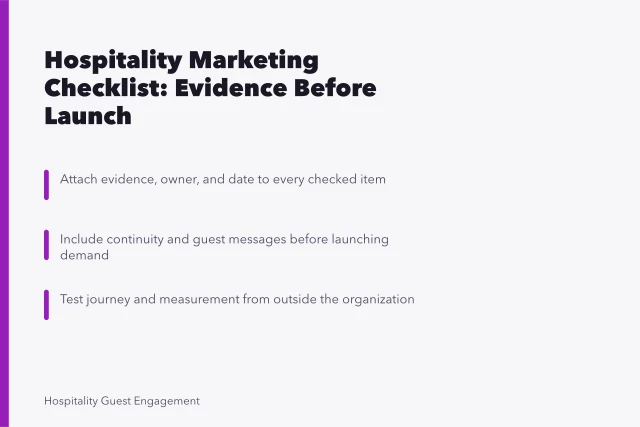
Apply these checks to the actual hospitality social media workflow. Record the tested data, roles, product versions, exceptions, and approval date. Repeat the review after a material source, model, access, contract, or decision change. The added sources define separate evaluation, privacy, and operating questions; none certifies the local implementation or supplies a guaranteed marketing result.
Common questions
What is hospitality social media?
It is the governed use of social platforms to help suitable guests discover, evaluate, choose, prepare for, and remember a hospitality experience.
How often should a property post?
Use a cadence the team can support with distinct useful material, timely responses, accurate facts, and safe account operations.
Which metric matters most?
The answer depends on the stage, but commercial decisions should reach completed hospitality outcomes, full costs, and guest delivery.
Should every property use every platform?
No. Maintain a channel only when it has a clear audience and job, suitable material, accountable access, and enough operating capacity.