Careers
Hospitality SEO: what to keep and what to drop
hospitality SEO in 2027 connects guest questions, accurate property facts, crawlable pages, useful local content, fast booking paths, and verified demand.
What to take away
- Build pages around a real stay, meal, event, or local decision.
- Keep public facts consistent with inventory, pricing, policies, and operations.
- Treat crawling, indexing, appearance, conversion, and completed business as separate stages.
- Use search data to diagnose; use reconciled outcomes to make commercial decisions.
Hospitality SEO is the work of making accurate, useful lodging, dining, event, and destination information understandable and discoverable in unpaid search. It connects technical access, property facts, intent-focused pages, local context, images, structured data, internal information governance, booking or inquiry paths, measurement, and operating delivery.
A hospitality search is rarely just a keyword. It may represent dates, party size, room or table needs, location, transport, accessibility, price, cancellation risk, dietary requirements, event capacity, or a desire for a specific experience. A strong page resolves that decision without hiding the information a guest needs to act.
Choose the commercial search problem
Start with a bounded gap such as weak nonbrand discovery for family rooms, missing visibility around an event venue, poor mobile completion from local dining queries, or thin information for accessible stays. Name the market, dates or dayparts, inventory, baseline, desired completed outcome, owner, and stop condition.
| Search problem | Page job | Business check |
|---|---|---|
| Room-type query | Explain exact fit and bookable facts | Eligible room nights and completed stays |
| Local dining query | Show menu, hours, route, and occasion | Served covers or fulfilled orders |
| Event query | Clarify capacity and inquiry requirements | Qualified pipeline and consumed events |
| Accessibility query | Provide current specific features and help | Successful task and service delivery |
| Destination question | Answer locally and connect to an offer | Suitable assisted demand |
Create a page and query map
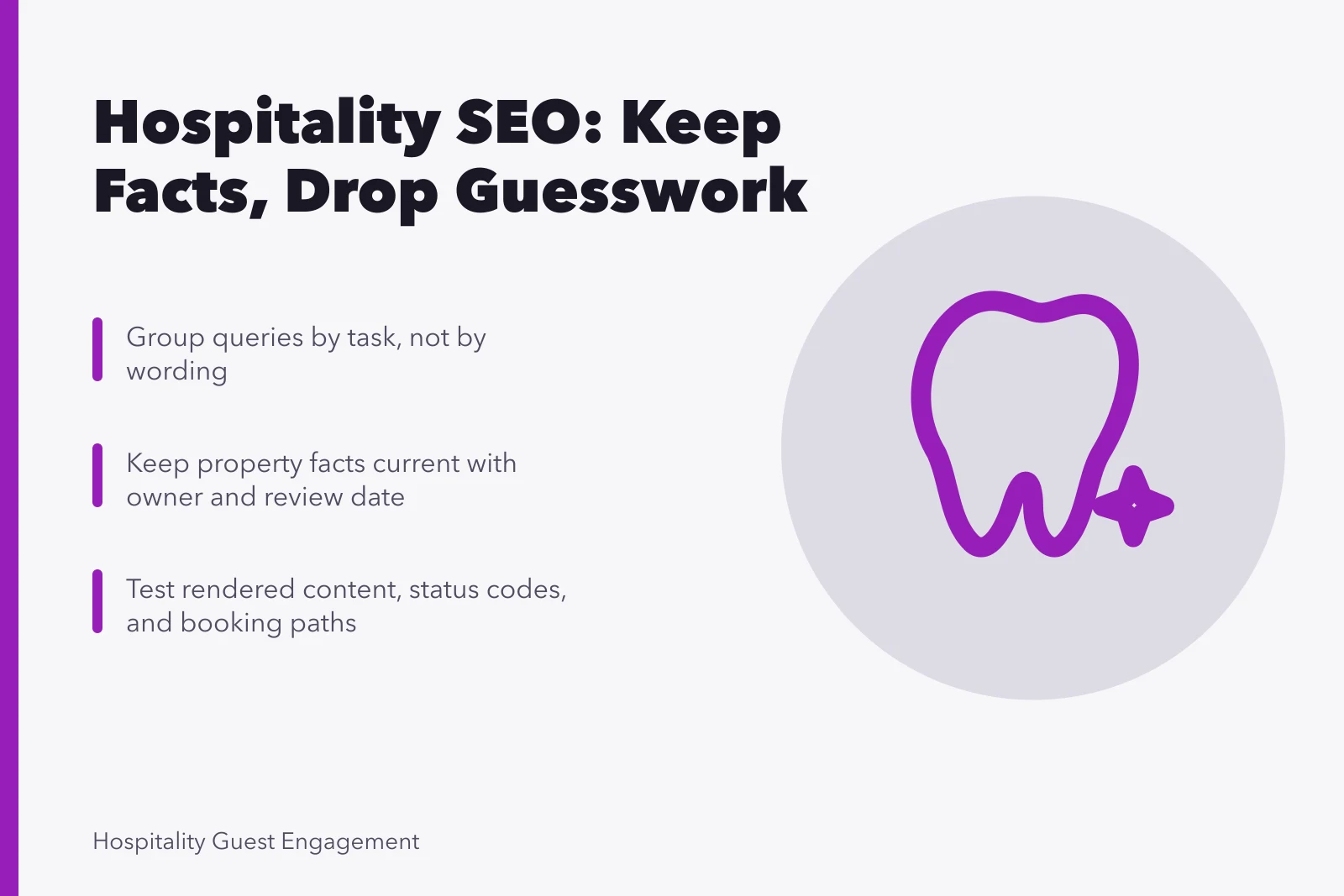
Group queries by underlying task, not by copying each wording to a new page, and one room-type page can cover bed setup, occupancy, space, view, and amenities. It can also cover access, price route, and policy questions. Separate pages when inventory, audience, evidence, action, or search result differs.
Grouping by task supports hotel marketing, linking room demand to accurate rates, booking paths.
Give each page one primary job, an accountable owner, authoritative facts, update triggers, and a retirement rule. Map the page to relevant properties, venues, rooms, outlets, events, offers, and destinations. Prevent two pages from competing for the same decision unless their scope is intentionally distinct.
Google's SEO Starter Guide recommends organizing useful content, descriptive URLs, clear text, relevant links, and accessible images while avoiding shortcuts. It does not promise rankings and should be applied to the hospitality site's actual users and systems.
Keep a property truth layer
Search pages should draw from current records for names, addresses, map pins, room or table details, amenities, accessibility features, hours, menus, prices, fees, taxes, policies, parking, transport, images, contact routes, and availability. Assign a system, owner, review date, approved wording, and correction time to each material fact.
A page is not accurate merely because it was correct at publication. Renovations, seasonal service, sold-out inventory, menu changes, partner migrations, and policy updates can change the decision. Trigger content review from operational change, not only from an editorial calendar.
Make important pages crawlable and indexable
Inventory the URLs that create search demand and the templates, parameters, filters, calendars, language versions, booking-engine transitions, and partner links that produce variants. Decide which pages should be indexed, consolidated, redirected, blocked from crawling, or removed. Test rendered content and status behavior rather than reading settings in isolation.
Use stable, descriptive addresses and direct navigation paths. Important property, room, dining, event, spa, meeting, policy, and destination pages should not depend solely on a search box or script state that a visitor or crawler cannot reach. Keep canonical, redirect, language, and sitemap signals consistent.
Answer the full decision
Put answers before promotional background: a guest comparing a room needs exact category, occupancy, bed, relevant dimensions, and current images. Material features, restrictions, and a path to dates and total price.
A planner needs capacity, layouts, services, location, and access. Minimums and an inquiry route.
A diner needs a readable current menu, hours, service mode, and a reservation or ordering path; answer first helps restaurant marketing connect local demand to a clear menu and accurate listings.
Use headings that match how people scan the choice. Lists work for features and requirements. Tables work for room, package, venue, or policy comparisons when cells remain readable on small screens. Place exceptions and material terms where they change the decision rather than in a distant general page.
Build local content with firsthand value
Useful destination content answers a guest's practical question with property-specific knowledge. Cover realistic travel times, transit, parking, seasonal access, operating hours, reservation needs, accessibility, weather exposure, neighborhood tradeoffs, and how the property fits the itinerary. Date facts that change.
Avoid mass-produced city pages that swap place names while keeping the same advice. Publish only where the property has a real relationship to the location and can add verified information, original observation, a suitable offer, or a helpful planning tool.
Use images and structured data accurately
Name what an image actually shows, preserve rights and credits, choose useful dimensions, and write alternative text for the image's purpose on that page. Remove outdated room, venue, menu, view, or facility images. Do not use a generic photograph to imply a feature the guest will receive.
Structured data should describe visible, current page content and the correct entity. Select supported types and properties, validate syntax, monitor reports, and fix the underlying fact before fixing markup. Valid code is eligibility information, not a guarantee of a rich result or traffic.
Protect the route from search to revenue
| Stage | Evidence | Failure to isolate |
|---|---|---|
| Crawl | Fetched URL and rendered content | Blocked resource or unreachable route |
| Index | Canonical and indexed status | Duplicate or excluded page |
| Appearance | Query, result, device, country | Wrong title, snippet, or feature |
| Visit | Qualified landing session | Mismatch or unusable page |
| Action | Booking, order, call, inquiry | Availability, price, form, engine |
| Outcome | Completed stay, meal, or event | Cancellation, no-show, bad lead |
| Economics | Incremental net contribution | Cost, discount, displacement, recovery |
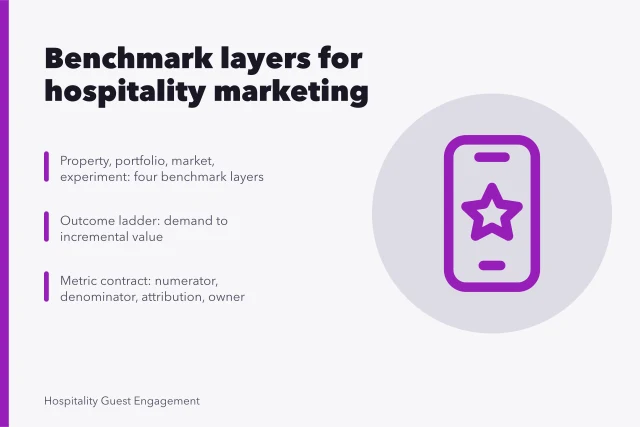
Do not report Search Console clicks as room revenue or a booking-engine last-click value as proof of SEO incrementality. Preserve original query and landing evidence, connect identifiers where lawful and reliable, and reconcile reservations, cancellations, stays, orders, events, refunds, and finance records.
Search to revenue route
- Crawl: fetched URL and rendered content
- Index: canonical and indexed status
- Appearance: query, result, device, country
- Visit: qualified landing session
- Action: booking, order, call, inquiry
- Outcome: completed stay, meal, or event
- Economics: incremental net contribution
Set a practical editorial system
- Assign a business question and owner to every planned page
- Require authoritative facts and update triggers before drafting
- Edit for a guest's task, not a target word count
- Test headings, tables, images, forms, and booking transitions on representative devices
- Record publication, change, redirect, and retirement decisions
- Review search evidence and completed outcomes on separate schedules
A pillar and its supporting articles should divide the subject by distinct work. One may explain room-page architecture, another listing consistency, another image governance, and another booking diagnostics. If two drafts answer the same question with rearranged headings, merge or re-scope them before publication.
Run a 90-day hospitality SEO cycle
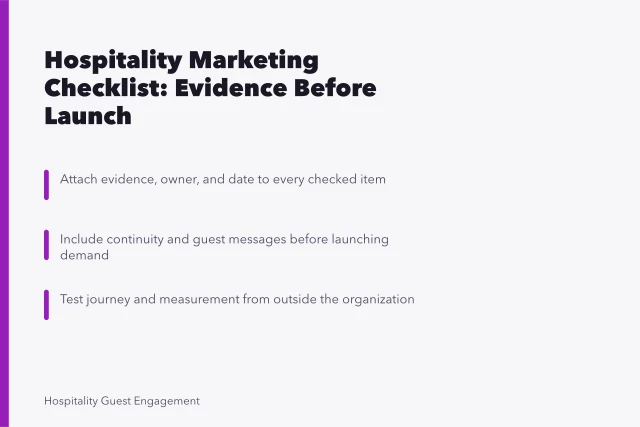
- Days 1 to 30inventory important URLs, facts, systems, query demand, indexing status, and completed-outcome records.
- Days 31 to 60choose one decision journey, repair technical access and public facts, and publish or consolidate the minimum useful pages.
- Days 61 to 90observe search appearance, test the action route, reconcile completed business, and record the next decision.
Keep one decision log for SEO, product, revenue, and operations. Record the change, evidence, expected effect, risk, approver, implementation date, observed result, and next review. This makes migrations and seasonal updates easier to audit and prevents an old workaround from becoming unexplained architecture.
90-day hospitality SEO cycle
- Days 1 to 30Inventory URLs, facts, demand, indexing
- Days 31 to 60Repair access, publish minimum pages
- Days 61 to 90Observe appearance, test action, reconcile
The first success should be a trustworthy search journey. A suitable guest finds a page that answers the real question, reaches a working action route, receives accurate availability and terms, completes the transaction, and experiences the promise. Scale only after the team can reproduce and verify that loop.
Include customer-facing teams in the review. Reservation agents, hosts, event coordinators, and front-desk staff hear the questions that search pages failed to answer. Classify those questions by page and decision, then correct recurring gaps at the source. This feedback does not replace query evidence, but it reveals language, exceptions, and service dependencies that an analytics interface cannot see.
Verify hospitality SEO before release
For hospitality SEO, the GAO evaluation design guide explains how evaluation questions, evidence needs, and design choices fit together. The guide is written for federal program evaluation. Use its design discipline as a check on the method, not as proof that a marketing result is causal or transferable.
The W3C Privacy Principles statement gives system designers a shared vocabulary for privacy and warns against shifting privacy work onto individuals. Apply that principle to the data flow behind hospitality SEO. It does not replace the law, contract terms, consent analysis, or a review of the actual configuration.
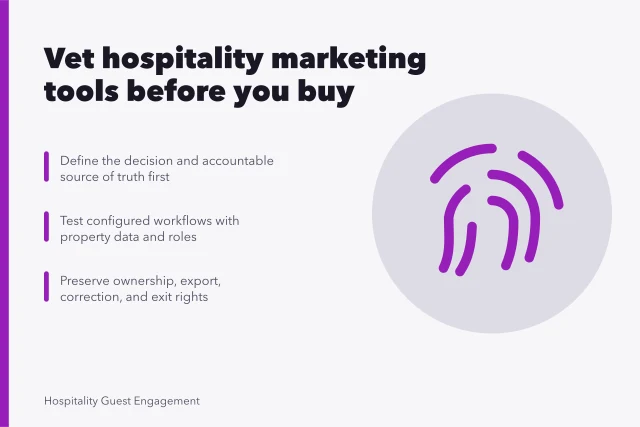
The GOV.UK technology selection guidance recommends choices that can change over time, preserve data control, address security risk, and include ownership cost. Those public-service rules become useful buying questions for hospitality SEO, but they are not private-sector mandates or product endorsements.
Apply these checks to the actual hospitality SEO workflow. Record the tested data, roles, product versions, exceptions, and approval date. Repeat the review after a material source, model, access, contract, or decision change. The added sources define separate evaluation, privacy, and operating questions; none certifies the local implementation or supplies a guaranteed marketing result.
Common questions
What is hospitality SEO?
It is the technical, editorial, local, and measurement work that helps suitable guests discover accurate hospitality information through unpaid search and complete a useful next step.
How long does hospitality SEO take?
Technical fixes can change eligibility quickly, while discovery, demand, behavior, and completed outcomes depend on crawling, competition, season, inventory, and implementation.
Should every query have its own page?
No. Create a separate page only when the user task, inventory, evidence, action, or result meaningfully differs.
What should be fixed first?
Fix the largest verified barrier in a commercially relevant journey, such as inaccessible content, wrong facts, duplication, weak decision support, or a failed booking route.