Rules
Part of Turning hotel demand into bookings: a practical marketing guide
What good looks like: hotel marketing benchmarks
hotel marketing benchmarks align demand, room inventory, channel definitions, completed stays, acquisition cost, contribution, cancellations, and guest experience.
What to take away
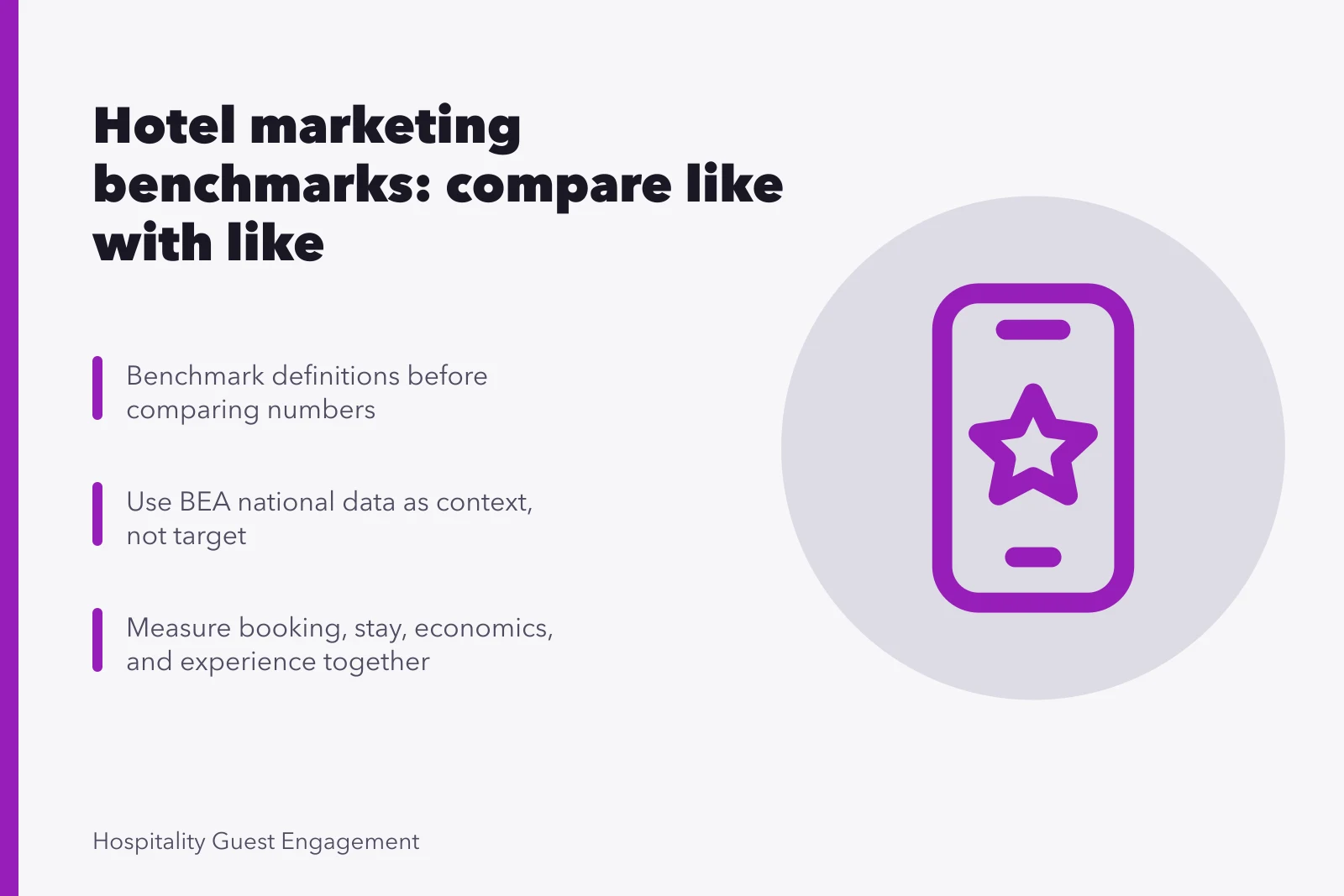
- Benchmark definitions before comparing numbers.
- Use accommodation data as context, not a property target.
- Measure booking, stay, economics, and experience together.
Hotel marketing benchmarks become misleading when properties compare different markets, dates, inventories, prices, channels, or definitions. Start with the decision. Then choose an internal baseline, relevant peer context, and a test that respects the hotel's actual constraints.
Use a benchmark ladder
| Level | Measure | Required context |
|---|---|---|
| Demand | Eligible searches, inquiries, or impressions | Market, occasion, dates, access |
| Booking | Completion and reservation value | Room, rate, device, channel |
| Stay | Consumed room nights | Cancellation, no-show, displacement |
| Economics | Net room contribution | All acquisition and service costs |
| Guest | Promise delivery and recovery | Segment, room, stay, response |
| Learning | Incremental change | Baseline, comparison, uncertainty |
BLS's Accommodation industry page reports current workforce, earnings, safety, prices, establishments, and productivity indicators for NAICS 721. Those national series may affect operating context, but they do not specify a hotel's marketing conversion or target.
Keep national accounts in scope
BEA's report on the U.S. Travel and Tourism Satellite Account for 2018 to 2023 presents national output, price, value-added, and employment measures across travel and tourism goods and industries. It is not property-level demand or campaign evidence.
Use external series to explain conditions that may change demand, labor cost, capacity, or pricing. To evaluate the hotel, use the property management system, booking engine, central reservations, finance, and guest feedback.
Also use channel records, and reconcile IDs and dates before joining data. Once the property data is reconciled, review the common hotel marketing questions that shape how benchmarks get used.
Define every comparison
- State the eligible inventory and stay dates
- Name booking date, stay date, and reporting lag
- Separate direct, partner, assisted, group, and offline routes
- Include cancellations, no-shows, refunds, commission, media, and discounts
- Show counts beside rates and uncertainty
- Record material market, price, distribution, and service changes
A target should express an operational hypothesis, not an industry aspiration. For example, improve completed mobile booking among eligible brand-search visits after a tested engine repair, without increasing price mismatch, service failures, or acquisition cost beyond stated limits.
If a benchmark changes behavior in the wrong direction, retire it. Owners should be able to explain the desired decision and likely gaming risk for every target.
Make the comparison reproducible
The GAO evaluation design guide connects evaluation questions with evidence needs and design choices. Apply that discipline to hotel marketing benchmarks; federal evaluation guidance does not make a local marketing result causal or transferable.
The NIST experimental design selection guidance begins design choice with the objective and practical constraints. It supports separating hotel marketing benchmarks reporting from controlled effect estimates, not turning observation into causation.
State the benchmark population, period, inclusion rules, calculation, currency. State maturity window and uncertainty before comparing results, keep market context separate from internal target, recalculate the figure from the cited source or governed dataset, and record any mismatch.
A benchmark is useful only after the local team explains why the comparison group and method fit the decision. Before locking any benchmark, run through a hotel marketing checklist to confirm data and assumptions are sound.
Keep the evidence record beside the decision for hotel marketing benchmarks so a reviewer can reproduce the reasoning without relying on memory. Set the next review date for hotel marketing benchmarks and name the change that triggers an earlier check.
Record rejected options and the chosen path because the original constraint may later change. Use the same definitions in the interface, export, meeting note, and correction log. Close unused reports and permissions after the decision cycle ends.
Common questions
What is a good hotel conversion rate?
There is no universal rate. Define eligible traffic, availability, price, market, device, room, journey, and completion before comparing.
Should hotels benchmark direct share?
Yes, with incrementality, full cost, guest quality, market access, and channel dependency beside it.
How often should metrics reconcile?
Operational measures may reconcile daily or weekly; finance-confirmed stay economics follow the property's close and adjustment cycle.