Reviews
Part of Turning hotel demand into bookings: a practical marketing guide
Hotel marketing mistakes: the traps and the way around them
hotel marketing mistakes include incomplete prices, stale room facts, mismatched feeds, weak booking pages, false scarcity, review manipulation, and bad reporting.
What to take away
- A low headline rate can mislead when mandatory charges appear later.
- Feed, landing page, and final booking price need active reconciliation.
- Correct every distributed copy, not only the campaign source.
Hotel marketing mistakes often happen where systems meet: a rate feed and booking engine disagree, a room name changes in one channel, a fee appears late, or a campaign continues after inventory closes. These are strategy and ownership failures, not minor copy problems.
Avoid ten expensive failures
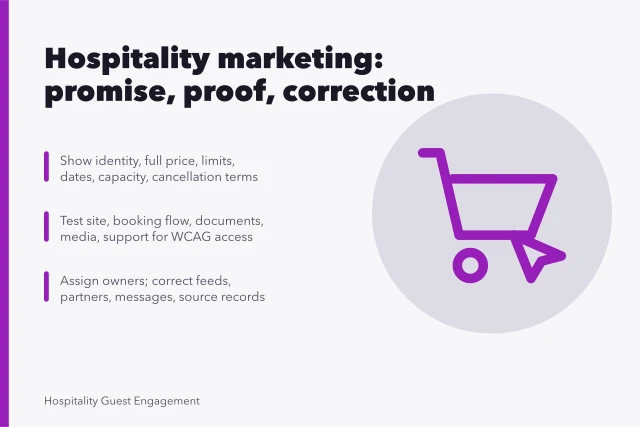
- Advertising a partial price where a total is required
- Describing a mandatory charge inaccurately
- Showing a room or amenity that is not the bookable product
- Letting rate, tax, fee, currency, or availability feeds drift
- Using false urgency or scarcity
- Promoting sold-out dates without a useful alternative
- Buying, suppressing, or filtering guest reviews deceptively
- Driving mobile demand into an unusable engine
- Counting reservations without cancellations and no-shows
- Scaling demand when service capacity is already failing
The FTC's final Rule on Unfair or Deceptive Fees addresses advertised prices and fee representations for short-term lodging and live-event tickets. Teams should verify current coverage, effective dates, definitions, exceptions, and other applicable law for the actual offer.
Ten Expensive Marketing Failures
- Partial price advertised instead of total
- Mandatory charge described inaccurately
- Room shown is not bookable product
- Rate, tax, fee, currency feeds drift
- False urgency or scarcity used
- Sold-out dates promoted without alternative
- Reviews bought, suppressed, or filtered deceptively
- Mobile demand driven to unusable engine
Treat price accuracy as a journey
Google's Hotel Center Price Accuracy Policy requires the total price shown after referral to match the Google display for the selected itinerary and describes booking, tax, fee, refundability, and enforcement expectations within that product.
| Mistake found | Containment | Repair |
|---|---|---|
| Price mismatch | Pause affected route | Reconcile feed, cache, currency, page, and engine |
| Wrong room fact | Correct all copies | Assign field owner and propagation log |
| Unavailable offer | Stop promotion | Connect release to inventory |
| Misleading review practice | Preserve evidence and stop | Use current reviewed solicitation rules |
| Bad attribution | Hold scaling | Reconcile completed stays and alternatives |
After a correction, verify the guest-facing result for representative dates, markets, devices, occupancies, and currencies. Record the source failure, affected copies, owner, time to containment, remediation, and retest. A fixed landing page does not prove that cached feeds or affiliates are correct.
Review incentives as well. A team paid only for bookings may ignore cancellations, price errors, or recovery costs. Pair volume targets with accuracy, consumed stays, contribution, and guest safeguards.
Prove the correction
The GAO data reliability guide treats reliability as fitness for an intended use and requires documented assessment. Use that test for hotel marketing mistakes; the federal guide does not certify the local data.
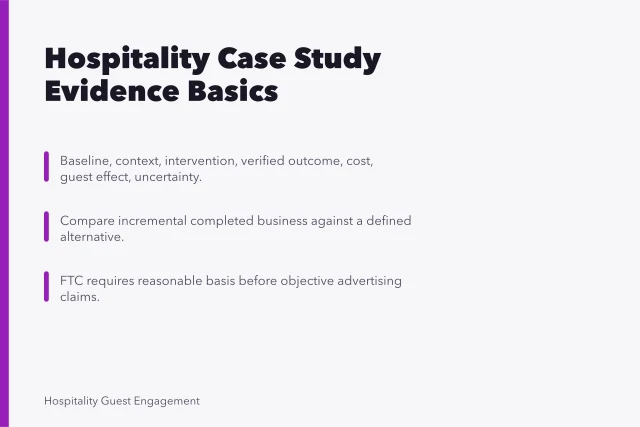
The FTC advertising substantiation policy requires a reasonable basis before objective advertising claims are disseminated. Apply that U.S. rule to public hotel marketing mistakes performance statements, with advice for the actual facts.
A dashboard change does not close a mistake. Trace the correction from source record through processing, reporting, exports, and the decision owner.
Preserve the prior value, reason, date, reviewer, and affected actions; test whether the same defect can recur; this turns an error list into an operating control and gives later readers evidence the published conclusion was repaired.
For hotel marketing mistakes, keep the evidence record beside the decision so a reviewer can reproduce the reasoning without relying on memory. Set the next review date for these mistakes and name the change that would trigger an earlier check.
Record rejected options as well as the chosen path, because the original constraint may later change. Use the same definitions in the interface, export, meeting note, and correction log.
Common questions
Are all hotel fees prohibited?
No. The issue depends on current rules and representations. Review the actual fee, offer, display, jurisdiction, and channel.
Can a disclosure fix a low headline price?
A disclosure cannot rescue a misleading main impression or replace requirements governing total-price display.
Who owns a feed error?
Assign one accountable business owner while technical, revenue, distribution, and vendor teams repair their parts.