Rules
How US tip credit rules change guest engagement for restaurants
Hospitality guest engagement shifts when US tip credit rules change restaurant service pricing, staff pay and guest trust across American states.
What to take away
- Hospitality guest engagement in the US runs on a pay model most other countries do not use, so tip credit rules land directly on the guest experience.
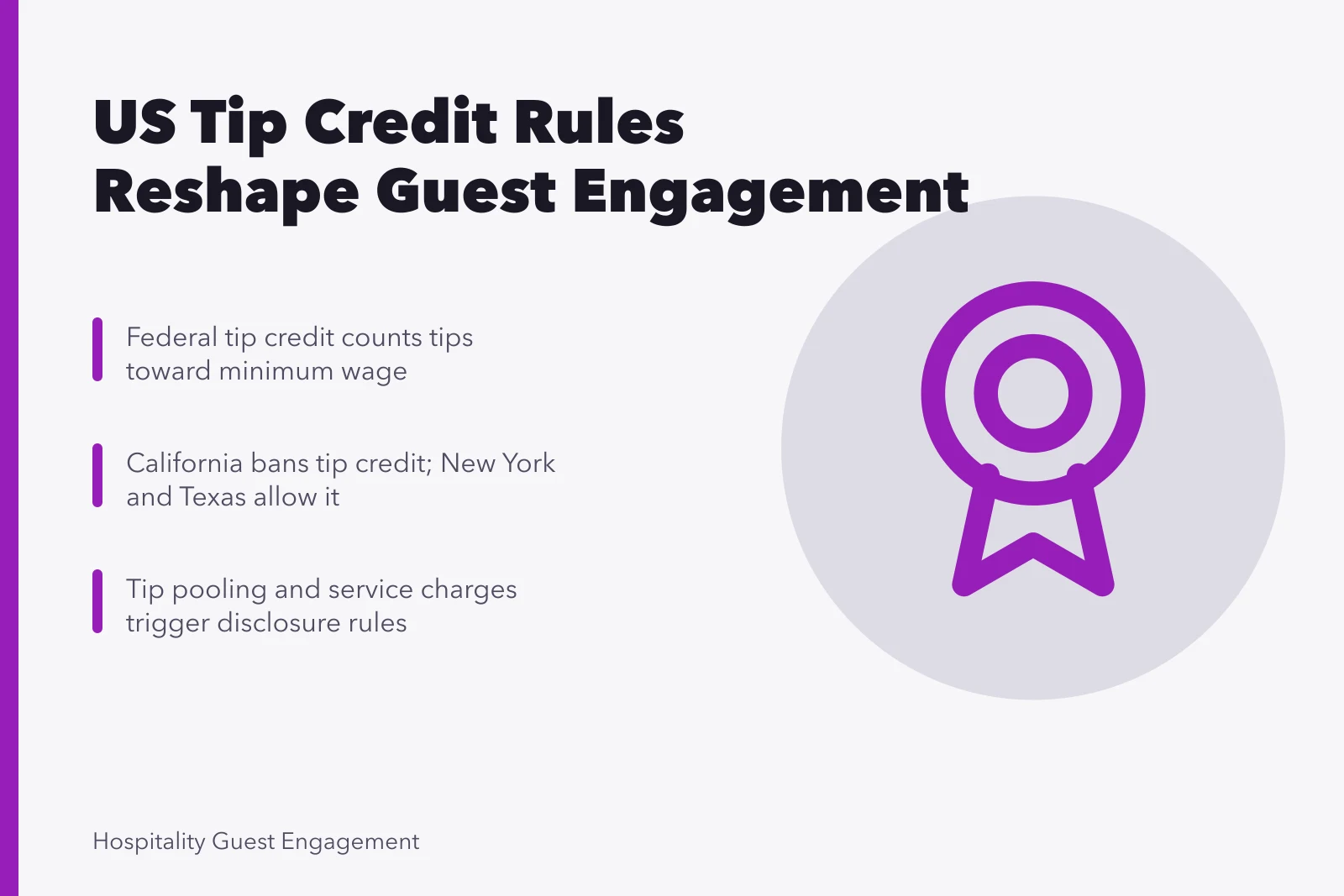
- The federal tip credit lets employers count tips toward the minimum wage, but California bans it while New York and Texas allow it with different thresholds.
- Tip pooling and service charges change what guests think they are paying for, and service charge disclosure is now a legal exposure, not just a menu wording choice.
- IRS tip reporting duties put servers in the middle of a compliance conversation with every table they serve.
- Guest satisfaction measurement gets harder when tipping is contested, because the tip line becomes a survey question with money attached.
How the federal tip credit works under the Fair Labor Standards Act
The federal tip credit is a wage accounting rule, not a tipping custom. It lets an employer pay a tipped employee less than the standard minimum wage in cash, then count the tips the employee receives toward the difference.
The framework comes from the Fair Labor Standards Act, which sets the federal minimum wage, overtime rules and the conditions under which tips can be credited against wages. A tipped employee is generally someone who customarily and regularly receives more than $30 a month in tips.
If tips plus the reduced cash wage do not reach the full federal minimum wage for every hour worked, the employer must make up the difference. That shortfall is not optional and not negotiable with staff.
The credit also depends on the employee keeping the tips. If a tip pool takes money from a worker who is not supposed to be in it, or if management retains a share, the employer can lose the credit and owe back wages.
That is why the tip credit is a guest-facing rule. Every dollar of wage cost an operator shifts onto tips is a dollar the guest is asked to supply at the end of the meal.
What the credit changes at the table
A restaurant on the tip credit is effectively asking guests to fund part of payroll through the check. Guests rarely articulate it that way, but they feel it in service pacing, in how many tables a server carries, and in how hard the tip line is pushed.
Operators who treat the credit as free money usually find the cost elsewhere: turnover, thinner service, and reviews that mention being rushed or ignored.
Where California, New York and Texas diverge on tipped wages
Three states, three different answers. The Department of Labor tipped employee minimum wage page tracks the state-by-state figures operators actually have to pay.
Tip credit rules by state
California
- Tip credit
- Not allowed
- Cash owed
- Full state minimum
- Service effect
- Higher labor cost
New York
- Tip credit
- Allowed
- Cash owed
- State cash wage
- Service effect
- Regional variation
Texas
- Tip credit
- Follows federal
- Cash owed
- Federal cash wage
- Service effect
- Heavier tip reliance
California does not permit a tip credit at all. Tipped employees must receive the full state minimum wage in cash, and tips sit on top of that. There is no credit to calculate and no shortfall to make up.
New York allows a tip credit but runs a higher effective wage floor than the federal one, and the rules differ by region and by industry. Operators there need to check the current state figure rather than the federal number.
Texas follows the federal tip credit, so the federal cash wage and the federal minimum wage set the floor. That makes Texas one of the cheaper states to run a tipped model on paper.
| State | Tip credit allowed | What the operator owes in cash | Practical effect on service |
|---|---|---|---|
| California | No | Full state minimum wage for all hours | Higher labor cost, less reliance on tip pressure |
| New York | Yes, with state-specific floors | State cash wage, tips make up the rest | Regional variation, more payroll administration |
| Texas | Yes, follows federal | Federal cash wage, tips make up the rest | Lower cash payroll, heavier tip dependence |
The divergence matters for multi-state operators because a single service standard cannot be priced the same way in all three. A training script built for Texas will read as aggressive in California.
Why the map keeps moving
State legislatures, ballot measures and wage boards change these numbers on their own schedules. An operator who set payroll assumptions two years ago may be running on stale figures.
The hospitality guest engagement software you defend should include a wage assumption review, not just ad spend and cover counts.
What tip pooling and service charges do to menu pricing and guest perception
Tip pooling is the practice of collecting tips and redistributing them among a group of employees. Federal rules restrict who can be in the pool when the employer takes a tip credit, and the current interpretations live in the Field Assistance Bulletins published by the Department of Labor.
A valid pool under the credit generally includes only employees who customarily and regularly receive tips. Back-of-house staff in the pool can jeopardize the credit if the employer is taking one.
Service charges are a different animal. A mandatory service charge added to the bill is generally not a tip under federal rules, which means it can be distributed more freely, but it also carries different tax and disclosure consequences.
The guest perception problem is the gap between the two. A guest who sees an 18 percent service charge and then a tip line assumes one of them is a trick.
That assumption costs more than the charge. It contaminates the whole check, and it shows up in the review even when the food was good.
Service charge disclosure wording that survives a dispute
If a charge is mandatory, say so before the guest orders. Menu footnotes, a line on the reservation confirmation, and a spoken note from the server all work.
If the charge is not distributed to the staff who served the table, say that too. Guests can accept a house fee. They resent discovering one.
Federal advertising and endorsement guidance from the Federal Trade Commission treats misleading pricing claims as a consumer protection issue, and a service charge described as a tip when it is not sits close to that line.
Menu pricing when the model changes
Operators who drop the tip credit usually raise menu prices rather than add fees, because a higher menu price is easier to explain than a new percentage line.
That creates a positioning problem. A restaurant that was mid-priced at $22 an entree and $2 in tips is not the same offer at $26 with no tipping expected.
Guests compare the number they see, not the number they pay. The restaurant marketing work is to make the all-in comparison visible before the check arrives.
IRS tip reporting duties that shape how staff talk to guests
Tip income is taxable income, and the employer has a role in reporting it. The IRS tip recordkeeping and reporting guidance covers what employers must track, including reported tips and allocated tips.
Employees report their own tip income, and Publication 531 explains how they do it, including the requirement to keep a daily record.
In practice, that daily record is a conversation. Servers who fall behind on reporting get a nudge from payroll, and payroll nudges usually arrive during service.
A server worried about a reporting shortfall is not fully present at the table. That is a guest engagement problem wearing a tax costume.
Where the friction shows up
Large parties, cash tips and tip-outs to other staff are the three places records get messy. A server who tipped out 30 percent of a cash tip and reported only the remainder is creating a problem for themselves and the house.
Smart operators build the record into the point-of-sale flow so the server never reconstructs it from memory. The less the reporting system depends on memory, the less it leaks into service.
What not to do
Do not coach staff to underreport. It exposes the employee to penalties and the employer to back assessments, and it teaches a house culture where the guest is the mark.
That culture is visible. Guests read it in the pacing, the upsell and the way a server checks the tip line before saying goodbye.
Designing service standards when staff incentives hinge on tips
When pay depends on tips, service standards and sales standards collapse into one thing. A server optimizing for the tip is optimizing for the check average and the review, and those two goals do not always agree.
A guest who wanted a quiet anniversary dinner does not want the dessert upsell. A guest who wanted speed does not want the tasting menu pitch.
The fix is to make the standard about reading the table rather than maximizing the ticket. That sounds soft, but it is operational: it changes what you put in the pre-shift meeting.
Pre-shift should cover the two or three tables from yesterday where the server misread the room, not just the specials and the 86 list.
Incentive design that does not punish honesty
If the only rewarded outcome is the tip percentage, staff will chase tip percentage. If you also reward repeat guests and named mentions in reviews, the incentive broadens.
A guest loyalty program gives servers a second scoreboard. A returning guest is a measurable outcome that does not depend on a single check.
Managers should also watch for tip-driven behavior that damages the room: hovering, over-familiarity, and rushing the close on a table that is still talking.
Steps to reset service standards around the pay model
- Confirm which tip credit rules apply at each location and write the cash wage into the pre-shift sheet.
- Map every step of service to the guest outcome it is supposed to produce, and cut the steps that only produce tip pressure.
- Rewrite the pre-shift meeting to include one service read and one retention metric alongside the specials.
- Give servers a script for explaining the check, including any service charge, before the guest asks.
- Review tip distribution monthly against the pooling rules that apply in that state.
- Track complaints that mention tipping separately from complaints about food or speed.
Measuring guest satisfaction when tipping is contested
Standard satisfaction surveys get noisy when guests are angry about tipping. A one-star review that says "food was great, tip line is a scam" is not a food problem.
Separate the signals. Tag reviews and survey comments for tipping, service charge and value language, then read those separately from food and atmosphere comments.
Watch the tip percentage itself as a service metric. A falling average tip with stable food scores usually means the guest felt pressured, not underserved.
Compare across states if you operate in more than one. A California location with no tip credit and a Texas location on the credit will produce different tip behavior from similar service.
That comparison is useful, but only if you resist the urge to import the Texas playbook into California. The rules do not travel.
A short checklist for contested-tipping markets
Contested-tipping market checklist
- Confirm state minimum wage and tip credit
- Verify tip pool membership by state
- Disclose mandatory service charge before ordering
- Capture reported and allocated tips in payroll
- Tag guest feedback mentioning tipping
- Review pre-shift scripts for tip pressure
- Compare tip averages across wage regimes
Where messaging fits
The hotel guest messaging playbook is a useful model even for restaurants: short, timely, specific, and never a sales pitch disguised as service.
A pre-arrival note that explains a service charge is guest engagement. A post-visit text that asks for a five-star review because the server needs it is not.
Training and disclosure language for front-of-house teams
Front-of-house training has to cover three things that used to be payroll's problem: what the guest is actually paying, how tips are distributed, and what staff may say about it.
Start with the check. Every server should be able to explain, in one sentence, what each line on the bill represents.
Then the pool. Servers should know who is in it and why, because guests ask. A vague answer sounds like a cover-up.
Then the limits. Staff should not speculate about other employees' pay, and managers should not ask them to.
Scripts that hold up under pressure
For a service charge: "An 18 percent service charge is added to parties of six or more. It goes to the staff who served you, and the tip line is optional."
For a tip credit question: "Our team is paid a base wage plus tips. The base is set by state law here."
For a guest who wants to tip in cash: "Cash is fine, and it goes to your server. Thank you."
These are short on purpose. Long explanations sound defensive, and defensive sounds guilty.
Disclosure placement that guests actually read
Put service charge language on the menu, the reservation confirmation and the check presenter. Three placements is not overkill when the alternative is a dispute at the table.
For online menus, put it above the fold rather than in a footer. Guests who only see it at payment feel ambushed.
Operators with questions about how wage rules interact with their marketing claims can find related answers in the common hospitality marketing strategy questions archive.
Training cadence
Revisit the training whenever a state changes its tipped wage or when the Department of Labor issues new guidance. Those are the two triggers that matter.
New hires should get the disclosure script on day one, not after their first complaint. The script is part of the job, like knowing the specials.