Operations
How Miami hotels engage bilingual guests under US marketing rules
Hospitality guest engagement in Miami means bilingual service, FTC-compliant Spanish promotions, Florida alcohol rules, and tools that read Spanish reviews.
What to take away
- Hospitality guest engagement in Miami runs in two languages by default, so staffing, signage and follow-up must work in Spanish and English.
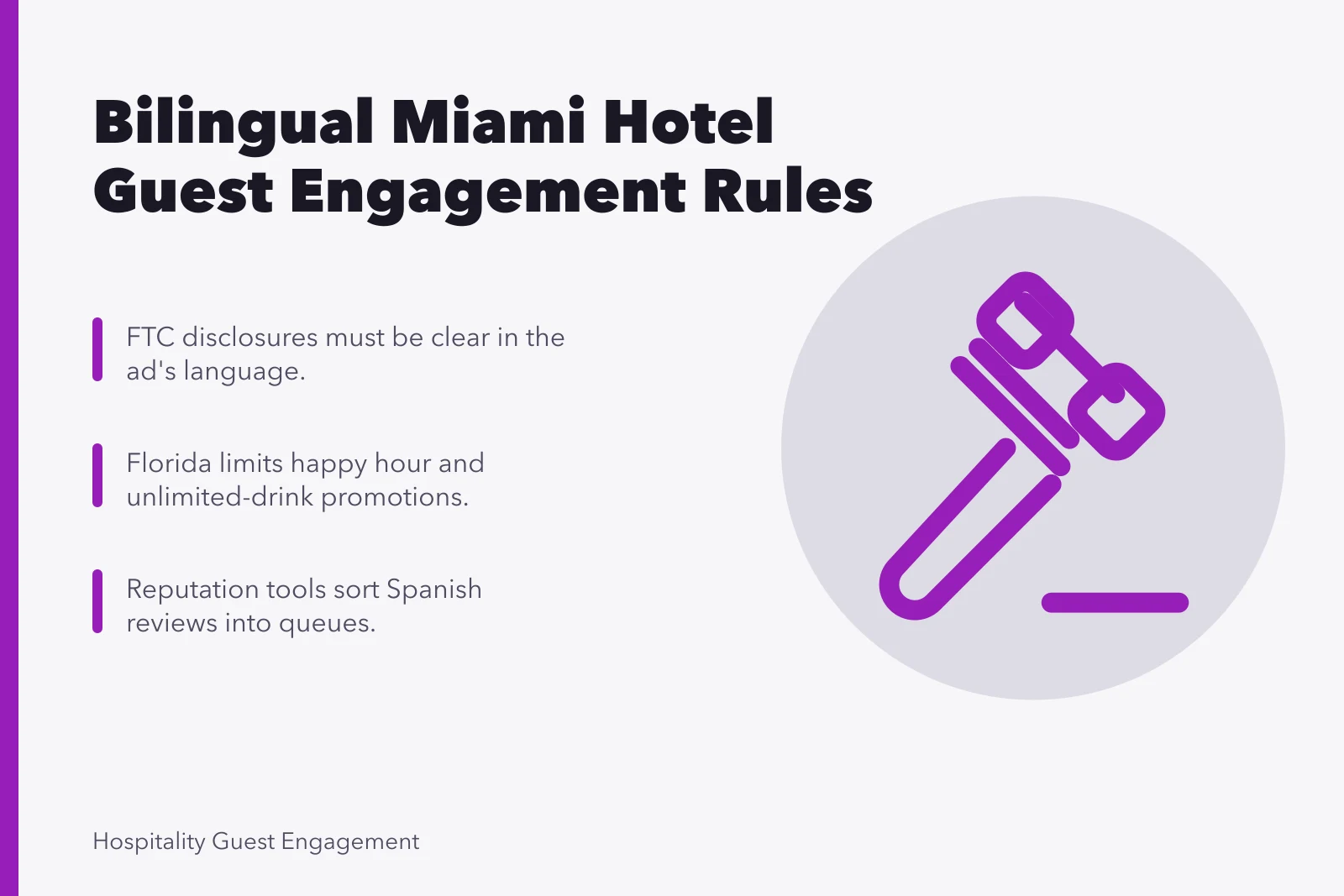
- FTC disclosure rules apply the same way to Spanish-language influencer posts and reviews: the disclosure must be clear in the language of the ad.
- Florida alcohol beverage regulations restrict how drink promotions, happy hours and free-drink offers can be worded in either language.
- Review platforms and reputation tools now sort Spanish feedback, but translation alone is not enough; someone on staff has to answer it.
- Local operators such as hotels on Brickell Avenue and restaurants in Little Havana treat bilingual service as an operations standard, not a campaign.
What bilingual guest engagement looks like in Miami hotels and restaurants
Miami is not a market where Spanish is a niche add-on. Guests arrive from Latin America, Spain and the Caribbean, and a large share of residents speak Spanish at home. A front desk that can only handle English loses bookings and tips.
Engagement starts before arrival. Pre-stay messages, upsell offers and check-in instructions go out in the guest's preferred language, which the booking record should capture. This is the same discipline covered in our guide to hotel guest messaging, where language preference sits alongside arrival time and room type.
Restaurants face the same split. A host stand in Coral Gables may greet in Spanish, take a reservation in English and hand a menu that lists dishes in both. Servers who can move between the two languages cover more tables and read the room faster.
The staffing math matters. Leisure and hospitality is one of the largest employers in the Miami metro area, and wage and employment counts by industry are published through the Quarterly Census of Employment and Wages. That data helps managers benchmark pay for bilingual staff.
Bilingual guest engagement is not only translation. It shows up in how complaints are handled, how birthdays are recognized and how a returning guest is greeted by name in the language they used last time.
Where the two languages actually meet
- Front desk and concierge conversations
- Reservation and confirmation emails
- Menus, allergen notes and daily specials
- Review responses on Google, TripAdvisor and Booking.com
- Post-stay surveys and loyalty offers
FTC disclosure rules for Spanish-language promotions and reviews
The Federal Trade Commission governs advertising claims and endorsements in the United States, and its rules do not change with language. If a Miami hotel pays an influencer to post about a rooftop bar, the post needs a disclosure that viewers can see and understand.
The agency's guidance for creators, Disclosures 101 for Social Media Influencers, explains that disclosures must be hard to miss and placed near the endorsement itself. A hashtag buried under twenty others does not qualify, in Spanish or English.
Language matters here. If the promotional post is written in Spanish, the disclosure should be in Spanish too, so the audience it targets can read it. A Spanish caption with an English-only disclosure fails the clarity test.
Reviews sit in a related area. Hotels may not write fake reviews, suppress negative ones or pay for positive ratings, and the same applies to Spanish-language listings. The agency's broader question-and-answer resource, FTC's Endorsement Guides: What People Are Asking, covers incentives, employee posts and review platforms.
Staff training is the practical fix. Whoever runs the local influencer program should know the disclosure rules and check Spanish captions before they publish.
Florida alcohol regulations that constrain bilingual drink promotions
Alcohol in Florida is regulated at the state level through the Division of Alcoholic Beverages and Tobacco, with local licensing layered on top. That shapes what a Miami bar or restaurant can say in a promotion, in either language.
Happy hour advertising is restricted. Florida law limits how discounted drinks can be promoted and prohibits certain practices such as unlimited-drink offers during set periods. A Spanish-language flyer promising free drinks all night creates the same problem as an English one.
Age verification is not optional. Staff must check identification, and a promotion that suggests anyone can walk in and drink undermines that duty. Bilingual signage should state the requirement clearly.
Licensing rules also govern where alcohol can be served and how late. A rooftop bar in South Beach and a restaurant in Little Havana may operate under different conditions, so the marketing copy has to match the license, not the other way around.
Translation errors are a real risk. A phrase that reads as a mild discount in one Spanish dialect can imply an open bar in another. Have a native speaker review drink promotions before they run.
A short compliance checklist for bilingual drink promos
- Confirm the offer matches the terms of the Florida alcohol license
- Avoid unlimited or all-you-can-drink wording in Spanish and English
- State age requirements in both languages
- Check happy hour time limits against state and local rules
- Have a native Spanish speaker review the final copy
- Keep a record of what ran and when
Review management tools that handle Spanish-language feedback
Spanish reviews arrive on every major platform, and they often carry operational detail that English reviews miss: a slow check-in, a dish that did not match the menu description, a shuttle that never came.
Most reputation platforms now detect language and route reviews into separate queues. That helps, but the sorting is only the first step. Someone has to read the review and respond in the language it was written in.
Machine translation is a starting point, not a finished reply. A translated response often reads stiff, and guests notice. The better pattern is a drafted translation that a bilingual staff member edits before it goes out.
Sentiment scoring also breaks down across languages. A phrase that reads as mild in English may be sharply negative in Spanish, so teams should not rely on a single score to triage. Our overview of guest loyalty marketing covers how these systems are usually layered.
Response time matters more than polish. A Spanish review answered within a day signals that the property listens, even if the reply is short. Teams sorting out escalation paths can start with the common hospitality marketing strategy questions that come up most often.
A worked example
A boutique hotel in Brickell gets a three-star Google review in Spanish complaining that the valet took forty minutes. The tool flags it as Spanish and negative. A bilingual manager replies in Spanish within a few hours, apologizes, explains the staffing change and offers a return credit.
The guest updates the review to four stars. No translation service was needed, only a person who could read the complaint and answer it.
Examples from Miami operators serving Spanish-speaking guests
Miami hotel marketing tends to treat language as part of the brand rather than a translation layer. Properties near Brickell Avenue and downtown court business travelers from Latin America, and their websites, booking engines and confirmation emails run in both languages from the start.
Restaurants in Little Havana and along Calle Ocho lean the other way. Spanish is the default, and English is the accommodation. Menus, social captions and review replies lead in Spanish, which builds trust with local regulars and visitors from across the region.
South Beach properties often run three languages during high season, adding Portuguese for Brazilian visitors. That raises the staffing bar, because a front desk cannot cover three languages with one bilingual hire.
Social teams in the market plan separate calendars. A bilingual guest engagement plan might post in Spanish on Instagram and in English on LinkedIn, with different offers for each audience. The hospitality marketing analytics that come up in these planning meetings usually center on who writes and who approves each version.
Software choices follow the same logic. Properties comparing platforms should look at language handling as a core feature, not an add-on, which is the frame in our breakdown of hospitality guest engagement software.
What the local market looks like
| Segment | Typical guest | Language priority |
|---|---|---|
| Brickell business hotels | Corporate travelers from Latin America | Spanish and English |
| South Beach resorts | Leisure travelers, international | English, Spanish, Portuguese |
| Little Havana restaurants | Local regulars and visitors | Spanish first |
| Coral Gables dining | Affluent local and regional guests | English and Spanish |
Metro-level employment and wage figures for these segments come from the same federal data sets, and the Overview of BLS Statistics by Geography explains how to pull numbers for the Miami area.
How to build the program in five steps
- Capture language preference at booking and store it on the guest profile.
- Staff each shift with at least one bilingual team member on the front desk and in the dining room.
- Write and review promotions in both languages, with FTC disclosure and Florida alcohol rules checked before publishing.
- Route Spanish reviews to a bilingual responder and set a one-day reply target.
- Track response rates and repeat visits by language segment, then adjust staffing to match.