Rules
Tour operator partnerships and local business predictability: a US hospitality guide
How US hotels and restaurants build the predictability tour operators reward, from group standards and referral ledgers to privacy rules and repeat group bookings.
What to take away
- Tour operators reward local partners who deliver the same capacity, timing and price on every group arrival.
- Predictability comes from small habitsconfirmed headcounts, fixed service windows, a named contact and invoices sent on time.
- Reward programs hold up when the terms are written down and the guest data behind them is handled with a published privacy process.
- Referrals between hotels, restaurants and attractions are the cheapest new group bookings, but only when the referral path is tracked.
How tour operator reward programs actually get decided
When a tour operator ranks local partners, the scoring is dull. Did the restaurant hold forty seats at 6:15 pm? Did the hotel have rooms ready before the coach pulled in? Did anyone answer the phone on a Sunday?
Reward programs follow those answers. Commission tiers, free seats for guides, priority placement in the itinerary schedule, all of it rewards the partner that never surprises the operator. The mechanics resemble any loyalty scheme, where tiers and redemption rules decide who keeps coming back.
Operators also publish booking pages that look like an online travel agency, yet they keep control of the whole group. A partner who causes a delay can be dropped from the next departure without much discussion.
That is why operators test new partners with one coach before they commit a season. One clean arrival buys a second departure, and a second departure buys a contract.
The reliability signals local partners send
| Signal | What the operator sees | What it costs you |
|---|---|---|
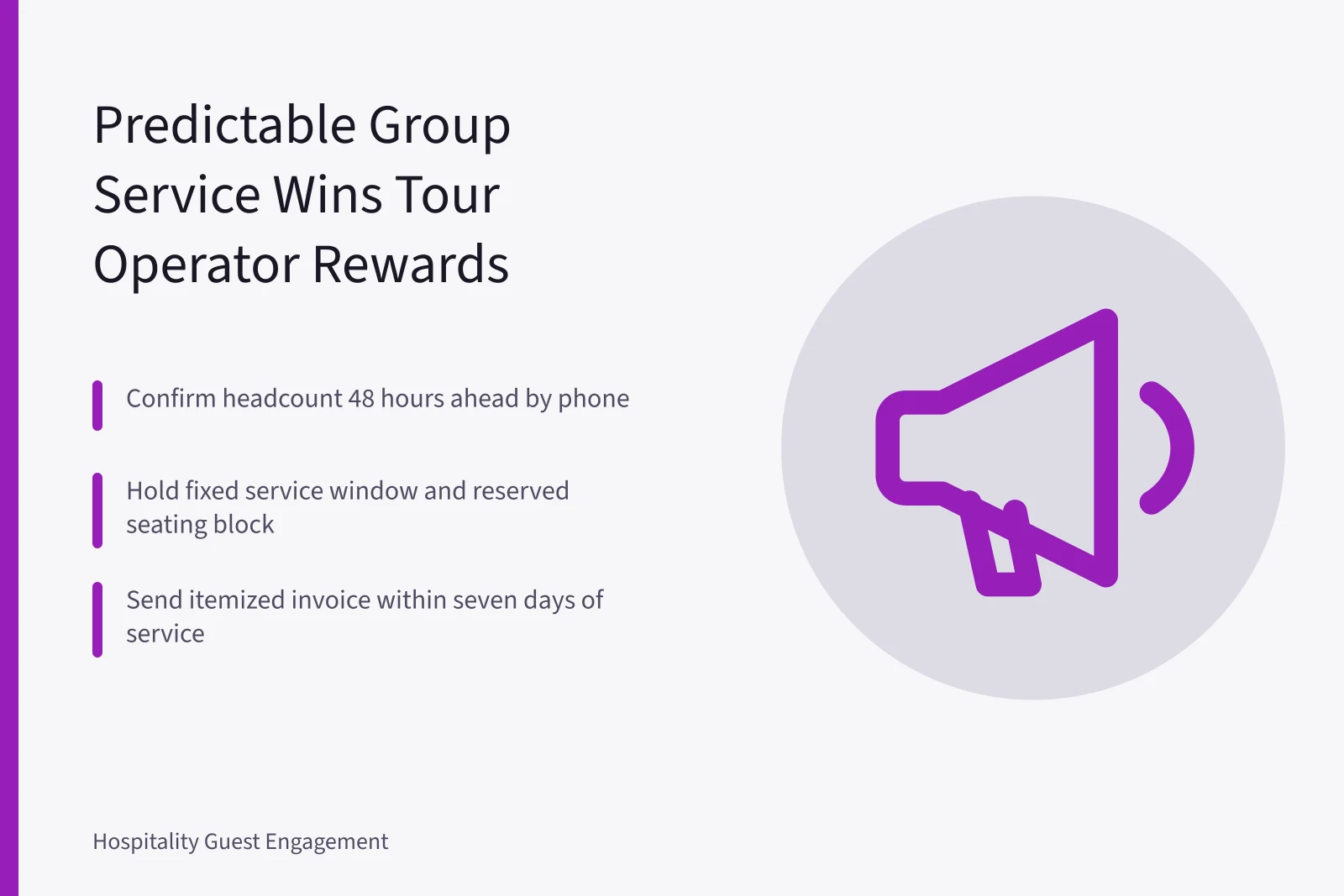
| Headcount confirmed 48 hours ahead | Kitchen prep and seating planned | One phone call |
| Fixed service window | A coach schedule that holds | A reserved section |
| Named group contact | Faster problem solving | One staff email |
| Itemized invoice within seven days | Cleaner reconciliation | A bookkeeping habit |
Signals are cheap to send and expensive to skip. An operator remembers the partner who confirmed numbers twice and the one who guessed.
Timing is the signal that matters most. A kitchen that can serve sixty covers inside ninety minutes protects the rest of the operator schedule, including the next stop on the route.
Building predictability into guest engagement
Guest engagement covers every message a traveller receives before arrival, during the visit and after departure. For group business, the messages that matter are the boring ones.
- Write a one page group standard covering arrival window, seating block, luggage handling and deposit terms.
- Put the group contact and a backup name on every confirmation email.
- Log group covers in the reservation system rather than on a paper pad.
- Send the invoice within seven days with the operator reference number attached.
- Review the numbers each quarter with the operator and agree on one change.
Group capacity is the hardest promise to keep, since one late coach can push a dinner service past midnight. If you want the operational detail, the guide on how local businesses support rail tour companies covers seating blocks, luggage storage and timed meals.
Collecting referral data means managing privacy risks, and one written retention rule keeps that work simple. Delete guest records you no longer need.
Predictability is a product. Operators buy it with volume, priority and referrals.
Example: A downtown hotel that hosts river cruise groups
Consider a hotel that sits a short walk from a river cruise dock. Groups arrive between 5 pm and 7 pm, and one front desk staffer owns the relationship.
That hotel keeps a single sheet with the operator group contact, the deposit terms and the luggage plan. It confirms headcount the day before and sends the invoice by the end of the week.
The payoff is quiet. The same operator books the same block of rooms each season, and recommends the hotel to a second operator running the same schedule.
Guest referral partnerships and the paper trail
Referrals move in both directions. A hotel sends guests to a restaurant, the restaurant sends tour groups back. Without a written path, nobody knows what was earned or who owes what.
Reward redemptions also create a record. Keep a ledger of what was given, to whom and when, because bookkeeping and tax treatment depend on it.
Small operators can borrow structure from the SBA marketing and sales guidance, which covers pricing, customer research and sales tracking.
Listings matter too. A complete Google Business Profile with group hours and coach parking notes helps an operator find your property before the season opens.