Rules
Licenses vs landlord control: the two things hospitality property really turns on
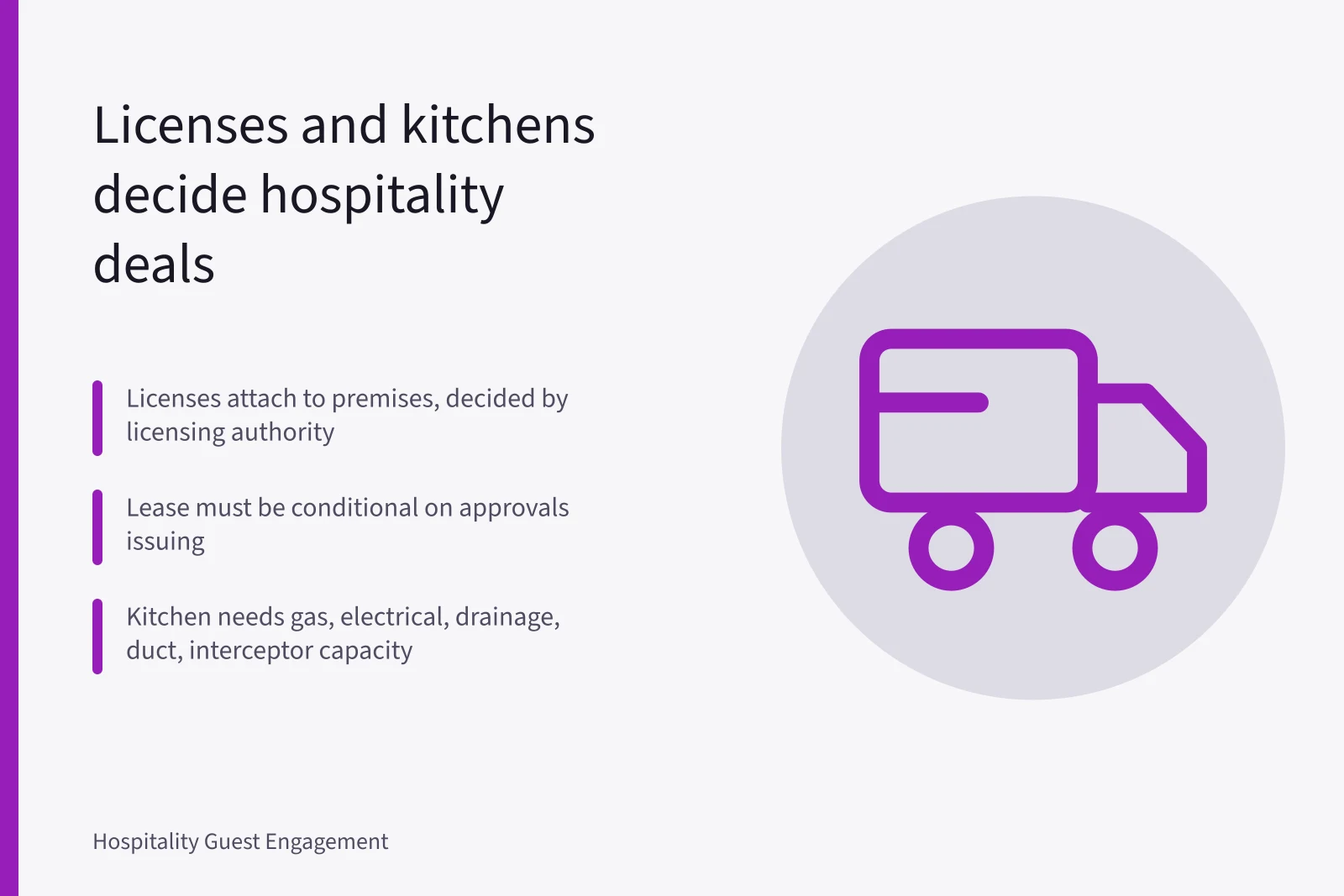
Hospitality property turns on two things the landlord does not control: whether the licenses will issue, and whether the building can carry a kitchen.
A restaurant, bar, cafe or venue lease turns on two things that most other tenants never think about: whether you can obtain the licenses the business depends on, and whether the building can physically carry a kitchen. Both take longer to resolve than the lease negotiation itself, and neither is under the landlord's control.
Everything else, including rent, term and the improvement allowance, is ordinary commercial negotiation. Get the two hospitality-specific problems settled first, because they are the ones that can leave you paying for a space you can never open.
What to take away
- The licenses and the building services decide the deal. Settle both before signature, because neither is under the landlord's control.
- Make the lease conditional on the approvals you cannot control, or take a due diligence period long enough to get a real answer.
- A site that was already a restaurant transfers infrastructure, not compliance. Ask what was built with permits and who owns the equipment.
Make the deal depend on the licenses
The permissions a hospitality business needs are frequently tied to the premises, not just to the operator. That means they are decided after you have identified a site, on a timetable set by the licensing authority, and sometimes at a hearing where neighbors can object.
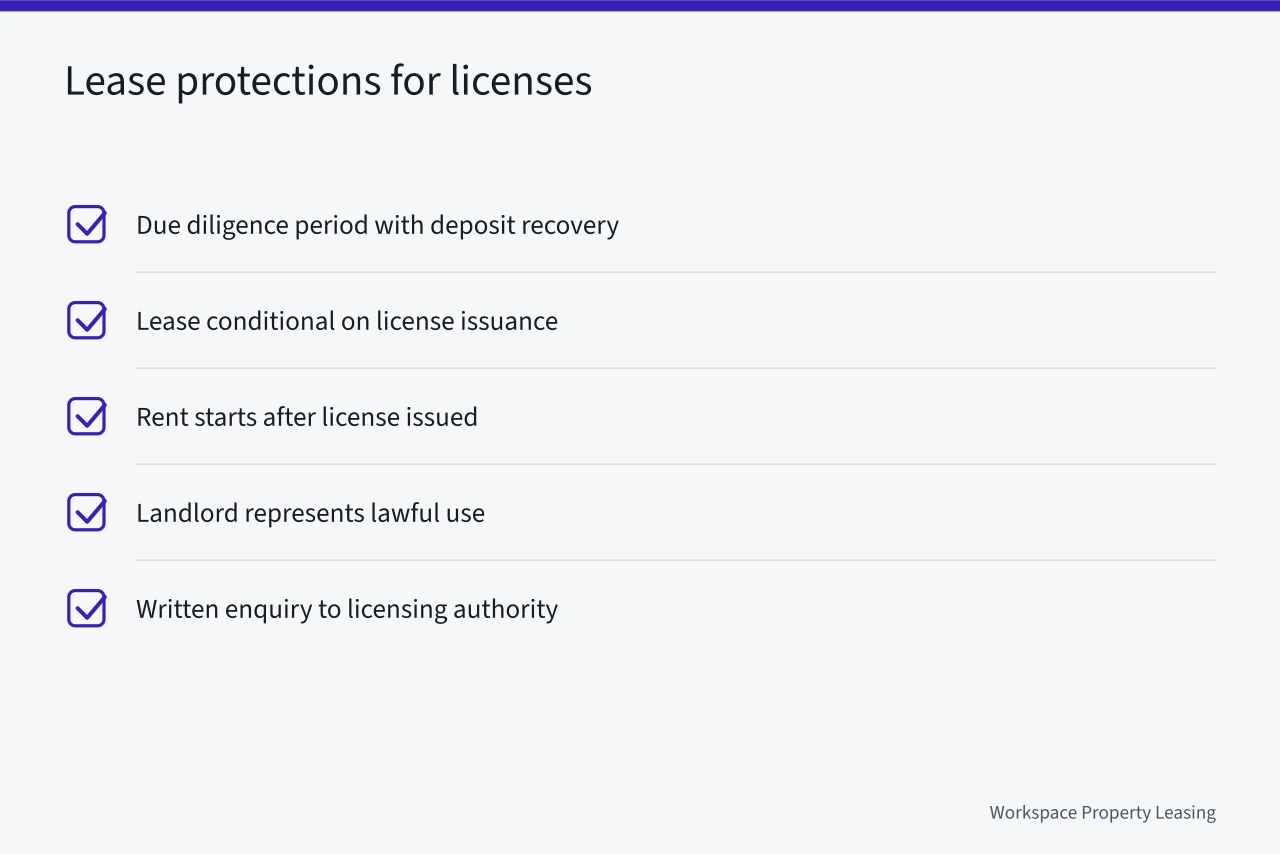
Never sign a lease on the assumption that a license will follow. Ask your lawyer to build in protection, which usually looks like one or more of these:
- A due diligence period long enough to make the license applications, or at least to get a substantive answer, with the right to walk away and recover your deposit.
- A contingency making the lease conditional on issuance of the named licenses by a stated outside date.
- Rent starting on the later of delivery of the space and issuance of the license you cannot trade without.
- A landlord representation that the premises may lawfully be used for your stated use.
The previous occupant's license is not evidence that yours will be granted. Licenses can be personal to the holder, can lapse after a period of closure, and can carry conditions attached to the last operator's application.
Ask the licensing authority directly about the address, describing your intended operation honestly, including hours and whether you plan live music, outdoor seating or late trading. Put the enquiry in writing and keep the reply, because a conversation at a counter is a lead rather than an answer.
What a kitchen needs from a building
An empty shell that suits a shop will not suit a restaurant. The services required for cooking are the largest single variable in a hospitality fit-out, and the building either has capacity or it does not. An office of the same size can hold very different headcounts, and a hospitality build-out has the same problem in reverse.
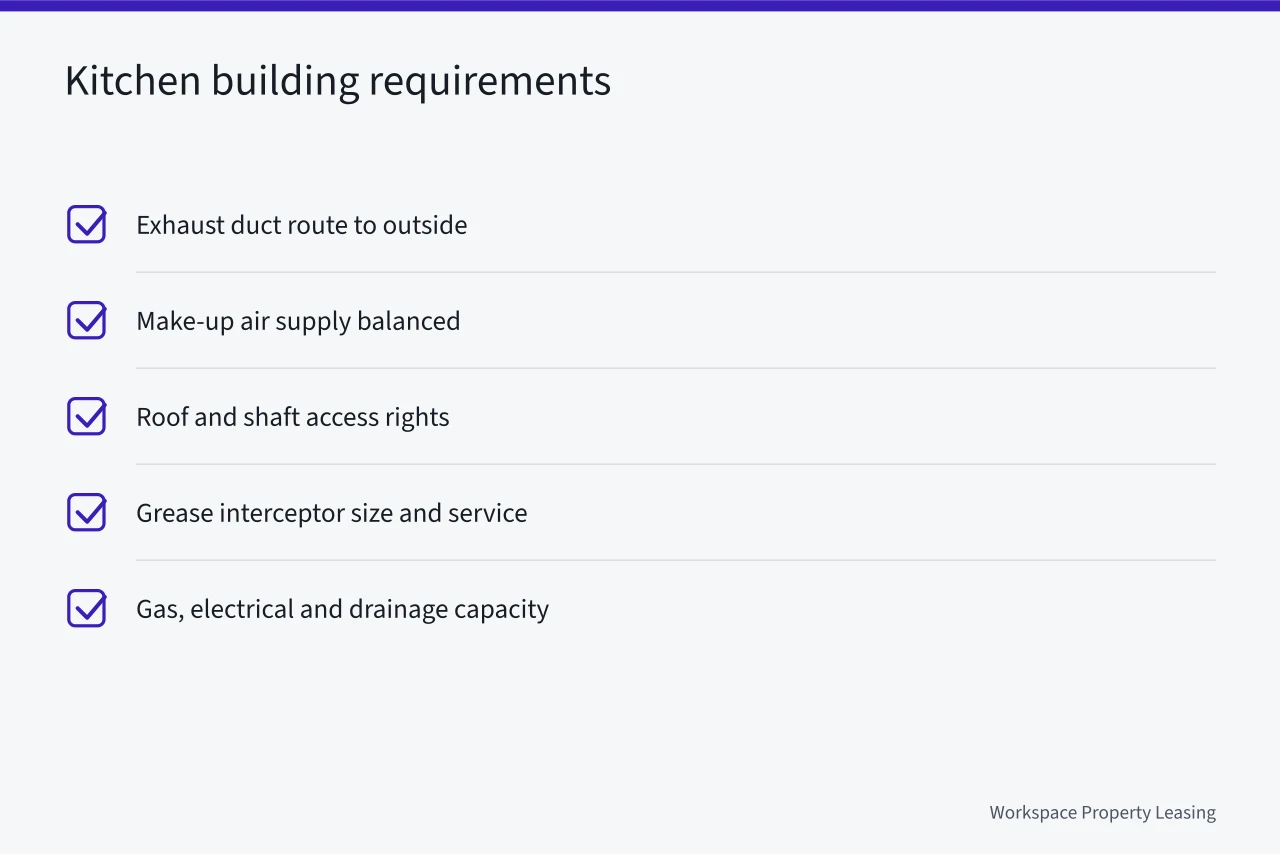
Work through these before you fall in love with a site:
- Exhaust route.A commercial cooking hood needs a duct running to the outside, usually to the roof, along a path that may pass through parts of the building you do not lease. Confirm the route exists or can be built, and that you have the legal right to use it. Commercial kitchen ventilation is designed against a standard such as NFPA 96, in the edition the local fire authority enforces.
- Make-up air.Extraction has to be balanced by supply. This is often forgotten in budgets and is not optional in practice.
- Roof and shaft rights.You need the lease to grant you the right to penetrate the roof, to place equipment on it, and to run services through common areas and risers. Get it written down, including access rights for maintenance.
- Grease interceptor.Whether one exists, its size and condition, where it sits, who services it, and what the local sewer authority expects. Most states build their retail food rules on the FDA's model Food Code, so ask which edition your health authority has adopted before the kitchen is designed.
- Gas.Whether gas is available at the required capacity, and what an upgrade would involve. In some buildings and some districts, it is simply not available, which changes your entire equipment plan.
- Electrical service.Kitchens, refrigeration and HVAC together demand far more than a typical retail suite. Check the spare capacity, not the nominal service.
- Water and hot water.Volume, pressure, and where the heating plant would go.
- Waste.Where bins and recycling live, how often they are collected, whether there is refrigerated waste storage for a food operation, and whether the landlord's arrangements accommodate a restaurant's volume.
- Deliveries.Where a truck stops, at what hour, and whether the route into your back of house works with the building's rules.
- Grease, noise and odor.All three generate complaints. Look at what sits above and beside you, particularly residential neighbors, and ask what the building's rules say about noise transmission and odor control.
Second-generation space
Taking over a space that was already a restaurant can save a great deal of money and inherit a great deal of trouble.
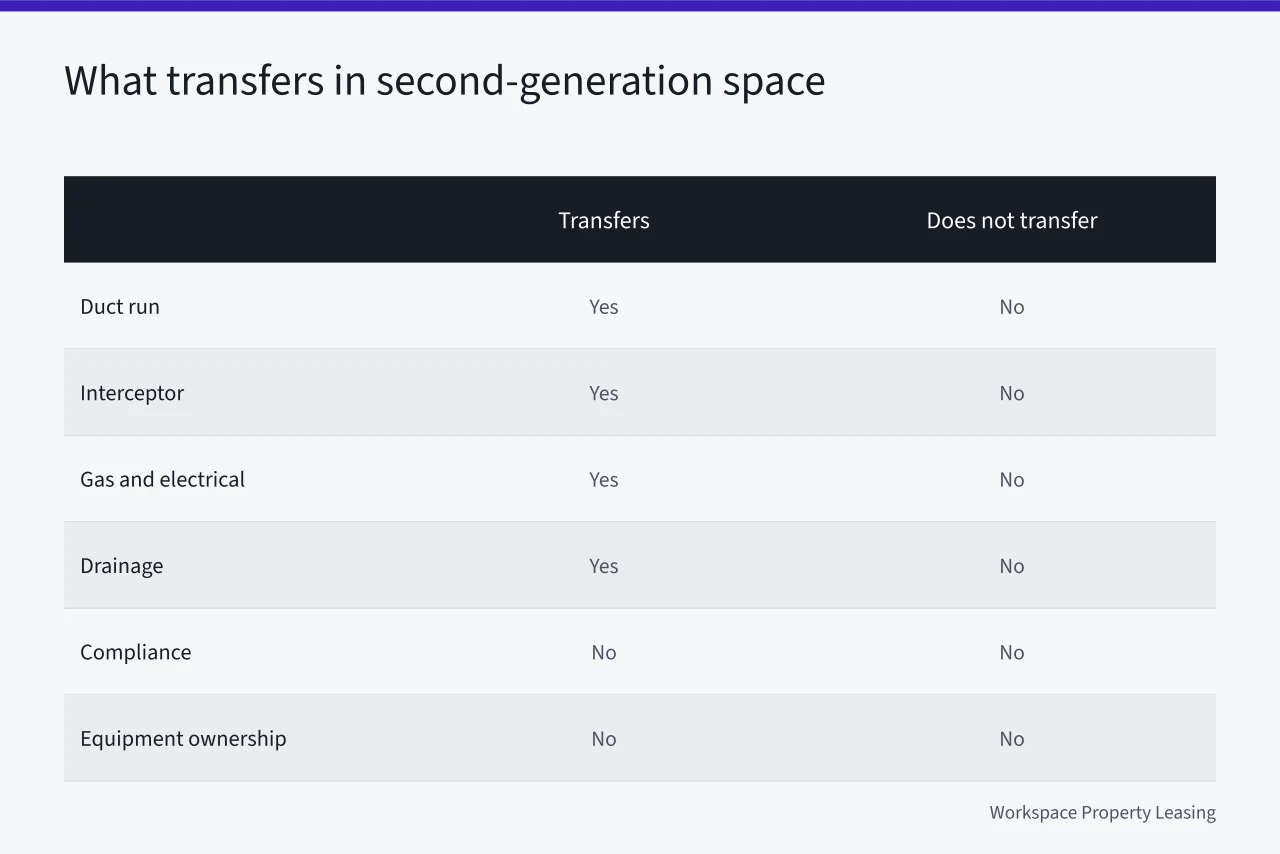
What genuinely transfers is the infrastructure: the duct run, the interceptor, gas and electrical capacity, the drainage. That is worth real money.
What does not transfer is any assumption of compliance.
Ask what was built with permits and what was not. Ask whether open code enforcement matters exist, and whether the last operator's alterations will survive a fresh inspection under your application.
If you also run production away from the customer-facing site, a commissary kitchen or a bakery, assess that building the way you would industrial space rather than a restaurant.
Also establish who owns the equipment. Kitchen equipment on site may belong to the landlord, may belong to a departing tenant, may be leased, or may be subject to a lender's security. Get the answer in writing, along with condition and age, and do not budget on the assumption that anything left behind works.
Percentage rent, and what counts as sales
Hospitality leases in managed centers often use percentage rent, on the same pattern as retail space: a base rent plus a share of sales above an agreed threshold. If your deal has it, the definitions matter more than the percentage.
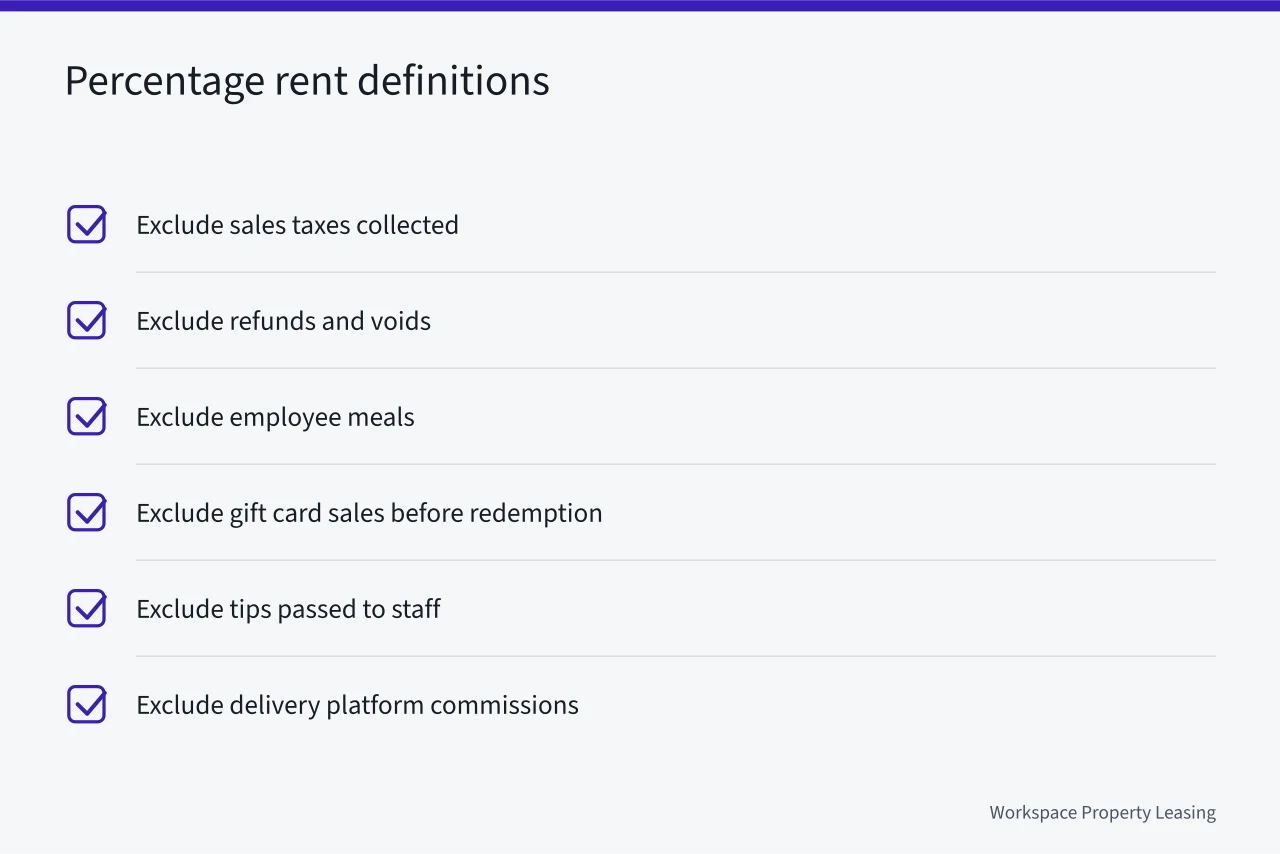
Then check the reporting obligations, the audit right, and what happens if a reconciliation goes against you.
Two related clauses tend to travel with percentage rent. A continuous operation covenant requires you to keep trading during set hours, which hurts a struggling or seasonal business.
A radius restriction bars you from opening another location within a defined distance, which constrains your expansion for the length of the term. Both are negotiable, and both are easy to sign without noticing.
If the site sits in a center, ask about co-tenancy too: whether your rent falls or you can exit if the anchor tenant leaves or occupancy drops below an agreed level. In a location whose footfall depends on other people's businesses, that is not an exotic request.
The build-out is longer than you think
Hospitality fit-outs run long because they stack sequential approvals on top of construction. Design, plan review by the building authority, separate review by the health authority, licensing, equipment lead times, inspections, sign-off, then staff training and a soft opening. Revenue starts only at the end of that.
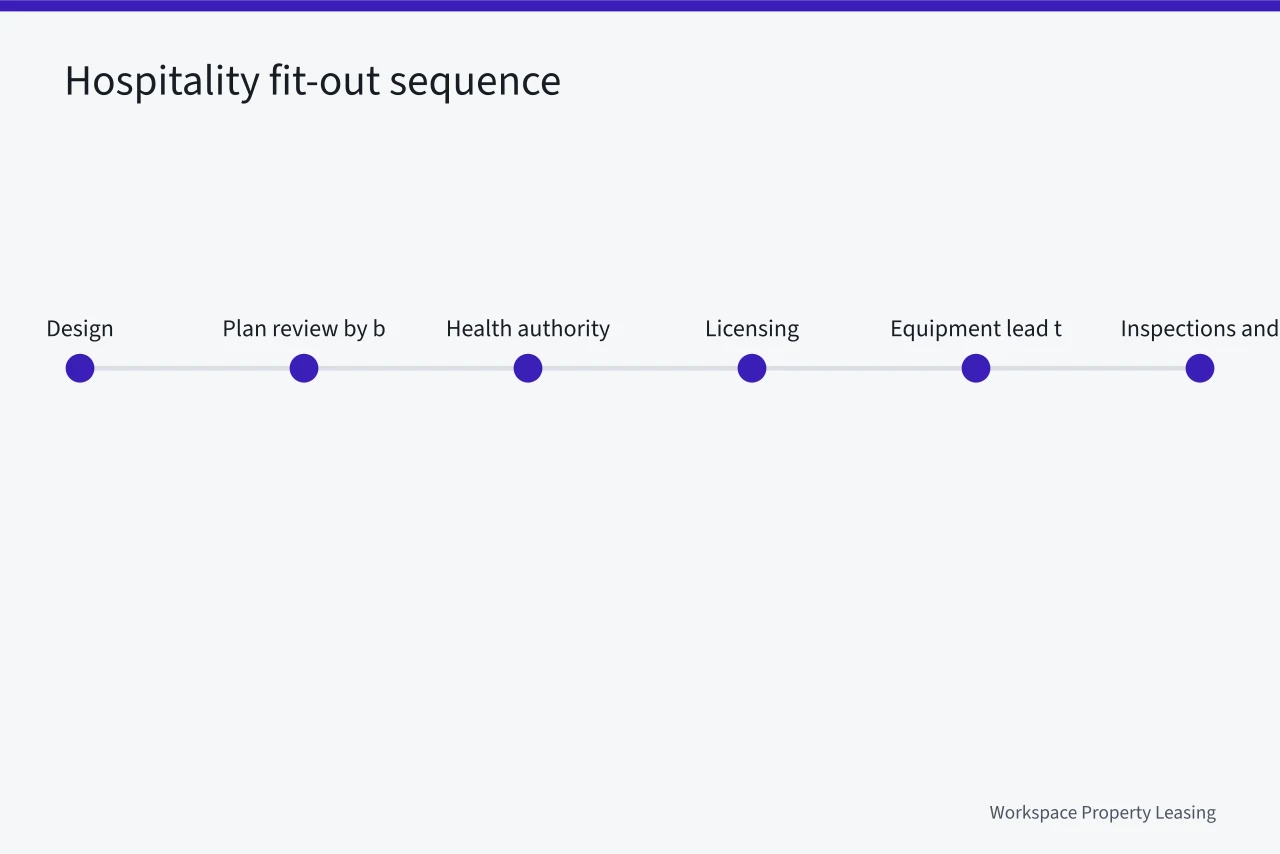
Size the free rent period against that whole sequence rather than against construction alone, and structure the rent commencement date so that landlord delay and permit delay do not both land on you. Tie rent commencement to substantial completion rather than to a calendar date, and make landlord delay push your dates day for day.
Keep the same discipline on the improvement allowance. Hospitality fit-outs are expensive, so allowances tend to be larger, and a larger allowance means more landlord capital recovered through your rent, and a larger unamortized balance to argue about if you leave early.
Exit is the deal you are really signing
Most hospitality businesses are eventually sold, and what the buyer is buying is largely the lease and the location. If your assignment clause lets the landlord refuse consent at its discretion, or take the space back instead of consenting, your ability to sell the business belongs to someone else.
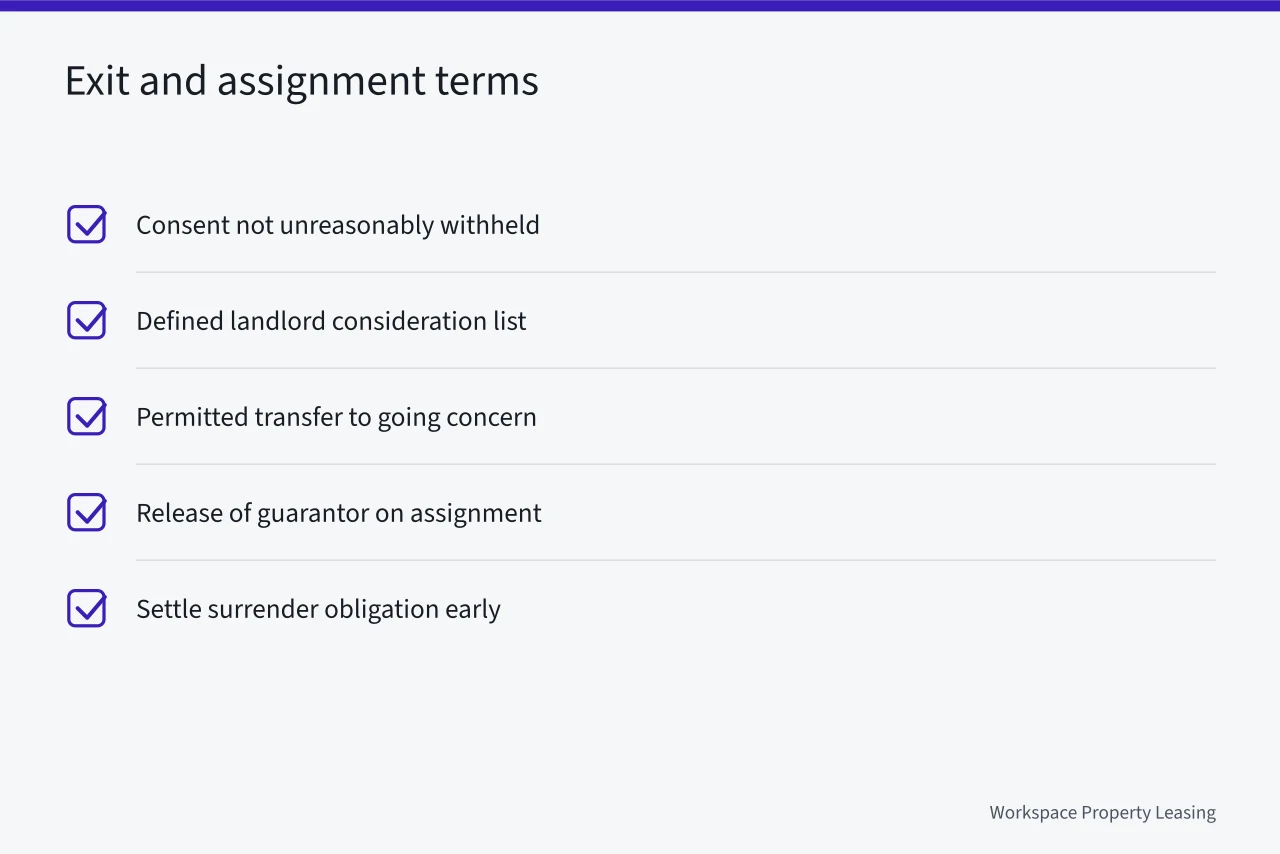
Ask for a consent standard that cannot be withheld unreasonably. Get a defined list of what the landlord may consider. Allow permitted transfers to a buyer of the business as a going concern.
Get clarity on whether you and any guarantor are released on assignment. Read the guarantee alongside it. Hospitality landlords often ask for personal guarantees. Understand what a guarantee exposes before you negotiate the rent.
Finally, settle the surrender obligation while you still have room to negotiate. Removing a kitchen, capping services, patching a roof penetration and restoring a shell is expensive, and a broad restoration clause can put all of it on you at the moment you have least money.
Before you commit
- Have I asked the licensing authority about this specific address and my specific operation?
- Can the building physically carry my kitchen, and who has confirmed that, an engineer or an agent?
- Do I have written rights to the roof, the risers and the exhaust route?
- What did the previous occupant build without permits?
- Who owns the equipment on site, and does it work?
- What does "gross sales" mean in this lease, and what have I agreed to keep open, and where have I agreed not to open?
- What is my route out, by assignment, by sublet or by termination, and what does it cost?
Common questions
The unit was already a restaurant. Is that enough?
No. Infrastructure transfers; compliance does not. Licenses can be personal to the holder, can lapse after a period of closure, and can carry conditions from the last operator's application. Ask the licensing authority about your operation at that address.
What most often stops a hospitality deal?
Either a license that cannot be obtained for the premises, or a building that cannot carry the kitchen, usually because there is no viable exhaust route or no gas and electrical capacity to upgrade to.
What is percentage rent charged on?
Whatever the lease defines as gross sales, which is why the definition matters more than the percentage. Negotiate exclusions for sales taxes collected, refunds, employee meals, tips passed to staff and commissions retained by delivery platforms.
Why does the assignment clause matter so much here?
Because most hospitality businesses are eventually sold, and what a buyer is largely buying is the lease and the location. A consent right the landlord can exercise at its discretion puts your exit in someone else's hands.